 Common · +100 XP
Best time to visit: May–Jun · Sep
Daily spend ~$100
Common · +100 XP
Best time to visit: May–Jun · Sep
Daily spend ~$100
Croatia
A thousand islands and a coast road that earns every hairpin. The Adriatic stays swimmable long after the crowds leave.
Croatia in ten slides
Wikipedia · 3 Sep 2026


Best time to visit Croatia: May–Jun · Sep
Where people go in Croatia
What people go to see in Croatia

The Walls of Dubrovnik are a series of defensive stone walls surrounding the city of Dubrovnik in southern Croatia. Ramparts were built in the outlying areas of the city, including the mountain slopes as part of a set of statutes from 1272. The existing city walls were constructed mainly during the 13th–17th centuries.
Wikipedia · CC BY-SA 4.0 · 26 Aug 2026
Miroslav.vajdic · CC BY-SA 4.0

Lokrum is an island in the Adriatic Sea 600 metres from the city of Dubrovnik, Croatia. It stretches from northwest to southeast and receives regular ferry service from the Old City port.
Wikipedia · CC BY-SA 4.0 · 23 Aug 2026
Diego Delso · CC BY-SA 3.0

Fort Lovrijenac or St. Lawrence Fortress, Italian Fortezza di San Lorenzo, often called "Dubrovnik's Gibraltar", is a fortress and theater outside the western wall of the city of Dubrovnik in Croatia, 37 metres (121 ft) above sea level. Famous for its plays and importance in resisting Venetian rule, it overshadows the two entrances to the city, from the sea, and by land.
Wikipedia · CC BY-SA 4.0 · 19 Jul 2026
Raki_Man · CC BY 3.0

Dubrovnik, historically also known as Ragusa, is a city in southern Dalmatia, Croatia, by the Adriatic Sea. It is one of the most prominent tourist destinations in the Mediterranean, a seaport and the centre of the Dubrovnik-Neretva County. In 2021, its total population was 41,562.
Wikipedia · CC BY-SA 4.0 · 26 Aug 2026
Zysko serhii · CC BY-SA 4.0

Srđ is a low mountain just behind the walled city of Dubrovnik in Dalmatia, Croatia. The mountain, part of the Dinaric Alps, has a height of 412 metres (1,352 ft). At its top is a large white stone cross and Fort Imperial, a defensive structure built by the French in 1810 during the Napoleonic Wars.
Wikipedia · CC BY-SA 4.0 · 23 Aug 2026
Richard Mortel from Riyadh, Saudi Arabia · CC BY 2.0

Stradun or Placa, whose name derives from Venetian, and means "large road" or "wide road", is the main street of Dubrovnik, Croatia. The limestone-paved pedestrian street runs some 300 metres through the Old Town, the historic part of the city surrounded by the Walls of Dubrovnik.
Wikipedia · CC BY-SA 4.0 · 23 Aug 2026
dronepicr · CC BY 2.0

Ban Jelačić Square is the central square of the city of Zagreb, Croatia, named after ban Josip Jelačić. Its official name is Trg bana Josipa Jelačića and is colloquially called 'Jelačić plac'.
Wikipedia · CC BY-SA 4.0 · 30 Jul 2026
Roberta F. · CC BY-SA 3.0

Dolac is a farmers' market located in Gornji Grad - Medveščak city district of Zagreb, Croatia. Dolac is the most visited and the best-known farmer's market in Zagreb, well known for its combination of traditional open market with iconic red umbrella stalls and a sheltered market below. It is located above Ban Jelačić Square, between the oldest parts of Zagreb, Gradec and Kaptol.
Wikipedia · CC BY-SA 4.0 · 2 Jul 2026
Rilegator · CC BY-SA 4.0

The Mirogoj City Cemetery, also known as Mirogoj Cemetery, is a cemetery park that is considered to be among the more noteworthy landmarks in the city of Zagreb. The cemetery inters members of all religious groups: Catholic, Orthodox, Muslim, Jewish, Protestant, Latter Day Saints; irreligious graves can all be found. In the arcades are the last resting places of many famous Croats.
Wikipedia · CC BY-SA 4.0 · 13 Apr 2026
Fred Romero from Paris, France · CC BY 2.0

The Museum of Broken Relationships is a museum in Zagreb, Croatia, founded by artists Olinka Vištica and Dražen Grubišić. It grew from a traveling exhibition revolving around the concept of failed relationships and their ruins. The museum features a diverse collection of objects, each representing a personal story of a past relationship, contributing to a broader narrative of human emotional experiences.
Wikipedia · CC BY-SA 4.0 · 9 Jul 2026
Unknown author · Public domain

The Church of St. Mark is the parish church of old Zagreb, located in St. Mark's Square in the Upper Town. It is one of the oldest architectural monuments in Zagreb. The most distinctive feature of the church is its medieval architecture and the colorful tiled roof featuring the coat of arms of Croatia, Dalmatia, and Slavonia, as well as the emblem of the city of Zagreb.
Wikipedia · CC BY-SA 4.0 · 27 May 2026
Jorge Franganillo · CC BY 2.0

The Zagreb Cathedral, is a Catholic cathedral in Kaptol, Zagreb. It is the tallest sacral building in Croatia and the most monumental sacral building of Gothic architecture southeast of the Alps.
Wikipedia · CC BY-SA 4.0 · 11 Aug 2026
Bernard Gagnon · CC BY-SA 4.0

The Cathedral of Saint Domnius, known locally as the Sveti Dujam or colloquially Sveti Duje, is the Catholic cathedral in Split, Croatia. The cathedral is the seat of the Archdiocese of Split-Makarska, currently headed by Archbishop Zdenko Križić.
Wikipedia · CC BY-SA 4.0 · 18 Jun 2026
Berthold Werner · CC BY-SA 4.0

Diocletian's Palace is an ancient Roman palace and fortress complex in Split, Croatia. It was built at the end of the third century AD by the Roman Emperor Diocletian as his retirement residence. About half of the complex was for Diocletian's personal use, with the rest housing the military garrison.
Wikipedia · CC BY-SA 4.0 · 5 Aug 2026
Dennis G. Jarvis · CC BY-SA 2.0

The Klis Fortress is a medieval fortress situated above the village of Klis, near Split, Croatia.
Wikipedia · CC BY-SA 4.0 · 20 Jul 2026
Općina Klis · CC BY-SA 4.0

Marjan is a hill on the peninsula of the city of Split, the second largest city of Croatia. It is covered in a dense Mediterranean pine forest and completely surrounded by the city and the sea, making it a unique sight. Originally used as a park by the citizens as early as the 3rd century, it is a favorite weekend excursion destination and a recreational center for the city.
Wikipedia · CC BY-SA 4.0 · 15 Aug 2026
dronepicr · CC BY 2.0
Sourced stays
Sourced experiences
Fly to Croatia
The facts you look up on the plane
Guides about Croatia
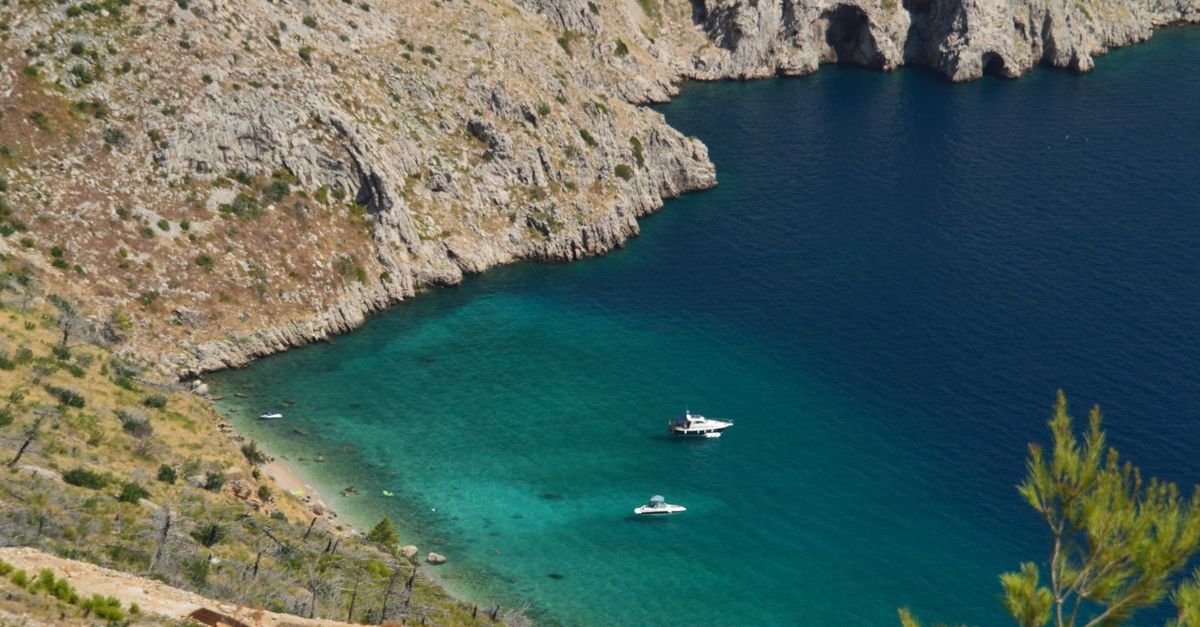
The best time to visit Croatia by month, with the coastal catamaran season that runs April to October and the park pricing that quadruples in summer.
Josefin Bakke · 4 Sep 2026
The threshold is EUR 3,622.50 a month in 2026 and it is recalculated every year, which no other guide explains. The steps, the tax rule, and the catch.
Tobi Adeyemi · 2 Sep 2026
Both have islands and old towns. They differ on ferries, driving and how long the season runs. Six rounds, the tax nobody mentions, and who wins.
Josefin Bakke · 2 Sep 2026Not going yet? Pin it.
One tap puts it on your map and in your pins, for when you are ready.