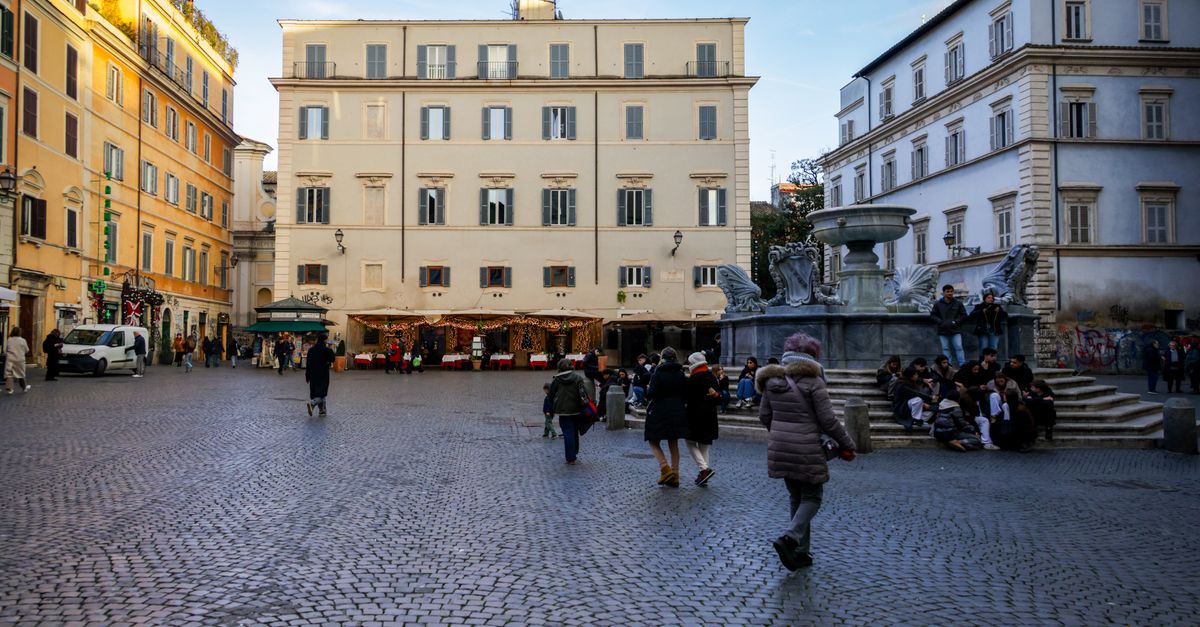
Where to stay in Rome, area by area
Which Rome neighbourhood suits your trip, the city tax nobody quotes you, and why the metro map changed in December 2025 in a way that matters.
Photo · Magda Ehlers · Pexels
Stay in Monti if you want the best of what changed recently, Trastevere if you want the evening, Prati if you want quiet and value within reach of everything, and Centro Storico if walking out of the door into Baroque Rome is worth paying for. Avoid Termini for a long first visit — but not for the reason everybody gives you.
Two things nobody ranking for this question tells you, and both change the answer.
The metro map changed in December 2025
Rome has three metro lines for a city of nearly three million, because you cannot dig here without hitting something archaeological. Every guide writes some version of "the centre has no metro." That was more true a year ago than it is now.
On 16 December 2025, line C opened at Colosseo, giving the ancient-Rome cluster a two-line interchange with line B for the first time. Line C now runs 24 stations and also meets line A at San Giovanni. Not one of the pages currently ranking for this question mentions it, and several still describe the area as poorly served.
What this actually changes: Monti — the neighbourhood wedged between the Forum and Termini — went from "walkable to things" to genuinely well connected, and it is the single biggest beneficiary. If you were choosing between Monti and somewhere else on transport grounds, choose again.
What has not changed: the Pantheon, Piazza Navona and Campo de' Fiori still have no station near them, and won't — reckon on a 20 to 30 minute walk from any of them to the nearest metro. Trevi is the one exception, about ten minutes from Barberini. That unserved quadrilateral is smaller and more precise than the vague warning everyone repeats, and worth knowing exactly: if you book inside it, you walk.
The reason is archaeology, and there is a specific proof of it. A station was planned at Largo di Torre Argentina — 400 metres from the Pantheon, and it would have solved the whole problem — and it was deleted from the project when Roman structures were found. Piazza Venezia's station survived that fate but is now a 2033 proposition, and the Vatican-side stations are 2036.
Which brings a practical warning for 2026: several of Rome's best squares are building sites. Piazza Venezia has had a new one-way layout since November 2025 that stays until 2031, and Metro C worksites opened during 2026 at Chiesa Nuova on Corso Vittorio Emanuele, Piazza Pia by Castel Sant'Angelo, Ottaviano and Viale Mazzini.
Interchanges worth memorising: Termini (A and B), San Giovanni (A and C), and now Colosseo (B and C), where the two lines are joined by a direct underground passage rather than a walk at street level. And the last trains go earlier than most European capitals — 23:30 Sunday to Thursday, 01:30 on Friday and Saturday — which is a bigger constraint on a Rome evening than anything else on this page. There is a proper night bus network, including five lines that shadow the metro routes.
Trams normally do a lot of the remaining work — 3 runs Trastevere, Testaccio and San Lorenzo, 8 is the Trastevere workhorse, 19 serves Prati.
Fares, current at September 2026: a single is €1.50 and lasts 100 minutes with unlimited surface transfers, a 24-hour pass is €8.50, 48 hours €15 and 72 hours €22. The much-discussed rise of the single to €2 has been refused by the region twice and is now pencilled in for 2027, so it is €1.50 for now. Contactless bank cards work on both the turnstiles and the on-board readers, and there is a daily cap — six trips on the same card in 24 hours and it charges you the €8.50 day rate instead.
The tax nobody quotes you
Rome's contributo di soggiorno is charged per person, per night, on top of your room rate, and it is collected at the property — frequently in cash. It is not in the price any booking site showed you. Not one of the five best-ranking guides to this question mentions it at all.
| Accommodation | Per person per night | In AUD |
|---|---|---|
| 5-star | €10.00 | A$16.19 |
| 4-star | €7.50 | A$12.14 |
| 3-star | €6.00 | A$9.71 |
| 2-star | €5.00 | A$8.09 |
| 1-star | €4.00 | A$6.48 |
| B&B or holiday apartment | €5.00–6.00 | A$8.09–9.71 |
| Hostel | €3.50 | A$5.67 |
A family of four in a 4-star for five nights owes €150 — about A$243 — that appeared nowhere in the booking. It is capped at ten consecutive nights at the same property, under-10s are exempt, and the counter resets if you leave Rome and come back.
Two warnings. The rates have been unchanged since October 2023, so anything describing a "2026 increase" is wrong. And stale tables are everywhere — several sites with 2026 in the headline still publish the pre-2023 figures, which were roughly €3 to €7. The city's own tourism office holds the current schedule.
Converted at €1 = A$1.619, the rate on 1 September 2026.
What a room costs, honestly
There is no reliable published breakdown of nightly rates by Roman neighbourhood, and any guide giving you one to the euro has invented it. What is real: August 2026 averaged about €167.90 per guest per night, roughly 10% down on August 2025, while fourteen new luxury hotels opened into the market.
The Jubilee story is the reverse of what most people assume, in both directions. The 2025 Jubilee boom did not really happen — travellers stayed away expecting crowds, and occupancy actually fell. But 2026 is Rome's busiest year on record, with the first half running about 7.5% above 2025 in guest nights, and it is cheaper per night than 2025. More people, softer prices.
Relative positioning holds even where absolute numbers don't: Centro Storico and the Tridente sit at the top, Trastevere close behind, Monti and Prati noticeably below them, and Testaccio, San Lorenzo and Esquilino below that.
The areas
Monti — the pick of the bunch right now. A genuine neighbourhood of bars and small shops immediately behind the Imperial Forums, walkable to the Colosseum, and since December 2025 sitting between two metro lines. Popular enough that it is no longer a secret, and it does get busy on the main lanes.
Centro Storico — the Pantheon, Navona, Campo de' Fiori. You are paying for the ability to walk out of the door into the postcard, and it is a real thing to pay for. The catch is transport: this is the middle of the unserved quadrilateral, so every metro journey starts with a walk. Also a night ZTL from 23:00 to 03:00 on Fridays and Saturdays, which tells you what the streets are doing at that hour.
Trastevere — the best evening in Rome, on the other side of the river, with no metro station of its own. Trams 3 and 8 and a lot of walking. It is also, by the city's own reckoning, the loudest place in Rome: its night traffic zone runs 21:30–03:00 on Fridays and Saturdays and extends to Wednesdays and Thursdays from May to October — four nights a week for half the year, the only area with that extension. If you sleep here, get a room off the main squares.
Prati and the Vatican — orderly, residential, good food that is not aimed at tourists, and cheaper than the centre. Line A at Lepanto and Ottaviano, and useful buses in the 492 and 87. Two notes: tram 19 will not be back here until early 2027, and Prati sits outside the Aurelian Walls, so it falls outside the airport taxi flat fare. Quiet in the evening and a river crossing from the historic core — a strong second-visit choice and a very good family one.
Testaccio — the eating neighbourhood, tram 3, working-class Rome with the market and the best casual food in the city. Night ZTL only Fridays and Saturdays, so quieter than Trastevere. Further out and short on sights.
Aventino — genuinely peaceful, green, and residential to the point of being sleepy. Lovely if you want that; frustrating if you wanted to walk to dinner.
San Lorenzo — the student quarter, cheap and lively, tram 3. It carries the same four-nights-a-week night zone as Trastevere from May to October, so the same caveat applies with less compensation.
Termini and Esquilino — see below.
Getting in from the airport
From Fiumicino, the Leonardo Express runs to Termini only: 32 minutes, every 15 minutes, €14 (about A$22.67).
The better-kept secret is the FL1 regional train at €8, which stops at Roma Trastevere in 27 minutes — faster than the express reaches Termini, and little more than half the price. It continues to Ostiense (34 min), Tuscolana (41) and Tiburtina (48). Aeroporti di Roma publishes both timetables.
One caveat that matters, and nobody prints it: Roma Trastevere station is not in Trastevere. It sits behind the district on the Portuense edge, a good half-hour walk from Piazza Santa Maria in Trastevere — and the tram that normally closes that gap is a replacement bus at the moment. If Trastevere is your destination, factor that in or take a taxi from the station.
Get off at Ostiense instead if you can. It has an underground passage straight through to Piramide on Metro B, which puts Circo Massimo, the Colosseum and Termini one ride away. For Testaccio, the Aventine or anywhere on line B, it beats the Leonardo Express on both price and time.
If a taxi is simpler, the fare is fixed: €55 from Fiumicino and €40 from Ciampino to any address inside the Aurelian Walls, per car rather than per person, with luggage and night supplements already included. Those walls take in Trastevere, Monti, Testaccio, the Aventine and the historic centre — but not Prati or the Vatican, which sit outside and fall under a higher cap.
From Ciampino there is no direct train — coaches to Termini, or a bus to the metro at Anagnina or Laurentina.
Termini: the advice everyone gives is out of date, and still half right
"Avoid Termini" is the most repeated line in Rome accommodation advice. The safety part of it does not hold up; the experience part does.
On safety. In January 2025 several English-language outlets reported that Termini and Esquilino had been designated police "red zones". The next day, the city's public-order committee decided otherwise and the mayor publicly opposed the designation — and almost none of the coverage was updated. Red zones were applied later, in August 2026, to Esquilino and San Lorenzo — but the same ordinance covered the Colosseum, the Imperial Forums and Colle Oppio. Anyone using red-zone status as a reason to avoid Termini has to avoid the Colosseum too, which nobody does. A red zone is a policing tool that lets officers move on specific people with prior records; it is not a danger rating.
Rome-resident writers are consistently the reassuring voices here, while tour companies are the ones telling you to stay away.
The real downside is amenity. There is very little around Termini you would choose to eat at, the budget accommodation is largely poor, and the streets are dull in the evening. That is a good reason not to spend five nights there and a bad reason to panic.
The distinction nobody makes: "Termini" is two different places. The north and west flank — Repubblica, Via Nazionale, the Monti edge — is perfectly pleasant, and Piazza dei Cinquecento in front of the station was rebuilt and pedestrianised in a €49m project finished in January 2025. The south and east — Via Giolitti, Piazza Vittorio, Esquilino proper — is what all the warnings are actually describing. Collapsing them is the real mistake.
Verdict: unbeatable for transport, with lines A and B, national rail, the airport express and one stop to Colosseo. Right for a one-night stopover or an early flight. Wrong for a five-day first visit. If you do book here, book the Repubblica side.
The other mistake: an apartment, booked for the self check-in
This has quietly stopped working in Rome.
The city has been physically removing key boxes since January 2025, with fines around €400 per device — police take them off railings, gates and drainpipes. And the legal position, which bounced around for a year, has now settled against you: a 2024 ministerial rule banning key-box-only arrival was struck down by a court in May 2025 and then reinstated on appeal by the Council of State in November 2025. It stands.
What that means in practice: you must be identified in person, or by a live video call or video intercom at the moment you arrive. A code emailed to you and a box on the wall is not legal, whatever the listing says. Italian law also requires every guest to be reported to the police within 24 hours of arrival — on arrival itself if you are staying less than a day — so bring the physical passport, not a photo of it.
A lot of currently-published advice still says self check-in is fine in Italy, because it was written in the few months between those two rulings. The practical upshot is that a 1am arrival now depends on a person being awake, so message the host with your real arrival time before you fly.
A 1am arrival at a lockbox is no longer a reliable plan. And the "cheaper" part leaks too: the city tax on a holiday apartment is €5–6 per person per night, collected separately — four people for five nights is another €120 before cleaning fees. Finally, a legitimate Italian rental must display a national identification code, a CIN, in the listing itself. No CIN is a red flag; hosts face fines up to €8,000 for not having one.
So, where?
Monti for a first visit now that the metro reaches it. Prati if you want value, quiet and good food without the crowds. Trastevere if the evening is the point and you can sleep through it. Centro Storico if you want the postcard and will pay for it. Termini for one night before a flight, on the Repubblica side.
The Rome city guide has what is actually in each neighbourhood, the Italy country guide covers the wider trip, and when to go matters here more than most places — August empties of Romans and fills with heat. Pairing Rome with other European cities is the usual plan, and Paris and Lisbon both have their own guides. See our other where-to-stay guides, or go to every Rome stay we can source.
Fares, taxes and transport checked September 2026. Metro line C and the ZTL rules both changed within the last year — here is how we research and re-check guides.