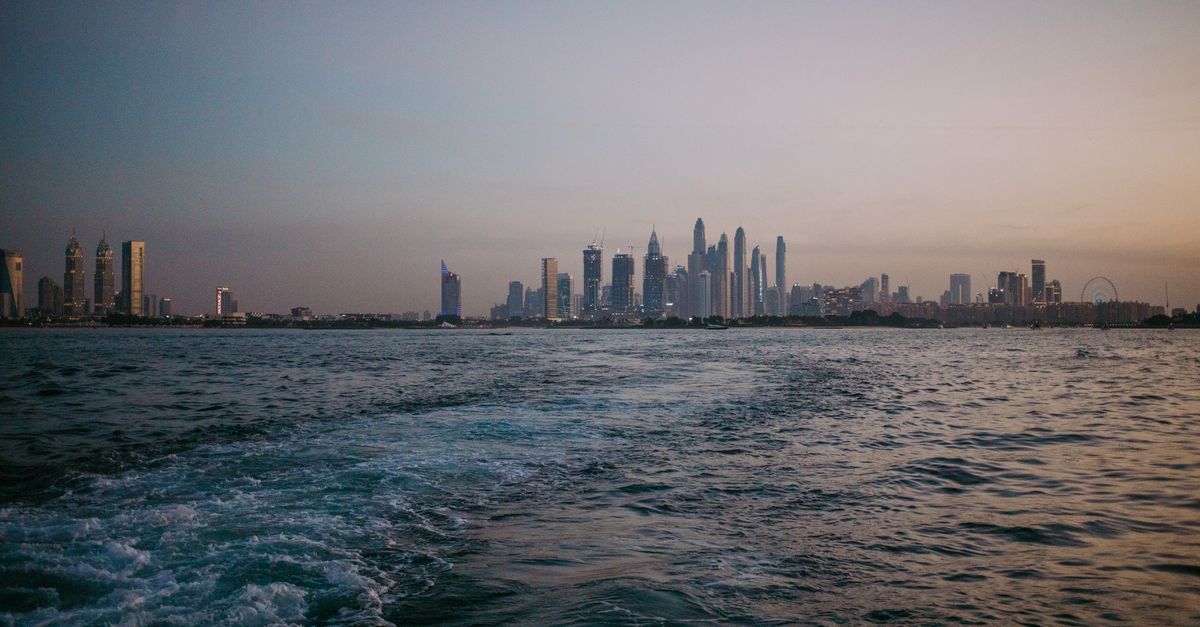
Where to stay in Dubai, beach or metro
The real Dubai question is beach or metro, because you rarely get both. Which area suits your trip, and the 25–30% in fees that is not in your room rate.
Photo · Galina Kolonitskaia · Pexels
The question everyone asks about Dubai is Marina or Downtown. It is the wrong question — they are on the same metro line, at similar prices, and choosing between them barely changes your trip.
The question that actually sorts every neighbourhood here is beach or metro, because in Dubai you rarely get both. Downtown, Business Bay, DIFC, Al Barsha and Deira have no beach at all. The Palm, JBR and the Jumeirah strip have no metro. Dubai Marina is the only place that credibly offers both, which is why it is the default answer for a first visit.
- First visit, want both: Dubai Marina. Metro, tram, and the beach one stop away.
- Beach first: JBR. Tram only, but you walk to the sand.
- Sightseeing, no beach: Downtown. One Red Line station, highest prices.
- Budget and transport: Deira. Eleven stations and the cheapest rooms in the city.
- Resort you barely leave: Palm Jumeirah. Understand the monorail hours first.
- Value with a metro station: Al Barsha or Business Bay.
The fees nobody quotes you
None of the top-ranking guides to this question gives a single price, and none mentions that the rate you are quoted is not the rate you pay.
On top of the room there is a Tourism Dirham, charged per room per night and capped at 30 consecutive nights — AED 20 in a 5-star, AED 15 in a 4-star, AED 10 in a 3-star, AED 7 below that. Then a municipality fee, a 10% service charge and 5% VAT.
Together they add roughly 25–30%. Seven nights in a 4-star at AED 500 a night works out like this:
| Line | AED |
|---|---|
| Room, 7 nights | 3,500 |
| Tourism Dirham | 105 |
| VAT at 5% | 175 |
| Municipality fee | 245 |
| Service charge 10% | 350 |
| Total | 4,375 — about A$1,662 |
One honest caveat: sources disagree on the municipality fee, putting it at between 7% and 10%, and we could not resolve that against a government source. Budget for the higher number and ask your hotel to confirm. Converted at A$1 = AED 2.634, the rate on 1 September 2026.
The metro is excellent, and it does not go to the beach
This is the fact that should decide where you book.
The Dubai Metro is fast, clean and cheap — AED 3 for one zone on a nol card, AED 7.50 for three or more, with a daily cap of AED 14 — and it runs every two to four minutes at peak. What it does not do is reach the water. The Palm, all of JBR, the entire Jumeirah beach strip, La Mer and Kite Beach have no metro station, and the Blue Line that would help does not open until September 2029.
Then there are the hours, which nobody writes down:
| Day | Metro runs |
|---|---|
| Mon–Thu, Sat | 05:00 – midnight |
| Friday | 05:00 – 01:00 |
| Sunday | 08:00 – midnight |
That Sunday start is three hours later than every other day and it catches people out constantly. More to the point for an Australian itinerary: a large share of Europe-bound flights land in Dubai between midnight and 5am, when there is no train at any price. Your first journey is a taxi wherever you booked, so "walking distance to a station" is worth less on arrival day than you would think.
Two other rails fill some of the gap. The tram runs eleven stations along Al Sufouh Road linking Marina, JBR, the Marina Mall and Palm Gateway, at AED 3 a ride. The Palm Monorail costs AED 5 one way, has four stations, and runs only from about 09:00 to 21:45 — useless for an early flight or a late dinner, and it was closed entirely from January to July 2026 for upgrades.
The areas, and what they cost
Bands are average nightly rates in US dollars from a March 2026 market survey, converted at A$1 = US$0.7169. There is no reliable published breakdown in dirhams by neighbourhood, so this is the honest version rather than an invented one.
| Area | Rail | Nightly | In AUD | Beach? |
|---|---|---|---|---|
| Deira | 11 stations, both lines | US$50–150 | A$70–209 | No |
| Bur Dubai / Al Fahidi | Green Line | US$50–150 | A$70–209 | No |
| Business Bay | Red Line | US$120–300 | A$167–419 | No |
| Dubai Marina | Red Line + tram | US$150–400 | A$209–558 | One stop |
| JBR | Tram only | US$150–400 | A$209–558 | Yes |
| Downtown | Red Line | US$200–500 | A$279–698 | No |
| Palm Jumeirah | Monorail only | US$300–2,000+ | A$419–2,790+ | Yes |
Dubai Marina is the all-rounder and the reason is structural: two Red Line stations plus the tram, walkable water, and JBR's beach one tram stop away. It is a canyon of towers, which some people love and some find oppressive.
JBR is the beach itself — a walkable promenade, good for families, and every metro trip starts with a tram ride.
Downtown is where the Burj Khalifa and the fountain are, and it is the most expensive area with no beach at all. Know one thing before booking: the station is called Burj Khalifa/Dubai Mall, and the walk from the platform through the mall to the tower is over a mile. People book Downtown for step-out-the-door access and get a long indoor trek at both ends of every day.
Deira is the most under-recommended area in Dubai. It has eight Green Line stations plus three on the Red Line, including the Union interchange — the best rail coverage in the city — at the cheapest prices in the city. It is the only place where "cheap" and "best connected" are the same answer. No beach, older buildings, and genuinely the most interesting street life here.
Bur Dubai and Al Fahidi is the heritage quarter across the Creek, with the abra crossings and the old wind-tower houses. Same price band as Deira.
Palm Jumeirah is over-recommended for anything but a resort stay. Between the monorail's 09:00–22:00 hours, its six-month closure this year and the single trunk road that every journey funnels down, it is taxi-dependent in practice. Wonderful if you are not planning to leave the hotel. Poor if you came to see the city.
Taxis, and the tolls you did not know about
Taxis are the default here and they are not expensive by Australian standards. Flag fall is AED 5, or AED 25 if you pick one up at the airport, then roughly AED 2 a kilometre — sources put it between AED 1.97 and 2.19 because the rate is re-indexed with fuel, so treat it as a range. Dubai airport to Downtown runs AED 60–80, about A$23–30.
What nobody mentions: Dubai's road tolls are added to your taxi fare automatically, and have been since 2013. Each gate is AED 6.30 at peak and AED 4.20 off-peak, free between 01:00 and 06:00, and 5% VAT was added to tolls on 1 June 2026. A cross-city run can pass several gates.
Getting in from the airport
Dubai International has two Red Line stations, Airport Terminal 1 and Airport Terminal 3. Note that Terminal 2 has no metro station and is not connected airside to the others — if you are flying flydubai from T2 you need a shuttle, about 20 minutes to T1 and 30 to T3.
And remember the hours above. If you land at 2am, the metro is shut.
Al Maktoum, the second airport, is 37 kilometres southwest at Jebel Ali and is mostly cargo with a handful of passenger airlines. There is no metro to it. Its enormous expansion is targeted at 2032 for the first phase, so it is not yet a factor in where you sleep.
Alcohol, and a rule most guides get wrong
You do not need a licence to drink in a hotel bar, restaurant or beach club. You do need one to buy alcohol to take away — and as a tourist that is straightforward: a free 30-day permit is issued on the spot at the two licensed retail chains when you show your passport and sign a declaration. Drinking age is 21.
The part that is out of date everywhere: the 30% alcohol sales tax was suspended for two years and then reinstated in full on 1 January 2025. It is still in force. Any guide telling you drinks in Dubai got cheap is describing 2023 and 2024.
Drinking in public or being drunk in public carries real fines, and drink-driving is zero-tolerance. Keep it to licensed venues and your room.
If you are travelling during Ramadan
Ramadan 2027 is expected to begin around Monday 8 February 2027, with Eid Al Fitr around 9–10 March. The dates depend on the moon sighting, so treat them as likely rather than fixed.
The rules have relaxed a great deal and most guides have not caught up. Eating and drinking in public during daylight is not restricted for people who are not fasting. Restaurants no longer need screens over their windows; cafés and food courts serve normally. Malls, beaches, pools, gyms and attractions open as usual, and the metro runs normal hours.
Alcohol is the real constraint. Many licensed venues serve only after iftar and some pause entirely for the month, so call ahead rather than turning up. Dress modestly in public — shoulders and knees — as a courtesy.
So, where?
Marina if you want one base that does everything. JBR if the beach is the trip. Deira if you want the best transport and the lowest prices and do not need sand. Downtown if the Burj and the fountain are the point and you accept the walk. The Palm only for a resort stay.
The Dubai city guide covers what is actually in each district, the UAE country guide handles the wider practicalities, and when to go matters more here than almost anywhere — the price swing between February and August is larger than every other decision on this page combined. If Dubai is a stopover on the way to Europe, Istanbul is the other one worth breaking the trip in, and Paris is often the far end. See our other where-to-stay guides, what is worth booking ahead, or every Dubai stay we can source.
Fares, fees and taxes checked September 2026 — here is how we research and re-check guides.