 Common · +100 XP
Best time to visit: Apr–Jun · Sep–Oct
Daily spend ~$65
Common · +100 XP
Best time to visit: Apr–Jun · Sep–Oct
Daily spend ~$65
Turkey
Where two continents argue and both win. Roman ruins on a beach, a Byzantine church that became a mosque, and breakfast served as fourteen small plates.
Turkey in ten slides
Wikipedia · 3 Sep 2026


Best time to visit Turkey: Apr–Jun · Sep–Oct
Where people go in Turkey
What people go to see in Turkey

Adana Archaeology Museum is a museum in Adana that houses the historical heritage of Cilicia. The museum is currently located at the former Simyonoglu textile plant that was built in 1906 by Aristidi Simyonoglu as being the largest manufacturing plant of the region. It is one of the oldest archaeological museums in Turkey.
Wikipedia · CC BY-SA 4.0 · 10 Jul 2026
Basak · CC BY-SA 4.0

Büyük Saat is a historical clock tower in Adana, rising 32 m (105 ft) high. The tower symbolizes the modernization of the city, which lasted from 1863 to the Adana massacre. During this period many Ottoman and European businesses moved to the city for the exploding cotton trade.
Wikipedia · CC BY-SA 4.0 · 9 May 2026
Seyhan668 · CC BY-SA 3.0

The Great Mosque of Adana, also known as the Ramazanoglu Mosque, is a 16th century mosque in Adana, Turkey. It forms part of a complex (külliye) that includes a madrasah and a mausoleum (türbe). The complex is on Kızılay Street, next to Ramazanoğlu Hall.
Wikipedia · CC BY-SA 4.0 · 2 Aug 2026
Mehmet E Yavuz · CC BY-SA 3.0

Ramazanoğlu Hall is the old government residence of the Ramadanids located in Adana. Currently used as a cultural center, it is one of the oldest examples of a mansion in Turkey. Located southeast of the Ulu Camii, it was the Harem of the Ramadanid family and besides being a fine expression of modesty of the emirate, it is also an important work resembling the Mamluk mansions of Egypt.
Wikipedia · CC BY-SA 4.0 · 23 Mar 2026
Seyhan668 · CC BY-SA 3.0

Sabancı Merkez Mosque or Sabancı Central Mosque in Adana is the second largest mosque in Turkey. The exterior of the mosque is similar to the Selimiye Mosque in Edirne, though it has six minarets, similar to the Sultan Ahmed Mosque in Istanbul.
Wikipedia · CC BY-SA 4.0 · 2 Aug 2026
Cobija · CC BY-SA 3.0

Taşköprü, historically known as Ponte Sarus, is a Roman bridge spanning the Seyhan River in Adana that was probably built in the first half of the second century AD. The bridge was a key link in ancient trade routes from the Mediterranean Sea to Anatolia and Persia. Until its closure in 2007, it was one of the oldest bridges in the world open to motorized vehicles.
Wikipedia · CC BY-SA 4.0 · 14 Dec 2024
MUSTAFA TOR · CC BY-SA 2.5

Yağ Cami or Oil Mosque is a historical mosque located in the old town of Adana, Turkey which was originally built as the Surp Hagop Armenian Apostolic Church at the second half of the 13th century during the Armenian Kingdom of Cilicia. It was converted into a mosque in c. 1501 by the Ramazanoğlu Bey Şihabeddin Ahmed, just after taking over the city.
Wikipedia · CC BY-SA 4.0 · 28 Aug 2026
Dosseman · CC BY-SA 4.0

Behram Pasha Mosque is a 16th-century Ottoman mosque located in the town of Diyarbakır in southeast Turkey. It was commissioned by the Ottoman governor-general Behram Pasha.
Wikipedia · CC BY-SA 4.0 · 2 Aug 2026
R Prazeres · CC BY-SA 4.0

The Dicle Bridge is a historic bridge in Diyarbakır over the river Tigris in southeastern Turkey. Completed in 1065, it numbers ten arches with a total length of 178 m (584 ft). Hence, it is locally called also "On Gözlü Köprü" / "Pira Dehderî".
Wikipedia · CC BY-SA 4.0 · 12 Jun 2026
Hedda Gabler · CC BY-SA 4.0

The Fortifications of Diyarbakır are a set of fortifications enclosing the historical district of Sur in Diyarbakır, Turkey. They consist of an inner fortress, the citadel, and an outer ring of city walls.
Wikipedia · CC BY-SA 4.0 · 31 Aug 2026
Brian Dell · Public domain

The Great Mosque of Diyarbakır was built in the late 11th century by the Seljuk sultan Malik-Shah I over an older mosque. According to some, it is the fifth holiest site in Islam after the Great Mosque of Damascus, which influenced its design. It can accommodate up to 5,000 worshippers and hosts four different Islamic traditions.
Wikipedia · CC BY-SA 4.0 · 30 Jul 2026
R Prazeres · CC BY-SA 4.0

The Hasan Pasha Han is a historic building and former caravanserai in Diyarbakır, Turkey. It is located near the center of the Sur district, across from the Great Mosque of Diyarbakır. It was built in the 16th century during the Ottoman period of the city.
Wikipedia · CC BY-SA 4.0 · 16 Jul 2026
Dosseman · CC BY-SA 4.0

The Hevsel Gardens, are the seven hundred hectares of cultivated, fertile lands near the Tigris in eastern Turkey, between the Diyarbakır Fortress and the river. The fortified city was enclosed by a two-part system of defensive walls, and the gardens, fed by springs on the steep slope below, played a vital role in keeping the city provisioned and watered.
Wikipedia · CC BY-SA 4.0 · 24 Jul 2026
Bjørn Christian Tørrissen · CC BY-SA 3.0


The Church of St. Giragos or Surp Giragos Church is a historic Armenian Apostolic church in Diyarbakır, Turkey. It is the largest Armenian church in the Middle East. The church was confiscated by the Turkish government in 2016.
Wikipedia · CC BY-SA 4.0 · 3 May 2026
Rob at Armenian Wikipedia · GFDL

Anıtkabir is a mausoleum complex located in the Çankaya district of Ankara, Turkey. It serves as the resting place of Mustafa Kemal Atatürk, founder and first President of the Turkish Republic. Designed by architects Emin Onat and Orhan Arda, the construction of Anıtkabir began in 1944 and was completed in 1953.
Wikipedia · CC BY-SA 4.0 · 3 Aug 2026
William Neuheisel from DC, US · CC BY 2.0

The Ankara Metro is the rapid transit system serving Ankara, the capital of Turkey. At present, the system consists of three lines – the Ankaray (A1), the M1 - M2 - M3 and the M4. The Ankaray, M1, M2, M3 and M4 lines transported 173.2 million passengers in 2025, corresponding to a ridership of approximately 474,448 per day.
Wikipedia · CC BY-SA 4.0 · 27 Aug 2026
Kurmanbek · Public domain
The Ethnography Museum of Ankara is dedicated to the cultures of Turkic civilizations. The building was designed by architect Arif Hikmet Koyunoğlu and was built between 1925 and 1928. The museum temporarily hosted the sarcophagus of Mustafa Kemal Atatürk from 1938 to 1953, during the period of the construction of Anıtkabir, his final resting place.
Wikipedia · CC BY-SA 4.0 · 30 Jun 2026
The Kocatepe Mosque is the largest mosque in Ankara, Turkey. It was built between 1967 and 1987 in the Kocatepe quarter in Kızılay, and its size and prominent situation have made it a landmark that can be seen from almost anywhere in central Ankara.
Wikipedia · CC BY-SA 4.0 · 1 Aug 2026
The Museum of Anatolian Civilizations is located on the south side of Ankara Castle in the Atpazarı area in Ankara, Turkey. It consists of the old Ottoman Mahmut Paşa bazaar storage building, and the Kurşunlu Han.
Wikipedia · CC BY-SA 4.0 · 30 Jun 2026

The Temple of Augustus and Rome is an augusteum located in the Altındağ district of Ankara. It is thought to have been built around 25–20 BC. Besides being one of the most important Roman-period ruins in the city, it is also known for the Monumentum Ancyranum.
Wikipedia · CC BY-SA 4.0 · 6 Aug 2026
Klaus-Peter Simon · CC BY-SA 3.0

The Antalya Museum or Antalya Archaeological Museum was one of Turkey's largest museums, located in Muratpaşa, Antalya. It includes 13 exhibition halls and an open-air gallery. It covers an area of 7,000 m2 (75,000 ft2) and 5000 works of art are exhibited.
Wikipedia · CC BY-SA 4.0 · 11 Jul 2026
Dat doris · CC BY-SA 4.0

The Düden Waterfalls are two waterfalls of the Düden River in the province of Antalya, Turkey.
Wikipedia · CC BY-SA 4.0 · 1 Sep 2026
Saffron Blaze · CC BY-SA 3.0

Hadrian's Gate is a memorial gate located in Antalya, Turkey, which was built in the name of the Roman emperor Hadrian, who visited the city in 130 CE. It was later incorporated in the walls that surround the city and harbor, of which it is the only remaining entrance gate today.
Wikipedia · CC BY-SA 4.0 · 20 Jul 2026
Joe Wallace · CC BY-SA 2.0

Kaleiçi is the historic city center of Antalya, located along the Mediterranean coast in southern Turkey. Enclosed by ancient city walls and overlooking the old harbor, it represents the original core of the city.
Wikipedia · CC BY-SA 4.0 · 26 Jul 2026
REHBER0770 · CC BY-SA 4.0

Konyaaltı Beach is one of the two main beaches of Antalya, the other being Lara Beach.
Wikipedia · CC BY-SA 4.0 · 27 Feb 2026
Esginmurat · CC BY-SA 4.0

Yivli Minaret Mosque is a historic mosque located in Kaleiçi, the old town center of Antalya, Turkey. Situated along Cumhuriyet Street near Kalekapısı Square, it is one of the city’s most important landmarks. Its fluted brick minaret, adorned with traces of blue tilework, has become a widely recognized symbol of Antalya.
Wikipedia · CC BY-SA 4.0 · 30 Jul 2026
Saffron Blaze · CC BY 3.0

The Grand Mosque of Bursa is a historic mosque in Bursa, Turkey. It was commissioned by the Ottoman Sultan Bayezid I to commemorate his great victory at the Battle of Nicopolis and built between 1396 and 1399. The mosque is a major monument of early Ottoman architecture and one of the most important mosques in the city, located in the heart of the old city alongside its historic markets.
Wikipedia · CC BY-SA 4.0 · 30 Jul 2026
Beñat Irasuegi · CC BY-SA 4.0

The Green Mosque, also known as the Mosque of Mehmed I, is a part of a larger complex in eastern Bursa, Turkey, the former capital of the Ottoman Turks before Constantinople was captured in 1453. The complex consists of a mosque, a mausoleum known as the Green Tomb, a madrasa, a public kitchen, and a bathhouse. The name Green Mosque comes from its green and blue interior tile decorations.
Wikipedia · CC BY-SA 4.0 · 3 Aug 2026
Yahia.Mokhtar · CC BY-SA 4.0

The Green Tomb is a mausoleum of the fifth Ottoman Sultan, Mehmed I, in Bursa, Turkey. It was built by Mehmed's son and successor Murad II following the death of the sovereign in 1421. The architect Hacı Ivaz Pasha designed the tomb and the Yeşil Mosque opposite to it.
Wikipedia · CC BY-SA 4.0 · 31 Jul 2026
Bernard Gagnon · CC BY-SA 3.0

Irgandı Bridge is an historical bridge in Bursa, Turkey. The bridge is over Gökdere, a tributary of Nilüfer River at 40°10′56″N 29°04′19″E. It is between Osmangazi (northwest) and Yıldırım (southeast), two second level municipalities of Greater Bursa
Wikipedia · CC BY-SA 4.0 · 15 Aug 2025
HALUK COMERTEL · CC BY 3.0

The Koza Han is a historic caravanserai (han) in Bursa, Turkey. It is located in the heart of the city's historic market district.
Wikipedia · CC BY-SA 4.0 · 24 Jul 2026
Christine und Hagen Graf from Fitou, France · CC BY 2.0

The Muradiye Complex or the Complex of Sultan Murad II, the Ottoman sultan, is located in Bursa, Turkey. It is part of the historic UNESCO World Heritage Site.
Wikipedia · CC BY-SA 4.0 · 2 Aug 2026
Bernard Gagnon · CC BY-SA 3.0

The Basilica Cistern, or Cisterna Basilica, is the largest of several hundred ancient cisterns that lie beneath the city of Istanbul, Turkey. The cistern, located 150 metres (490 ft) southwest of the Hagia Sophia on the historical peninsula of Sarayburnu, was built in the 6th century during the reign of Byzantine emperor Justinian I. Today, it is kept with little water for public access inside the space.
Wikipedia · CC BY-SA 4.0 · 24 Jul 2026
Diego Delso · CC BY-SA 4.0

The Sultan Ahmed Mosque, popularly known as the Blue Mosque, is an Ottoman-era historical imperial mosque located in Istanbul, Turkey. It was constructed between 1609 and 1617 during the rule of Ahmed I. It attracts a large number of tourists and is one of the most iconic and popular monuments of Ottoman architecture.
Wikipedia · CC BY-SA 4.0 · 1 Aug 2026
Pedro Szekely from Los Angeles, USA · CC BY-SA 2.0
The Galata Tower, officially the Galata Tower Museum, is a medieval Genoese tower in the Galata part of the Beyoğlu district of Istanbul, Turkey. Built as a watchtower at the highest point of the mostly demolished Walls of Galata, the tower is now an exhibition space and museum, and a symbol of Beyoğlu and Istanbul.
Wikipedia · CC BY-SA 4.0 · 30 Jul 2026
The Grand Bazaar in Istanbul is one of the largest and oldest covered markets in the world, with 61 covered streets and over 4,000 shops on a total area of 30,700 m2, attracting between 250,000 and 400,000 visitors daily. In 2014, it was listed No.1 among the world's most-visited tourist attractions with 91,250,000 annual visitors.
Wikipedia · CC BY-SA 4.0 · 2 Jul 2026

Hagia Sophia, officially the Hagia Sophia Grand Mosque, is a mosque and a major cultural and historical site in Istanbul, Turkey. It was formerly a church (360–1453) and a museum (1935–2020).
Wikipedia · CC BY-SA 4.0 · 28 Aug 2026
Adli Wahid · CC BY-SA 3.0

The Topkapı Palace or the Seraglio, is a large museum and library in the east of the Fatih district of Istanbul in Turkey. From the 1460s to the completion of Dolmabahçe Palace in 1853, it served as the administrative center of the Ottoman Empire, and was the main residence of its sultans.
Wikipedia · CC BY-SA 4.0 · 26 Jul 2026
Carlos Delgado · CC BY-SA 3.0

The Agora of Smyrna, alternatively known as the Agora of İzmir, is an ancient Roman agora located in Smyrna. Originally built by the Greeks in the 4th century BC, the agora was ruined by an earthquake in 178 AD. Roman Emperor Marcus Aurelius ordered its reconstruction.
Wikipedia · CC BY-SA 4.0 · 18 Jul 2026
Unknown · CC BY-SA 3.0


İzmir Clock Tower is a historic clock tower located at the Konak Square in the Konak district of İzmir, Turkey. It is considered as the main landmark of the city, and is featured on its municipal emblem.
Wikipedia · CC BY-SA 4.0 · 17 Jul 2026
User:Sailko · CC BY-SA 3.0

Kadifekale is a hilltop castle in İzmir, Turkey. The castle is located on the Mount Pagos which has an elevation of 186 metres. It was built in the 3rd century BC.
Wikipedia · CC BY-SA 4.0 · 19 Jul 2026
Mr. E. Unlu · CC BY 3.0


Konak is a municipality and district of İzmir Province, Turkey. Its area is 24 km2, and its population is 332,277 (2022). It is the most densely populated of the thirty districts of İzmir, and has historically acted as the administrative and economic core of the city.
Wikipedia · CC BY-SA 4.0 · 15 Aug 2026
Faik Sarıkaya · Attribution

The Alâeddin Mosque is the principal monument on Alaaddin Hill in the centre of Konya, Turkey. Part of the hilltop citadel complex that contained the Seljuk Palace, it served as the main prayer hall for the Seljuk Sultans of Rum and its courtyard contains the burial places of several of the sultans. It was constructed in stages between the mid-12th and mid-13th centuries.
Wikipedia · CC BY-SA 4.0 · 30 Jul 2026
Christian Mathis · CC BY-SA 3.0

Karatay Medrese is a madrasa in Konya, Turkey located at the foot of the citadel hill, across from the ruins of the Seljuk palace and in view of the Alâeddin Mosque. Since 1954, the building has served as a museum displaying a collection of historic tile art, particularly from the Seljuk period.
Wikipedia · CC BY-SA 4.0 · 24 Aug 2026
Dosseman · CC BY-SA 4.0

Konya Province is a province and metropolitan municipality in southwest Central Anatolia, Turkey. Its area is 40,838 km2, making it the largest province by area, and its population is 2,296,347 (2022). The provincial capital is the city of Konya.
Wikipedia · CC BY-SA 4.0 · 1 Sep 2026
Konya Karatay Belediyesi · CC BY 4.0

The Konya citadel refers to the defensive walls surrounding the center of the city of Konya in Turkey, encircling the area now called "Alaaddin Hill". The walls were built in the early 1220s by Kayqubad I (r.1220–1237) of the Sultanate of Rum.
Wikipedia · CC BY-SA 4.0 · 25 Mar 2026
Laborde, Alexandre 1838 · CC BY-SA 4.0

The Mevlâna Museum, in Konya, Turkey, started life as the dervish lodge (Tekke) of the Mevlevi order, better known as the whirling dervishes. It houses the mausoleum of Jalal ad-Din Muhammad Rumi, a Persian Sufi mystic.
Wikipedia · CC BY-SA 4.0 · 2 Aug 2026
Emad Nemati · CC BY-SA 4.0

The Sahib Ata Complex is a historic funerary and religious complex located in Konya, Turkey. It was built between 1258 and 1285 by Sâhib Ata, the Persian vizier of the Sultanate of Rum. This religious complex consists of a mosque, mausoleum, khanqah and a hammam.
Wikipedia · CC BY-SA 4.0 · 2 Aug 2026
Dosseman · CC BY-SA 4.0
Boztepe or Mount Minthrion is a hill near Trabzon, in Turkey. It is located 3 kilometers southeast of the city center of Trabzon. The Değirmendere Valley lies to the east of Boztepe.
Wikipedia · CC BY-SA 4.0 · 2 Oct 2025

The Fatih Mosque is a mosque in Ortahisar district of Trabzon Province, Turkey. It was originally built in Byzantine times as the Panagia Chrysokephalos Church, serving as both the catholicon for the see of Trebizond, and a church for a monastery. It was built sometime in the 10th or 11th century.
Wikipedia · CC BY-SA 4.0 · 30 Jul 2026
Francesco Bini · CC BY-SA 4.0

Hagia Sophia is a formerly Greek Orthodox church that was converted into a mosque following the conquest of Trabzon by Mehmed II in 1461. It is located in Trabzon, northeastern Turkey. It was converted into a museum in 1964 and back into a mosque in 2013.
Wikipedia · CC BY-SA 4.0 · 1 Aug 2026
Sasha India · CC BY 2.0

Ortahisar is a municipality and district of Trabzon Province, Turkey. Its area is 235 km2, and its population is 335,628 (2022). The district and municipality Ortahisar was created at the 2013 Turkish local government reorganisation from the former central district of Trabzon Province.
Wikipedia · CC BY-SA 4.0 · 2 Sep 2026
Batuhan duz · CC BY-SA 4.0


Gaziantep Castle is a castle on top of a mound in the centre of Gaziantep, Turkey. First used as an observation point during the Hittite Empire, it was expanded into a castle during Roman rule. The castle was severely damaged by earthquakes in February 2023.
Wikipedia · CC BY-SA 4.0 · 21 Jul 2026
Mxcil · CC BY-SA 3.0

The Gaziantep Zoo is a zoo in Gaziantep, southeastern Turkey. Opened in 2001, it is owned and operated by the Metropolitan Municipality of Gaziantep. The zoo, located in a Wildlife Protection and Recreation Area, includes a safari park and a zoology and nature museum.
Wikipedia · CC BY-SA 4.0 · 30 Jun 2026
Kanliercan · CC0


Zeugma Mosaic Museum, in the city of Gaziantep, Turkey, is the biggest mosaic museum in the world, containing 1700 m2 of mosaics. It opened to the public on 9 September 2011. The 30,000 m2 (320,000 sq ft) museum features 2,448 m2 (26,350 sq ft) of mosaic and replaces the Bardo National Museum in Tunis as the world's largest mosaic museum.
Wikipedia · CC BY-SA 4.0 · 2 Mar 2026
Klaus-Peter Simon · CC BY-SA 3.0
Sourced stays
Sourced experiences
Fly to Turkey
The facts you look up on the plane
Guides about Turkey

The best time to visit Turkey by region, with the month-by-month odds that a Cappadocia balloon actually flies and the shoulder seasons that cost least.
Yasmine Belkacem · 4 Sep 2026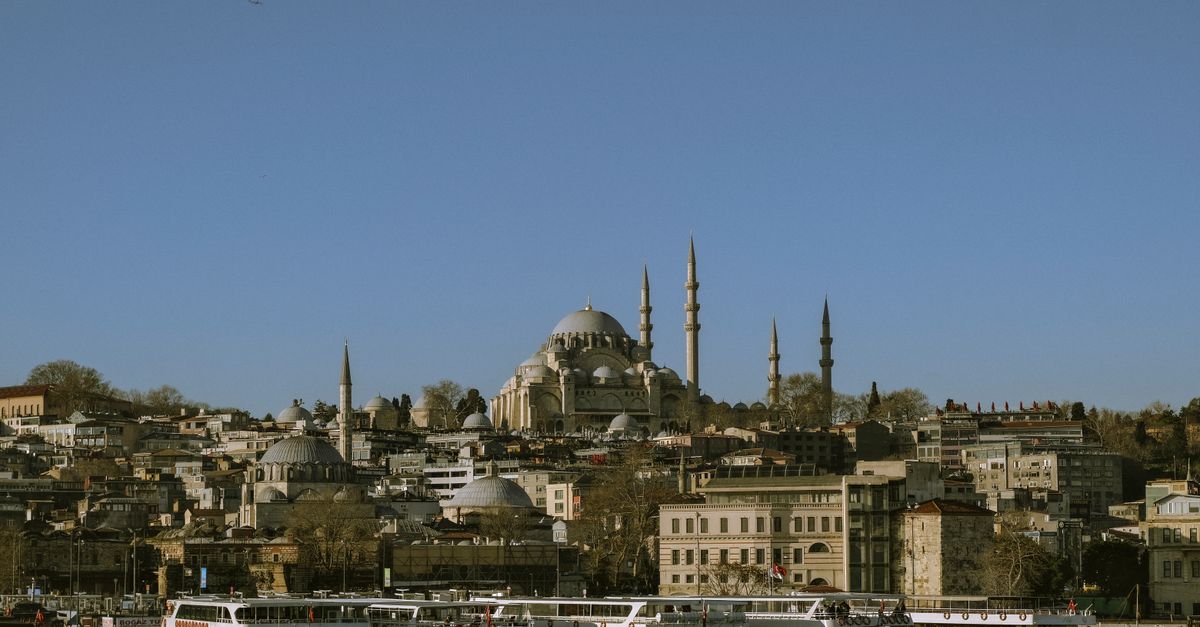
Three days in Istanbul across both continents, with the €25 Hagia Sophia ticket the Museum Pass excludes and the metro that reaches the airport.
Yasmine Belkacem · 2 Sep 2026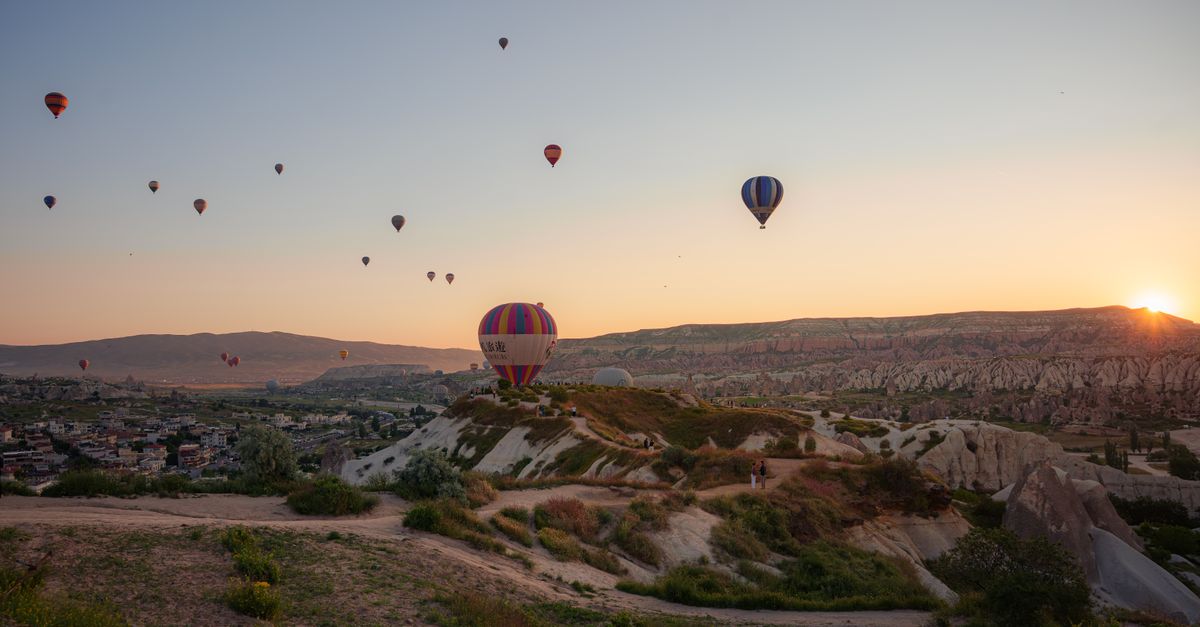
Istanbul, Cappadocia and the Aegean in 10 days. Why one balloon morning is a coin flip, and how many nights it actually takes to fly.
Yasmine Belkacem · 2 Sep 2026Not going yet? Pin it.
One tap puts it on your map and in your pins, for when you are ready.