 Common · +100 XP
Best time to visit: Apr–May · Sep–Nov
Daily spend ~$100
Common · +100 XP
Best time to visit: Apr–May · Sep–Nov
Daily spend ~$100
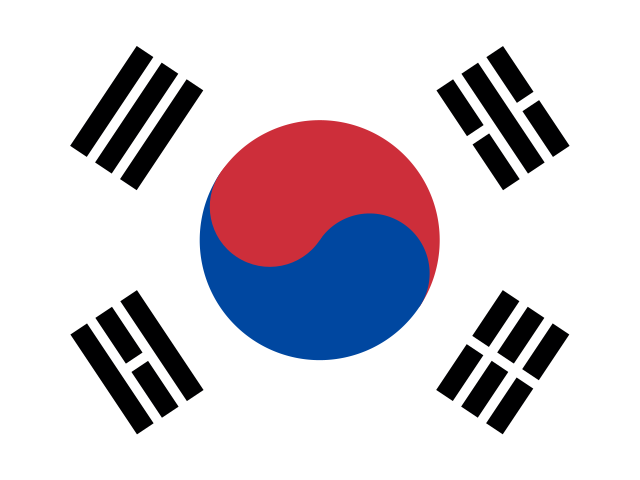
South Korea
Mountains behind every city, and a food culture built around sharing one table. Seoul runs late, the countryside closes early, and the trains are immaculate.
South Korea in ten slides
Wikipedia · 3 Sep 2026


Best time to visit South Korea: Apr–May · Sep–Nov
Where people go in South Korea
What people go to see in South Korea

Seonam Lake Park is an urban park next to Hamwolsan in Seonam-dong, Nam-gu, Ulsan, South Korea. The park was previously named Sunam Dam Park (선암댐공원) because of the large C-shaped dammed lake in the center of the park. There are approximately 4 kilometres of walking trails around the lake, a rose garden, a lotus pond, a soccer field, tennis courts, and a survival game field.
Wikipedia · CC BY-SA 4.0 · 5 Jul 2026
Rystheguy · CC BY-SA 3.0
The Taehwa River (Korean: 태화강) is a river in South Korea. It flows into Ulsan Bay. The river's entire 46-kilometer course lies within the metropolitan city of Ulsan.
Wikipedia · CC BY-SA 4.0 · 22 Apr 2026

Ulsan Castle is a Japanese style castle in Ulsan, South Korea which was constructed during the Japanese invasions of Korea by Katō Kiyomasa's army. Today, Ulsan Castle is almost ruined by the city planning of Ulsan.
Wikipedia · CC BY-SA 4.0 · 19 Jul 2026
문화재청 (공공누리 제1유형) · CC BY-SA 4.0

Ulsan Jungang Market or Ulsan Central Market (Korean: 울산중앙시장) is a traditional street market in Jung District, Ulsan, South Korea. It is the largest traditional market in Ulsan. The market contains many shops that sell fruit, vegetables, meat, fish, breads, clothing, and Korean traditional medicinal items.
Wikipedia · CC BY-SA 4.0 · 20 Aug 2025
Rystheguy · CC BY-SA 3.0


Ulsan Grand Park is the largest urban park in South Korea, with 3.69 square kilometres of park land. It is located in Ulsan Metropolitan City, and includes walking trails, a nature learning center, a botanical garden, a petting zoo, a butterfly zoo, and several playgrounds.
Wikipedia · CC BY-SA 4.0 · 5 Jul 2026
Dongchan0417 · CC BY-SA 4.0
Ulsan Museum is a history museum located adjacent to Ulsan Grand Park in Nam-gu, Ulsan, South Korea. The museum has a permanent exhibit that details life in Ulsan and the rest of Korea from prehistoric times to the present. Construction of the museum commenced on 2 January 2009 and was completed on 31 January 2011.
Wikipedia · CC BY-SA 4.0 · 10 Jul 2026
Beomeosa is one of the head temples of the Jogye Order of Korean Buddhism in Cheongnyeongnopo-dong, Geumjeong District, Busan, South Korea. Built on the slopes of the mountain Geumjeongsan, it is one of the country's best known temples.
Wikipedia · CC BY-SA 4.0 · 4 Aug 2026

Gamcheon Culture Village (Korean: 감천문화마을) is a town within Gamcheon-dong, Saha District, Busan, South Korea. The area is known for its layered streets, twisted labyrinth-like alleys, and brightly painted houses, which have been restored and enhanced in recent years to attract tourism. Built on a steep mountain-side slope, the village has been nicknamed "Korea's Santorini" and the "Machu Picchu of Busan".
Wikipedia · CC BY-SA 4.0 · 30 Aug 2026
Bl00dnFl4mes · CC BY-SA 4.0

The Gwangalli Beach or Gwangan Beach is a beach in Gwangan 2(i)-dong, Suyeong District, Busan, South Korea. It is west of Haeundae Beach. It sits inside a cove spanned by the Gwangan Bridge and covers 82,000 square meters over a length of 1.4 km and a width of 25 to 110 metres, in a curved in a half-moon shape with fine sand.
Wikipedia · CC BY-SA 4.0 · 6 Jul 2026
Chelsea Hicks · CC BY 2.0


Haeundae Beach (Korean: 해운대해수욕장) is an urban beach in Busan, South Korea, located in the eponymous Haeundae District.
Wikipedia · CC BY-SA 4.0 · 6 Jul 2026
Brit in Seoul · CC BY-SA 4.0

Chilseong Market, officially Chilsung Market, is a traditional market in Chilseong-dong, Buk District, Daegu, South Korea.
Wikipedia · CC BY-SA 4.0 · 21 Jul 2026

Daegu National Museum (Korean: 국립대구박물관) is a national museum located in Hwanggeum-dong, Suseong District, Daegu, South Korea. It opened on December 7, 1994, and holds approximately 30,000 artifacts. Its main collection consists of archaeological objects from Daegu and North Gyeongsang Province region.
Wikipedia · CC BY-SA 4.0 · 10 Jul 2026
Trainholic · CC BY-SA 3.0
Daegu Opera House is an opera house located in Buk-gu, Daegu, South Korea.
Wikipedia · CC BY-SA 4.0 · 16 Jul 2026
Gyeongsang Gamyeong Park (Korean: 경상감영공원) is a park in Jung District, Daegu, South Korea. The park is located at the site of the Gyeongsang Gamyeong during the reign of King Seonjo of the Joseon Dynasty, and was created to preserve the site. From 1910 to 1965, the North Gyeongsang government office was located here.
Wikipedia · CC BY-SA 4.0 · 14 Oct 2024

Seomun Market (Korean: 서문시장) is the largest traditional street market in Daegu, South Korea, containing more than 4,000 shops. Seomun Market is particularly known as a source for textiles and sewing services, a key ingredient of Daegu's fashion industry.
Wikipedia · CC BY-SA 4.0 · 28 Nov 2025
대구광역시 · CC BY-SA 4.0

Cheonjiyeon Waterfall (Korean: 천지연폭포) is a waterfall on Jeju Island, South Korea. It is 22 m (72 ft) high and 12 m (39 ft) wide. It is one of the main tourist attractions on Jeju, particularly when they are illuminated at night time.
Wikipedia · CC BY-SA 4.0 · 2 Jul 2026
Martin Chen · CC BY 2.0

Hallasan (Korean: 한라산) is a shield volcano comprising much of Jeju Island in South Korea. Its summit, at 1,947 m (6,388 ft), is the highest point in the country. The area around the mountain is a designated national park, named Hallasan National Park.
Wikipedia · CC BY-SA 4.0 · 18 Aug 2026
LG전자 · CC BY 2.0

Jeongbang Waterfall (Korean: 정방폭포) is a waterfall and popular tourist attraction located in Seogwipo, Jeju Province, South Korea. The waterfall is 23 m (75 ft) high and is very close to the ocean. Depending on the level of recent rainfall, it can be up 8 m (26 ft) wide.
Wikipedia · CC BY-SA 4.0 · 30 Nov 2025
Shane Porter EssPea · CC BY-SA 3.0

Manjanggul (Korean: 만장굴) is a lava tube located in Gimnyeong-ri, Gujwaeup, Jeju City, South Korea. At up to 23 metres (75 ft) wide, 30 metres (98 ft) high and 8.928 km long, it is the 12th-longest lava tube in the world and the second longest on Jeju Island. It is the only cave of the Geomunoreum Lava Tube System, considered one of the finest lava tube systems in the world.
Wikipedia · CC BY-SA 4.0 · 1 Sep 2026
AhmadElq · CC BY-SA 4.0

Seongeup Folk Village (Korean: 성읍민속마을) is a traditional Korean folk village in Pyoseon-myeon, Seogwipo, Jeju Province, South Korea. It has been continually inhabited for around 600 years, since the 15th century, and is maintained to resemble its traditional pre-modern form.
Wikipedia · CC BY-SA 4.0 · 1 May 2026
Trainholic · CC BY-SA 4.0

Seongsan Ilchulbong (Korean: 성산일출봉), also called Sunrise Peak, is a volcano on eastern Jeju Island, in Seongsan-ri, Seogwipo, Jeju Province, South Korea. It is 182 meters high and has a volcanic crater at the top.
Wikipedia · CC BY-SA 4.0 · 25 May 2026
Korea.net / Korean Culture and Information Service · CC BY-SA 2.0

Bukchon Hanok Village (Korean: 북촌한옥마을) is a residential neighborhood in Jongno District, Seoul, South Korea. It has many restored traditional Korean houses, called hanok. This has made it a popular tourist destination.
Wikipedia · CC BY-SA 4.0 · 18 Jul 2026
Bgag · CC0
Changdeokgung is a former royal palace in Seoul, South Korea. A UNESCO World Heritage Site and a Historic Site of South Korea, it is among the best preserved of all Korean palaces. It and its neighboring palace Changgyeonggung have together been called the "East Palace".
Wikipedia · CC BY-SA 4.0 · 3 Aug 2026

Gwangjang Market (Korean: 광장시장), previously Dongdaemun Market (동대문시장), is a traditional street market in Jongno District, Seoul, South Korea. The market is one of the oldest and largest traditional markets in South Korea, with more than 5000 shops and 20,000 employees in an area of 42,000 m2 (450,000 ft2). Approximately 65,000 people visit the market each day.
Wikipedia · CC BY-SA 4.0 · 27 May 2026
Bgag · CC0
Gyeongbokgung is a former royal palace in Seoul, South Korea. Established in 1395, it was the first royal palace of the Joseon dynasty, and is now one of the most significant tourist attractions in the country.
Wikipedia · CC BY-SA 4.0 · 27 May 2026
Jongmyo (Korean: 종묘) is a Confucian royal ancestral shrine in the Jongno District of Seoul, South Korea. It was originally built during the Joseon period (1392–1897) for memorial services for deceased kings and queens. According to UNESCO, the shrine is the oldest royal Confucian shrine preserved and the ritual ceremonies continue a tradition established in the 14th century.
Wikipedia · CC BY-SA 4.0 · 27 May 2026

Namsan Seoul Tower, also known as the YTN Seoul Tower, Namsan Tower, Seoul Tower or N Seoul Tower, is a communication and observation tower located on the summit of Namsan in central Seoul, South Korea. The 236-metre-tall (774 ft) structure was the nation’s first tower servicing multiple TV and radio broadcasters, and is considered a landmark and symbol of the city.
Wikipedia · CC BY-SA 4.0 · 12 Jul 2026
EasyKL · CC-BY-SA-3.0

Bomunsan, is an urban mountain park in the south of Daejeon in Korea, with a peak elevation of 457.6 m (1,501 ft). Known as one of the Eight Great Views Daejeon, Bomunsan was established as a park in 1965, and contains multiple culture, sports, and heritage sites, some dating back as far as the Bronze Age.
Wikipedia · CC BY-SA 4.0 · 15 Jun 2025
Pmlydon · CC BY-SA 4.0


Expo Science Park (Korean: 엑스포과학공원) is a science park in Yuseong District, Daejeon, South Korea, built for Taejŏn Expo '93. Facilities at Expo Park included a garden, amusement park, and observation tower. While the tower and some buildings remain, most of the expo buildings have now been removed.
Wikipedia · CC BY-SA 4.0 · 27 Feb 2024
Brücke-Osteuropa · CC0

Daejeon Hanbat Arboretum is an urban park and arboretum in Daejeon Metropolitan City, located in Seo District at the confluence of the Yuseongcheon and Gap rivers. Covering 387,000 sq/m, it is the largest manmade urban arboretum in Korea, and one of the most popular attractions in Daejeon, with nearly 1 million annual visitors.
Wikipedia · CC BY-SA 4.0 · 8 Mar 2024
Pmlydon · CC BY-SA 4.0

The Lee Ungno Museum is an art museum in Daejeon, South Korea focusing on Korean-born French painter and printmaker Lee Ungno.
Wikipedia · CC BY-SA 4.0 · 1 Feb 2026
Lee Ungno Museum · Public domain

The Asia Culture Center, also referred to as ACC, is located in Gwangju, South Korea. It was opened in November 2015 after more than 10 years of planning and development. The opening was attended by 700 people, including South Korean Prime Minister Hwang Kyo-ahn.
Wikipedia · CC BY-SA 4.0 · 15 Apr 2026
LERK · CC-BY-SA-4.0


May 18th National Cemetery is a cemetery for those who participated in the Gwangju Uprising. Built by the government of South Korea in 1997, it is located in Gwangju. Every May, on the anniversary of the uprising, it is common for citizens to visit the cemetery to honor the dead.
Wikipedia · CC BY-SA 4.0 · 6 Jul 2026
Salamander724 · Public domain

Mudeungsan is a mountain in South Korea. It extends over Buk District, Gwangju, as well as Hwasun County and Damyang County in South Jeolla Province. Mudeungsan has an elevation of 1,187 m (3,894 ft) and is a part of Mudeungsan National Park which gained national park status in 2012.
Wikipedia · CC BY-SA 4.0 · 11 Aug 2026
gary4now · CC BY 3.0

Jeonju Hanok Village is a village in the city of Jeonju, South Korea, and overlaps with the Pungnam-dong and Gyo-dong neighborhoods. The village contains over 800 Korean traditional houses called Hanok. The village is famous among Koreans and tourists because of its traditional buildings that strongly contrast with the modern city around it.
Wikipedia · CC BY-SA 4.0 · 27 Jun 2026

Jeonju National Museum (Korean: 국립전주박물관) is a national museum located in Jeonju, Jeollabuk-do, South Korea. It opened on October 26, 1990, as the ninth South Korean national museum.
Wikipedia · CC BY-SA 4.0 · 27 Nov 2025
Trainholic · CC BY-SA 3.0
Samyang Dabang (Korean: 삼양다방) is a historic dabang (coffeehouse) in Gyeongwon-dong, Wansan District, Jeonju, South Korea. It is the oldest active coffeehouse in the country, having been founded in 1952. The dabang was made a Jeonju Future Heritage in 2019 and set for preservation.
Wikipedia · CC BY-SA 4.0 · 30 Sep 2025
Sourced stays
Sourced experiences
Fly to South Korea
The facts you look up on the plane
Guides about South Korea

The best time to visit South Korea by month, with the blossom that lasts ten days, the rainy season that drops a quarter of Seoul's rain, and autumn's peak.
Rina Matsuda · 4 Sep 2026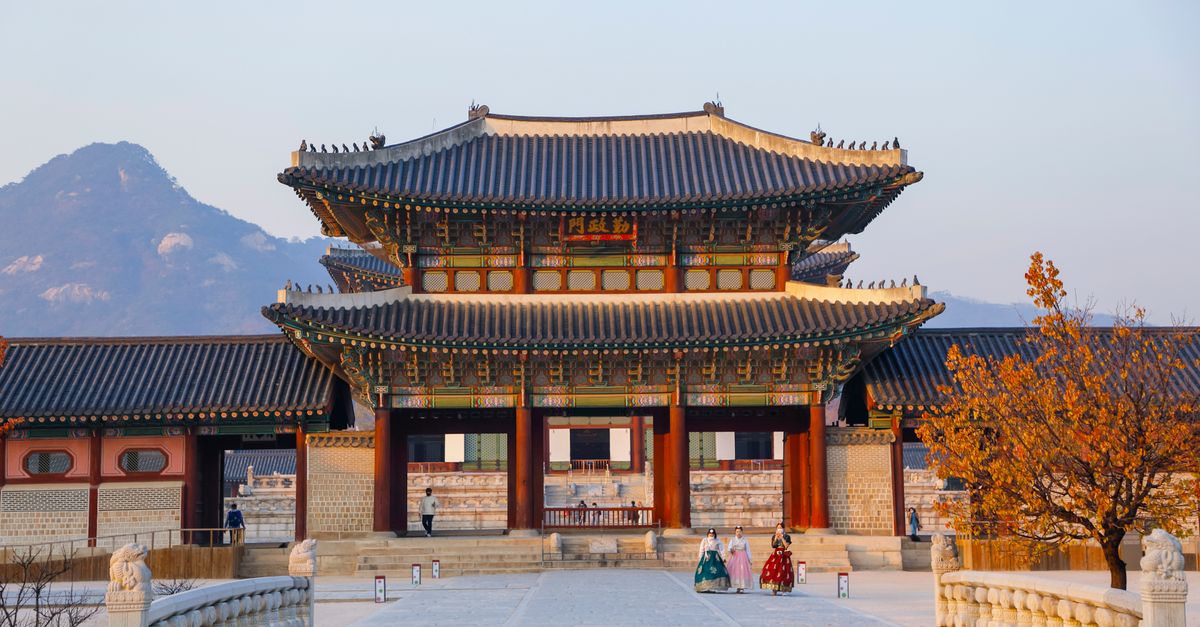
Four days in Seoul across the palaces, the hills and the river, with the transit pass arithmetic and the entry waiver that expires this December.
Rina Matsuda · 3 Sep 2026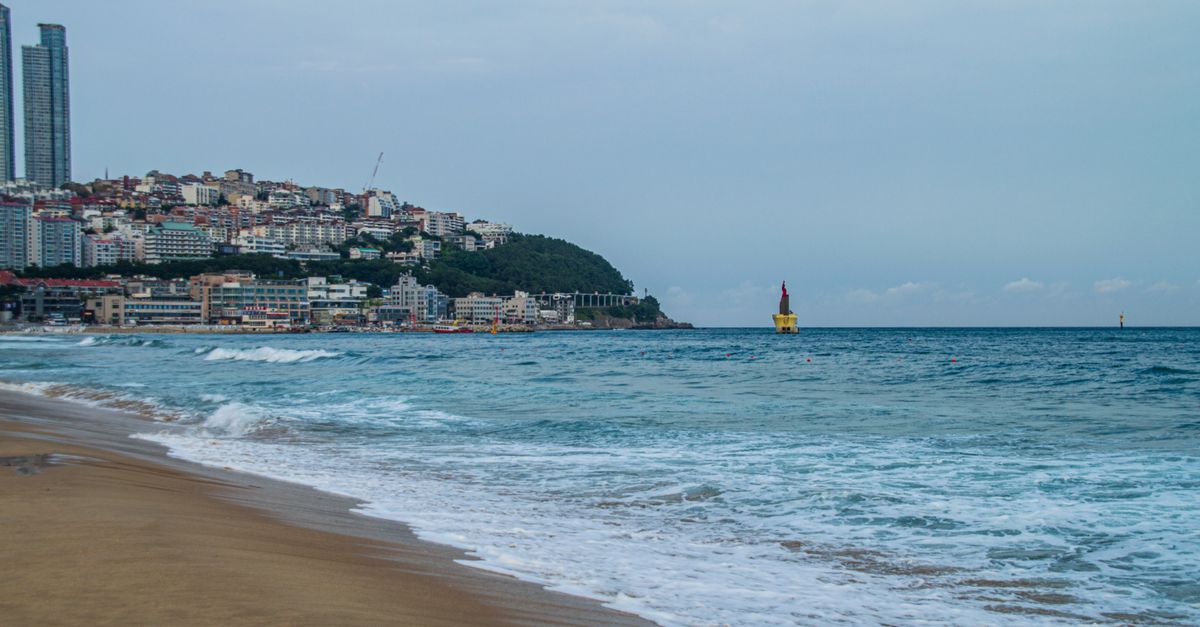
Korea is easier than Japan and less signposted, and two admin details decide the trip. The card, the entry rule, the route, and what a day actually costs.
Rina Matsuda · 2 Sep 2026Not going yet? Pin it.
One tap puts it on your map and in your pins, for when you are ready.