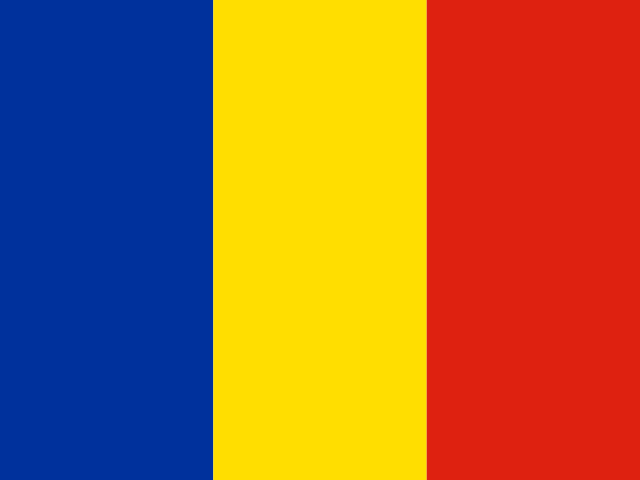
 Uncommon · +150 XP
Best time to visit: May–Jun · Sep–Oct
Daily spend ~$60
Uncommon · +150 XP
Best time to visit: May–Jun · Sep–Oct
Daily spend ~$60
Romania
Painted monasteries, fortified Saxon villages and the wildest forest left in Europe, with bears in it. The Dracula business is a distraction from a better country.
Romania in ten slides
Wikipedia · 4 Sep 2026


Best time to visit Romania: May–Jun · Sep–Oct
Where people go in Romania
What people go to see in Romania

Brașov is a city in Transylvania, Romania and the county seat of Brașov County.
Wikipedia · CC BY-SA 4.0 · 29 Aug 2026
Jorge Franganillo · CC BY 2.0

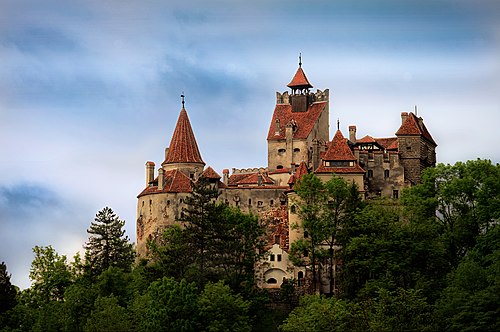
Bran Castle is a castle in Bran, 25 kilometres (16 mi) southwest of Brașov. The castle was built by Saxons in 1377 who were given the privilege by Louis I of Hungary. It is a national monument and landmark in Transylvania.
Wikipedia · CC BY-SA 4.0 · 6 May 2026
Dobre Cezar · CC BY-SA 3.0 ro

Catherine's Gate in Brașov, Romania, was built by the Tailors' Guild, in 1559 for defensive purposes to replace an old gate destroyed by a flood in 1526. It is named after St. Catherine's Monastery that was situated here in former times. It is the only original city gate to have survived from medieval times.
Wikipedia · CC BY-SA 4.0 · 4 Oct 2025
Alex:D · CC BY-SA 3.0
Brașov is a city in Transylvania, Romania and the county seat of Brașov County.
Wikipedia · CC BY-SA 4.0 · 29 Aug 2026
Jorge Franganillo · CC BY 2.0
Brașov is a city in Transylvania, Romania and the county seat of Brașov County.
Wikipedia · CC BY-SA 4.0 · 29 Aug 2026
Jorge Franganillo · CC BY 2.0
Brașov is a city in Transylvania, Romania and the county seat of Brașov County.
Wikipedia · CC BY-SA 4.0 · 29 Aug 2026
Jorge Franganillo · CC BY 2.0

Saint Nicholas Church is a Romanian Orthodox church in Brașov, dominating the historic district of Șcheii Brașovului. One of the oldest Orthodox churches in the country and an important cultural center for the Romanians in Țara Bârsei, it is documented as being built on the site of a wooden cross dating to 1292.
Wikipedia · CC BY-SA 4.0 · 17 May 2026
Chainwit. · CC BY 4.0

Arcul de Triumf is a triumphal arch located on the Kiseleff Road, in the northern part of Bucharest, Romania. The monument, designed by Petre Antonescu, was built in 1921–22, renovated in 1935–36, and renovated again starting in 2014. It commemorates Romania's victory in the First World War and the coronation of King Ferdinand I and his wife Marie.
Wikipedia · CC BY-SA 4.0 · 1 Feb 2026
David Stanley from Nanaimo, Canada · CC-BY-2.0

The Cișmigiu Gardens or Cișmigiu Park are a public park in the center of Bucharest, Romania, spanning areas on all sides of an artificial lake. The gardens' creation was an important moment in the history of Bucharest. They form the oldest and, at 14.6 hectares, the largest park in city's central area.
Wikipedia · CC BY-SA 4.0 · 4 Jul 2026
Gabriel from Bucharest, Romania · CC BY 2.0

Lipscani is a street and a district of Bucharest, Romania, which from the Middle Ages to the early 19th century was the most important commercial area of the city and Wallachia. It is located near the ruins of the old Princely Court built by Vlad III the Impaler.
Wikipedia · CC BY-SA 4.0 · 30 Jul 2026
Chainwit. · CC BY 4.0
The National Museum of Art of Romania is located in the Royal Palace in Revolution Square, central Bucharest. It features collections of medieval and modern Romanian art, as well as the international collection assembled by the Romanian royal family.
Wikipedia · CC BY-SA 4.0 · 19 Aug 2026

The Palace of the Parliament, initially designed during Communist times as the People's House or the House of the Republic, is the seat of the Parliament of Romania, located atop Dealul Spirii in Bucharest, the national capital. The Palace reaches a height of 84 m (276 ft), is 92 m (302 ft) deep underground, has a floor area of 365,000 m2 (3,930,000 sq ft) and a volume of 2,550,000 m3 (90,000,000 cu ft).
Wikipedia · CC BY-SA 4.0 · 17 Jul 2026
Jorge Franganillo · CC-BY-2.0
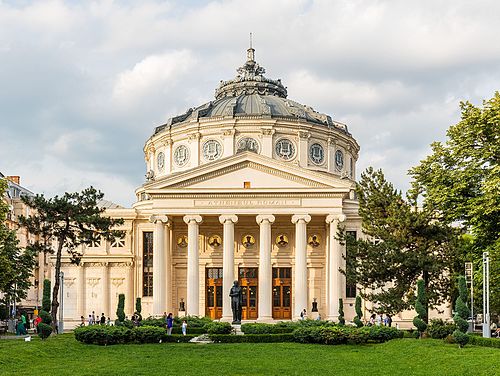
The Romanian Athenaeum is a concert hall in the center of Bucharest, Romania, and a landmark of the Romanian capital city. Opened in 1888, the ornate, domed, circular building is the city's most prestigious concert hall and home of the "George Enescu" Philharmonic and of the George Enescu Festival.
Wikipedia · CC BY-SA 4.0 · 26 Jul 2026
Diego Delso · CC BY-SA 4.0

Stavropoleos Monastery, also known as Stavropoleos Church during the last century when the monastery was dissolved, is an Eastern Orthodox monastery for nuns in central Bucharest, Romania. Its church is built in Brâncovenesc style. The patrons of the church are St. Archangels Michael and Gabriel.
Wikipedia · CC BY-SA 4.0 · 1 Aug 2026
Neoclassicism Enthusiast · Public domain

The Village Museum or formally National Museum of the Village "Dimitrie Gusti" is an open-air ethnographic museum located in the King Michael I Park, Bucharest, Romania. The museum showcases traditional Romanian village life. The museum extends to over 100,000 m2, and contains 123 authentic peasant settlements, 363 monuments and over 50,000 artefacts from around Romania.
Wikipedia · CC BY-SA 4.0 · 10 Jul 2026
Chainwit. · CC BY-SA 4.0

The Cathedral of Saints Peter and Paul, Constanța, located at 25 Arhiepiscopiei Street, Constanța, Romania, is the seat of the Romanian Orthodox Archbishop of Tomis, as well as a monastery.
Wikipedia · CC BY-SA 4.0 · 7 Jul 2026
No machine-readable author provided. Anonimu~commonswiki assumed (based on copyright claims). · CC BY-SA 3.0

Constanța is a city in the Northern Dobruja historical region of Romania. A port city, it is the capital of Constanța County and the country's fourth largest city and principal port on the Black Sea coast. It is the oldest continuously inhabited city in Romania, founded around 600 BC, and among the oldest in Europe.
Wikipedia · CC BY-SA 4.0 · 22 Aug 2026
Andymxm · CC BY-SA 4.0

The Constanța Casino is a casino located in Constanța, Romania. Designated by the Romanian Ministry of Culture and National Patrimony as a historic monument, the casino is situated on the Constanța seafront along the Black Sea in the historic Peninsulă District of the city.
Wikipedia · CC BY-SA 4.0 · 30 Apr 2026
Dennis Sylvester Hurd · CC0

The Genoese Lighthouse is a lighthouse and historic monument situated on the waterfront of the city of Constanța, Romania, behind a group of statues which has in its center the bust of Mihai Eminescu, sculpted by Oscar Han. It is located near Constanța Casino.
Wikipedia · CC BY-SA 4.0 · 24 Aug 2026
Kdanv · Public domain

The Grand Mosque of Constanța, originally known as the Carol I Mosque, is a mosque in Constanța, Romania. It is listed as an historic monument by the Romanian National Institute of Historical Monuments.
Wikipedia · CC BY-SA 4.0 · 2 Aug 2026
Unknown · CC BY-SA 3.0

The Constanța History and Archaeology Museum is a museum located at 12 Piața Ovidiu, Constanța, Romania.
Wikipedia · CC BY-SA 4.0 · 10 Jul 2026
Bejan Neculai · CC BY-SA 4.0

Mamaia is a resort on the Romanian Black Sea shore and a district of Constanța.
Wikipedia · CC BY-SA 4.0 · 27 Jun 2025
Razvan Socol · CC BY-SA 4.0
Constanța is a city in the Northern Dobruja historical region of Romania. A port city, it is the capital of Constanța County and the country's fourth largest city and principal port on the Black Sea coast. It is the oldest continuously inhabited city in Romania, founded around 600 BC, and among the oldest in Europe.
Wikipedia · CC BY-SA 4.0 · 22 Aug 2026
Andymxm · CC BY-SA 4.0

The Cetate Synagogue is a Neolog Jewish congregation and synagogue, located on Mărășești Street in the Cetate district of Timișoara, in Timiș County, Romania. Designed by Carl Schumann in an eclectic architectural style, the synagogue was completed in 1865.
Wikipedia · CC BY-SA 4.0 · 30 Jul 2026
Chainwit. · CC BY-SA 4.0

The Huniade Castle is the oldest monument in Timișoara, Romania, built between 1443 and 1447 by John Hunyadi and Paolo Santini de Duccio over the old royal castle dating from the 14th century. The castle was rebuilt by the Turkish pashas in the 17th century and by Prince Eugene of Savoy in the 18th century. The structure owes its present appearance to the 1850s reconstruction campaign.
Wikipedia · CC BY-SA 4.0 · 20 Jul 2026
Radufan · CC BY-SA 2.5

Liberty Square, formerly known as Parade Square or Prince Eugene Square, is an urban square in Timișoara. It is the second-oldest square of the former fortress of Timișoara. It got its current name during the Hungarian Revolution of 1848–1849 when Timișoara withstood a siege by Hungarian revolutionaries.
Wikipedia · CC BY-SA 4.0 · 9 Aug 2026
Silviunastase · CC BY-SA 4.0

Roses Park, previously known as Rosarium or Ștefan Plavăț Park of Culture and Leisure, is an urban park in Timișoara, located north of the Bega River. It is regarded as one of the city's landmarks and is also part of why Timișoara is known by the nickname "City of Roses."
Wikipedia · CC BY-SA 4.0 · 23 Jun 2026
Turbojet · CC BY-SA 4.0

The St. George Cathedral, colloquially known as the Roman Catholic Dome, is the cathedral of the Roman Catholic Diocese of Timișoara and one of the city's landmarks. The cathedral is dedicated to St. George and was built between 1736 and 1774. After the Cathedral Basilica of Oradea, it is the second largest Baroque religious building in Southeastern Europe.
Wikipedia · CC BY-SA 4.0 · 30 Jul 2026
Chainwit. · CC BY-SA 4.0

The Orthodox Cathedral, also known as the Metropolitan Cathedral, is a Romanian Orthodox church in Timișoara, in Romania. The cathedral is the seat of the Archbishopric of Timișoara and the Metropolis of Banat. It is dedicated to the Three Holy Hierarchs, Basil the Great, Gregory the Theologian and John Chrysostom.
Wikipedia · CC BY-SA 4.0 · 30 Jul 2026
Silviunastase · CC-BY-SA-4.0

Union Square, also known as Dome Square, is the oldest square in Timișoara, Romania. It was named in honor of the Romanian troops that entered Timișoara on 3 August 1919 and established the Romanian administration, thus finalizing the union of Banat with Romania. Initially, it was called Losonczy Square, after Count István Losonczy who was killed by the Turks in 1552, when the fortress was conquered.
Wikipedia · CC BY-SA 4.0 · 9 Aug 2026
Miomir Magdevski · CC BY-SA 4.0

The Victory Square, known until 1990 as the Opera Square, is the central square of Timișoara. It is the place where Timișoara was proclaimed on 20 December 1989 the first city free of communism in Romania. It was a main boulevard, transformed into a square after the closure of the southern side by the construction of the Metropolitan Cathedral.
Wikipedia · CC BY-SA 4.0 · 9 Aug 2026
Marius Catalin Boldeanu · CC BY-SA 4.0

Cluj-Napoca, or simply Cluj, is a city in northwestern Romania. It is the second-most populous city in the country and the seat of Cluj County. Geographically, it is roughly equidistant from Bucharest, Budapest and Belgrade.
Wikipedia · CC BY-SA 4.0 · 28 Aug 2026
Dennis G. Jarvis · CC BY-SA 2.0
Cluj-Napoca, or simply Cluj, is a city in northwestern Romania. It is the second-most populous city in the country and the seat of Cluj County. Geographically, it is roughly equidistant from Bucharest, Budapest and Belgrade.
Wikipedia · CC BY-SA 4.0 · 28 Aug 2026
Dennis G. Jarvis · CC BY-SA 2.0
Central Park is a large public, urban park in central Cluj-Napoca. It was founded in the 19th century and it located on the southern shore of Someșul Mic River. The Park is now home to the University of Arts and Design and to the Chemistry Faculty of the Babeș-Bolyai University.
Wikipedia · CC BY-SA 4.0 · 29 Jul 2026

The Hoia-Baciu Forest is a forest situated to the west of the city of Cluj-Napoca, near the open-air section of the Ethnographic Museum of Transylvania. The forest is used as a common recreation destination. In recent years a biking park has been added to the forest, along with areas for other sports such as paintball, airsoft and archery.
Wikipedia · CC BY-SA 4.0 · 5 Jul 2026
Roamata · Public domain
Cluj-Napoca, or simply Cluj, is a city in northwestern Romania. It is the second-most populous city in the country and the seat of Cluj County. Geographically, it is roughly equidistant from Bucharest, Budapest and Belgrade.
Wikipedia · CC BY-SA 4.0 · 28 Aug 2026
Dennis G. Jarvis · CC BY-SA 2.0

The St. Michael's Church is a Gothic-style Roman Catholic church in Cluj-Napoca. It is the second largest church in the geographical region of Transylvania, Romania. The nave is 50 meters long and 24 meters wide, the apse is 20×10 m.
Wikipedia · CC BY-SA 4.0 · 30 Jul 2026
Igor Sirbu · CC BY-SA 3.0 ro
Cluj-Napoca, or simply Cluj, is a city in northwestern Romania. It is the second-most populous city in the country and the seat of Cluj County. Geographically, it is roughly equidistant from Bucharest, Budapest and Belgrade.
Wikipedia · CC BY-SA 4.0 · 28 Aug 2026
Dennis G. Jarvis · CC BY-SA 2.0

Iași, also sometimes referred to historically as Jassy, is the third most-populous city in Romania and the seat of Iași County. Located in the historical region of Moldavia, it has traditionally been one of the leading centres of Romanian social, cultural, academic and artistic life.
Wikipedia · CC BY-SA 4.0 · 30 Aug 2026
Andrei Lucian Vaida · CC BY-SA 4.0

The Iași Botanical Garden, now named after its founder, Anastasie Fătu, is a botanical garden located in the Copou neighbourhood of Iași, Romania. Established in the year 1856 and maintained by the Alexandru Ioan Cuza University, it is the oldest and largest botanical garden in Romania.
Wikipedia · CC BY-SA 4.0 · 5 Jul 2026
Sb2s3 · CC BY-SA 4.0

The Copou Park or Copou Gardens is the oldest public park in Iași, Romania. Its development started in 1834 under the reign of Mihail Sturdza, making the park one of the first public gardens in Romania and a Iași landmark.
Wikipedia · CC BY-SA 4.0 · 4 Jul 2026
Editura Horovitz, România · Public domain

The Golia Monastery is a Romanian Orthodox fortified monastery located in Iaşi, Romania. The monastery is listed in the National Register of Historic Monuments. In 2012, the conservation of the Monastery was awarded the European Union Prize for Cultural Heritage / Europa Nostra Award.
Wikipedia · CC BY-SA 4.0 · 2 Aug 2026
Manole Alexandru · CC BY-SA 4.0

The Metropolitan Cathedral, Iași, located at 16 Ștefan cel Mare și Sfânt Boulevard, Iași, Romania, is the seat of the Romanian Orthodox Archbishop of Iași and Metropolitan of Moldavia and Bukovina, and the largest historic Orthodox church in Romania. It is dedicated to Saint Parascheva, to the Presentation of Jesus and to Saint George.
Wikipedia · CC BY-SA 4.0 · 18 May 2026
Manole Alexandru · CC BY-SA 4.0
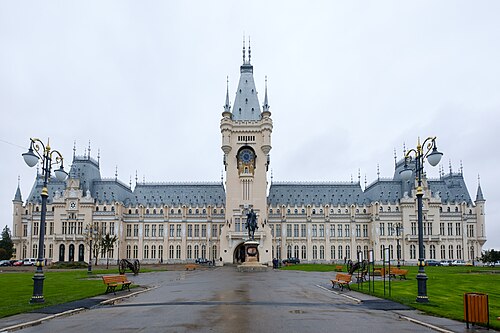
The Palace of Culture is an edifice located in Iași, Romania. The building served as the Administrative and Justice Palace until 1955, when its designation and use was changed, and assigned to the four museums nowadays united under the name of Moldavia National Museum Complex. Also, the building houses the Cultural Heritage Conservation-Restoration Centre, and hosts various exhibitions and other events.
Wikipedia · CC BY-SA 4.0 · 23 Mar 2026
Europeana EU · CC BY 2.0

Mănăstirea Trei Ierarhi is a seventeenth-century monastery located in Iași, Romania. The monastery is listed in the National Register of Historic Monuments and included on the tentative list of UNESCO World Heritage Sites.
Wikipedia · CC BY-SA 4.0 · 2 Aug 2026
Loraine · CC BY-SA 4.0

The Cathedral of Saint Demetrius is a Romanian Orthodox cathedral, see of the Metropolis of Oltenia. It is located at 14 Matei Basarab Street, Craiova, Romania, in the historic region of Oltenia. There was likely a church on the site by the 1490s, renovated in 1651 and, having fallen into disrepair, demolished in 1889.
Wikipedia · CC BY-SA 4.0 · 7 Jul 2026
User:Mvelam · CC BY-SA 3.0

The University of Craiova is a public university located in Craiova, Romania. It was founded in 1947, initially with four institutes, in the Palace of Justice of Craiova. It is the largest university in the historical Oltenia province of Romania.
Wikipedia · CC BY-SA 4.0 · 18 Aug 2026


Galați is the capital city of Galați County in the historical region of Western Moldavia, in eastern Romania. Galați is a port town on the river Danube. and the sixth-largest of all cities on the river Danube. According to the 2021 census it is the 8th most populous city in Romania.
Wikipedia · CC BY-SA 4.0 · 30 Aug 2026
Nica George este autorul imaginilor. Mi-a dat acordul lui pentru încărcarea lor pe Wikipedia. · CC BY-SA 4.0

Galați TV Tower is a 110-metre (360 ft) tall concrete tower used for FM and TV broadcasting in Galați, Romania. The tower, completed in 1978, is equipped with a tower restaurant, perhaps the only of this kind in Romania.
Wikipedia · CC BY-SA 4.0 · 6 Nov 2024
Baditastefan · Public domain
Galați is the capital city of Galați County in the historical region of Western Moldavia, in eastern Romania. Galați is a port town on the river Danube. and the sixth-largest of all cities on the river Danube. According to the 2021 census it is the 8th most populous city in Romania.
Wikipedia · CC BY-SA 4.0 · 30 Aug 2026
Nica George este autorul imaginilor. Mi-a dat acordul lui pentru încărcarea lor pe Wikipedia. · CC BY-SA 4.0

Mihai Eminescu was a Romanian Romantic poet, novelist, and journalist from Moldavia, generally regarded as the most famous and influential Romanian poet. Eminescu was an active member of the Junimea literary society and worked as an editor for the newspaper Timpul, the official newspaper of the Conservative Party (1880–1918).
Wikipedia · CC BY-SA 4.0 · 26 Aug 2026
Jan Tomas · Public domain

Băile Felix is a thermal spa resort near the commune of Sânmartin in Bihor County, Transylvania, Romania. Băile Felix is at a close distance to Oradea, a major city in western Romania.
Wikipedia · CC BY-SA 4.0 · 20 Jun 2026
ArnoldPlaton · CC BY-SA 3.0

The Baroque Palace of Oradea, also known as the Roman Catholic Episcopal Palace of Oradea, of the city of Oradea in Bihor County, Romania, is a building that dates to the Baroque times.
Wikipedia · CC BY-SA 4.0 · 27 Apr 2026
Maróthy Ádám · CC BY 4.0

The Cathedral Basilica of St. Mary also called the Catholic Cathedral of the Assumption, is the cathedral church of the Latin Diocese of Oradea Mare. It is located at 2 Șirul Canonicilor Street, Oradea, Romania.
Wikipedia · CC BY-SA 4.0 · 12 Jul 2026
Nagyvarad_bazilika.jpg: Horváth György derivative work: Rabanus Flavus · CC0

Holy Trinity Church is a Romanian Orthodox church located at 13 Parcul Traian Street, Oradea, Romania. It is dedicated to the Holy Trinity.
Wikipedia · CC BY-SA 4.0 · 30 Mar 2026
Mihai Andrei · CC BY-SA 3.0

The St. Nicholas Cathedral also called Greek-Catholic Cathedral of St. Nicholas It is a Catholic church that serves as the cathedral of the Eparchy of Oradea Mare. It is located in the city of Oradea in the European country of Romania.
Wikipedia · CC BY-SA 4.0 · 13 Jul 2026
Insidercam · CC BY-SA 4.0
Sourced stays
Sourced experiences
Fly to Romania
The facts you look up on the plane
Not going yet? Pin it.
One tap puts it on your map and in your pins, for when you are ready.