Bucharest
Ceaușescu's parliament is one of the heaviest buildings on earth, and the city has spent thirty years growing back around it. The old streets behind it are where the bars are.
Bucharest in eight slides
Wikipedia · 4 Sep 2026


Things to do in Bucharest
Where to stay in Bucharest
Bucharest in a day, two days, three
- Day 24 stops
- Palace of the Parliament
- Romanian Athenaeum
- Stavropoleos Monastery
- Village Museum
Landmarks in Bucharest

Arcul de Triumf is a triumphal arch located on the Kiseleff Road, in the northern part of Bucharest, Romania. The monument, designed by Petre Antonescu, was built in 1921–22, renovated in 1935–36, and renovated again starting in 2014. It commemorates Romania's victory in the First World War and the coronation of King Ferdinand I and his wife Marie.
Wikipedia · CC BY-SA 4.0 · 1 Feb 2026
David Stanley from Nanaimo, Canada · CC-BY-2.0

The Cișmigiu Gardens or Cișmigiu Park are a public park in the center of Bucharest, Romania, spanning areas on all sides of an artificial lake. The gardens' creation was an important moment in the history of Bucharest. They form the oldest and, at 14.6 hectares, the largest park in city's central area.
Wikipedia · CC BY-SA 4.0 · 4 Jul 2026
Gabriel from Bucharest, Romania · CC BY 2.0

Lipscani is a street and a district of Bucharest, Romania, which from the Middle Ages to the early 19th century was the most important commercial area of the city and Wallachia. It is located near the ruins of the old Princely Court built by Vlad III the Impaler.
Wikipedia · CC BY-SA 4.0 · 30 Jul 2026
Chainwit. · CC BY 4.0
The National Museum of Art of Romania is located in the Royal Palace in Revolution Square, central Bucharest. It features collections of medieval and modern Romanian art, as well as the international collection assembled by the Romanian royal family.
Wikipedia · CC BY-SA 4.0 · 19 Aug 2026

The Palace of the Parliament, initially designed during Communist times as the People's House or the House of the Republic, is the seat of the Parliament of Romania, located atop Dealul Spirii in Bucharest, the national capital. The Palace reaches a height of 84 m (276 ft), is 92 m (302 ft) deep underground, has a floor area of 365,000 m2 (3,930,000 sq ft) and a volume of 2,550,000 m3 (90,000,000 cu ft).
Wikipedia · CC BY-SA 4.0 · 17 Jul 2026
Jorge Franganillo · CC-BY-2.0
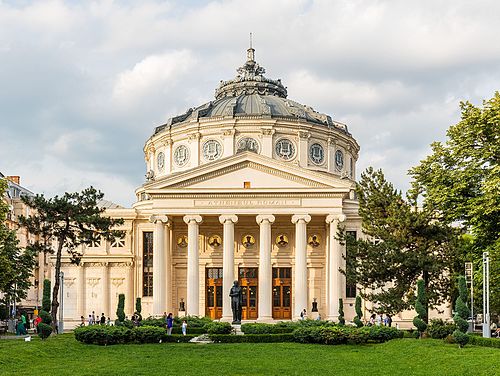
The Romanian Athenaeum is a concert hall in the center of Bucharest, Romania, and a landmark of the Romanian capital city. Opened in 1888, the ornate, domed, circular building is the city's most prestigious concert hall and home of the "George Enescu" Philharmonic and of the George Enescu Festival.
Wikipedia · CC BY-SA 4.0 · 26 Jul 2026
Diego Delso · CC BY-SA 4.0

Stavropoleos Monastery, also known as Stavropoleos Church during the last century when the monastery was dissolved, is an Eastern Orthodox monastery for nuns in central Bucharest, Romania. Its church is built in Brâncovenesc style. The patrons of the church are St. Archangels Michael and Gabriel.
Wikipedia · CC BY-SA 4.0 · 1 Aug 2026
Neoclassicism Enthusiast · Public domain

The Village Museum or formally National Museum of the Village "Dimitrie Gusti" is an open-air ethnographic museum located in the King Michael I Park, Bucharest, Romania. The museum showcases traditional Romanian village life. The museum extends to over 100,000 m2, and contains 123 authentic peasant settlements, 363 monuments and over 50,000 artefacts from around Romania.
Wikipedia · CC BY-SA 4.0 · 10 Jul 2026
Chainwit. · CC BY-SA 4.0
Arcul de Triumf is a triumphal arch located on the Kiseleff Road, in the northern part of Bucharest, Romania. The monument, designed by Petre Antonescu, was built in 1921–22, renovated in 1935–36, and renovated again starting in 2014. It commemorates Romania's victory in the First World War and the coronation of King Ferdinand I and his wife Marie.
Wikipedia · CC BY-SA 4.0 · 1 Feb 2026
David Stanley from Nanaimo, Canada · CC-BY-2.0
The Cișmigiu Gardens or Cișmigiu Park are a public park in the center of Bucharest, Romania, spanning areas on all sides of an artificial lake. The gardens' creation was an important moment in the history of Bucharest. They form the oldest and, at 14.6 hectares, the largest park in city's central area.
Wikipedia · CC BY-SA 4.0 · 4 Jul 2026
Gabriel from Bucharest, Romania · CC BY 2.0
Lipscani is a street and a district of Bucharest, Romania, which from the Middle Ages to the early 19th century was the most important commercial area of the city and Wallachia. It is located near the ruins of the old Princely Court built by Vlad III the Impaler.
Wikipedia · CC BY-SA 4.0 · 30 Jul 2026
Chainwit. · CC BY 4.0
The National Museum of Art of Romania is located in the Royal Palace in Revolution Square, central Bucharest. It features collections of medieval and modern Romanian art, as well as the international collection assembled by the Romanian royal family.
Wikipedia · CC BY-SA 4.0 · 19 Aug 2026
The Palace of the Parliament, initially designed during Communist times as the People's House or the House of the Republic, is the seat of the Parliament of Romania, located atop Dealul Spirii in Bucharest, the national capital. The Palace reaches a height of 84 m (276 ft), is 92 m (302 ft) deep underground, has a floor area of 365,000 m2 (3,930,000 sq ft) and a volume of 2,550,000 m3 (90,000,000 cu ft).
Wikipedia · CC BY-SA 4.0 · 17 Jul 2026
Jorge Franganillo · CC-BY-2.0
The Romanian Athenaeum is a concert hall in the center of Bucharest, Romania, and a landmark of the Romanian capital city. Opened in 1888, the ornate, domed, circular building is the city's most prestigious concert hall and home of the "George Enescu" Philharmonic and of the George Enescu Festival.
Wikipedia · CC BY-SA 4.0 · 26 Jul 2026
Diego Delso · CC BY-SA 4.0