 Uncommon · +150 XP
Best time to visit: Mar–May · Oct–Nov
Daily spend ~$95
Uncommon · +150 XP
Best time to visit: Mar–May · Oct–Nov
Daily spend ~$95
Jordan
A small country carrying an outsized amount of history. Petra deserves two days rather than one, and the desert past it is where the trip quietly turns.
Jordan in ten slides
Wikipedia · 3 Sep 2026


Best time to visit Jordan: Mar–May · Oct–Nov
Where people go in Jordan
What people go to see in Jordan

Capitolias was an ancient city east of the Jordan River, and is identified with the modern village of Beit Ras in the Irbid Governorate in northern Jordan. Anciently it was a town of Coele-Syria.
Wikipedia · CC BY-SA 4.0 · 28 Jul 2026
Zachchan2015 · CC BY-SA 4.0

Gilead or Gilad is the ancient, historic, biblical name of the mountainous northern part of the region of Transjordan, present-day Jordan. The region is bounded in the west by the Jordan River, in the north by the deep ravine of the river Yarmouk and the region of Bashan, and in the southwest by what were known during antiquity as the "plains of Moab", with no definite boundary to the east.
Wikipedia · CC BY-SA 4.0 · 24 Jul 2026
Jim Greenhill, U.S. Army · Public domain

The Museum of Jordanian Heritage is part of the Faculty of Archeology and Anthropology at Yarmouk University. The museum also shows the stages of civilization development that Jordan witnessed during successive periods of time, focusing on cultural relations, contacts, population distribution, economic life, and various aspects of civilization.
Wikipedia · CC BY-SA 4.0 · 10 Jul 2026
Dosseman · CC BY-SA 4.0

Pella was an ancient city in what is now northwest Jordan, and contains ruins from the Neolithic, Chalcolithic, Bronze Age, Iron Age, Canaanite, Hellenistic and Islamic periods. It is located near a rich water source within the eastern foothills of the Jordan Valley, close to the modern village of Ṭabaqat Faḥl some 27 km (17 mi) south of the Sea of Galilee.
Wikipedia · CC BY-SA 4.0 · 18 Jul 2026
Ben Churcher, Pella Project, University of Sydney, Australia · CC BY 3.0

Irbid or Irbed is a governorate in Jordan, located north of Amman, the country's capital. The capital of the governorate is the city of Irbid. The governorate has the second largest population in Jordan after Amman Governorate, and the highest population density in the country.
Wikipedia · CC BY-SA 4.0 · 26 Jul 2026
TUBS · CC BY-SA 3.0

Umm Qais, also known as Qays, is a town in northern Jordan principally known for its proximity to the ruins of the ancient Gadara. It is the largest city in the Bani Kinanah Department and Irbid Governorate in the extreme northwest of the country, near Jordan's borders with Israel and Syria.
Wikipedia · CC BY-SA 4.0 · 16 Aug 2026
Daniel Case · CC BY-SA 3.0

The Amman Citadel on Citadel Hill is an archaeological site on an L-shaped hill towering over Downtown Amman, in the central part of the capital of Jordan.
Wikipedia · CC BY-SA 4.0 · 10 Aug 2026
David Bjorgen · CC BY 2.5

Abdullah I was the ruler of Jordan from 11 April 1921 until his assassination in 1951. He was the Emir of Transjordan, a British protectorate, until 25 May 1946, after which he was king of an independent Jordan. As a member of the Hashemite dynasty, the royal family of Jordan since 1921, Abdullah was a 38th-generation direct descendant of Muhammad.
Wikipedia · CC BY-SA 4.0 · 12 Aug 2026
Cecil Beaton · Public domain

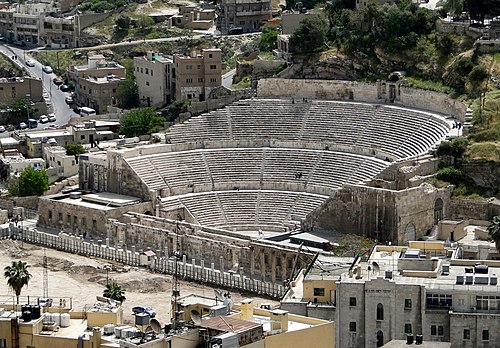
Roman Theatre of Amman is a 6,000-seat, 2nd-century Roman theatre. A famous landmark in the Jordanian capital, it dates back to the Roman period when the city was known as Philadelphia. The theatre and the nearby Odeon are flanking the new Hashemite Plaza from the south and the east respectively, while the Roman Nymphaeum is just a short stroll away in north-westerly direction.
Wikipedia · CC BY-SA 4.0 · 18 May 2026
Bernard Gagnon · CC BY-SA 4.0

The Jordan Museum is located in Ras al-Ein district of Amman, Jordan. Built in 2014, the museum is the largest museum in Jordan and hosts some of the country's most important archaeological findings. Its two main permanent exhibitions are the Dead Sea Scrolls, including the Copper Scroll, and the 9000-year-old ʿAin Ghazal statues, which are among the oldest human statues ever made.
Wikipedia · CC BY-SA 4.0 · 27 Jul 2026
Dan Palraz · CC BY-SA 4.0

Ed-Deir, also spelled el-Deir and ad-Deir/ad-Dayr, is a monumental building carved out of rock in the ancient city of Petra in southern Jordan. The Deir was probably carved in the mid-first century AD.
Wikipedia · CC BY-SA 4.0 · 2 Jul 2026
Azurfrog · CC BY-SA 3.0

The Siq is the main entrance to the ancient Nabatean city of Petra in southern Jordan. Also known as Siqit, it is a dim, narrow gorge and winds its way approximately 1.2 kilometres and ends at Petra's most elaborate ruin, Al-Khazneh. A wide valley outside leading to the Siq is known as the Bab as-Sīq.
Wikipedia · CC BY-SA 4.0 · 22 Dec 2025
David Bjorgen · CC BY-SA 3.0

Al-Khazneh, also known as Khaznat el-Far'oun, is one of the most elaborate rock-cut tombs in Petra, a city of the Nabatean Kingdom inhabited by the Arabs in ancient times. As with most of the other buildings in this ancient town, including the Monastery, this structure was carved out of a sandstone rock face.
Wikipedia · CC BY-SA 4.0 · 1 Jun 2026
Al_Khazneh_Petra.jpg: Graham Racher from London, UK derivative work: MrPanyGoff · CC BY-SA 2.0
Sourced stays
Sourced experiences
Fly to Jordan
The facts you look up on the plane
Not going yet? Pin it.
One tap puts it on your map and in your pins, for when you are ready.