Amman
White stone spread over seven hills, and a Roman theatre in the middle of the traffic. Most people use it as a door to Petra and it deserves a day of its own.
Amman in eight slides
Wikipedia · 3 Sep 2026


Things to do in Amman
Where to stay in Amman
Amman in a day, two days, three
Landmarks in Amman

The Amman Citadel on Citadel Hill is an archaeological site on an L-shaped hill towering over Downtown Amman, in the central part of the capital of Jordan.
Wikipedia · CC BY-SA 4.0 · 10 Aug 2026
David Bjorgen · CC BY 2.5

Abdullah I was the ruler of Jordan from 11 April 1921 until his assassination in 1951. He was the Emir of Transjordan, a British protectorate, until 25 May 1946, after which he was king of an independent Jordan. As a member of the Hashemite dynasty, the royal family of Jordan since 1921, Abdullah was a 38th-generation direct descendant of Muhammad.
Wikipedia · CC BY-SA 4.0 · 12 Aug 2026
Cecil Beaton · Public domain

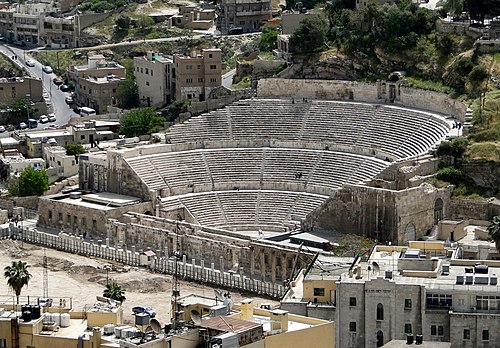
Roman Theatre of Amman is a 6,000-seat, 2nd-century Roman theatre. A famous landmark in the Jordanian capital, it dates back to the Roman period when the city was known as Philadelphia. The theatre and the nearby Odeon are flanking the new Hashemite Plaza from the south and the east respectively, while the Roman Nymphaeum is just a short stroll away in north-westerly direction.
Wikipedia · CC BY-SA 4.0 · 18 May 2026
Bernard Gagnon · CC BY-SA 4.0

The Jordan Museum is located in Ras al-Ein district of Amman, Jordan. Built in 2014, the museum is the largest museum in Jordan and hosts some of the country's most important archaeological findings. Its two main permanent exhibitions are the Dead Sea Scrolls, including the Copper Scroll, and the 9000-year-old ʿAin Ghazal statues, which are among the oldest human statues ever made.
Wikipedia · CC BY-SA 4.0 · 27 Jul 2026
Dan Palraz · CC BY-SA 4.0
The Amman Citadel on Citadel Hill is an archaeological site on an L-shaped hill towering over Downtown Amman, in the central part of the capital of Jordan.
Wikipedia · CC BY-SA 4.0 · 10 Aug 2026
David Bjorgen · CC BY 2.5
Abdullah I was the ruler of Jordan from 11 April 1921 until his assassination in 1951. He was the Emir of Transjordan, a British protectorate, until 25 May 1946, after which he was king of an independent Jordan. As a member of the Hashemite dynasty, the royal family of Jordan since 1921, Abdullah was a 38th-generation direct descendant of Muhammad.
Wikipedia · CC BY-SA 4.0 · 12 Aug 2026
Cecil Beaton · Public domain
Roman Theatre of Amman is a 6,000-seat, 2nd-century Roman theatre. A famous landmark in the Jordanian capital, it dates back to the Roman period when the city was known as Philadelphia. The theatre and the nearby Odeon are flanking the new Hashemite Plaza from the south and the east respectively, while the Roman Nymphaeum is just a short stroll away in north-westerly direction.
Wikipedia · CC BY-SA 4.0 · 18 May 2026
Bernard Gagnon · CC BY-SA 4.0
The Jordan Museum is located in Ras al-Ein district of Amman, Jordan. Built in 2014, the museum is the largest museum in Jordan and hosts some of the country's most important archaeological findings. Its two main permanent exhibitions are the Dead Sea Scrolls, including the Copper Scroll, and the 9000-year-old ʿAin Ghazal statues, which are among the oldest human statues ever made.
Wikipedia · CC BY-SA 4.0 · 27 Jul 2026
Dan Palraz · CC BY-SA 4.0