 Common · +100 XP
Best time to visit: Apr–May · Sep–Oct
Daily spend ~$120
Common · +100 XP
Best time to visit: Apr–May · Sep–Oct
Daily spend ~$120
Italy
Two thousand years stacked on top of each other, and lunch is still the important part of the day.
Italy in ten slides
Wikipedia · 3 Sep 2026


Best time to visit Italy: Apr–May · Sep–Oct
Where people go in Italy
What people go to see in Italy

The Colosseum is an elliptical amphitheatre in the centre of the city of Rome, Italy, just east of the Roman Forum. It is the largest ancient amphitheatre ever built, and is the largest standing amphitheatre in the world. Construction began under the Emperor Vespasian in 72 and was completed in AD 80 under his successor and heir, Titus.
Wikipedia · CC BY-SA 4.0 · 3 Aug 2026
FeaturedPics · CC BY-SA 4.0

The Pantheon is an ancient temple in Rome, Italy, originally built under emperor Augustus and reconstructed under Hadrian (117–138); since AD 609, it is a Catholic church called the Basilica of St. Mary and the Martyrs. It is perhaps the most famous, and architecturally most influential, rotunda.
Wikipedia · CC BY-SA 4.0 · 2 Sep 2026
NikonZ7II · CC BY-SA 4.0

The Roman Forum, also known by its Latin name Forum Romanum, is a rectangular forum (plaza) surrounded by the ruins of several important ancient government buildings at the centre of the city of Rome. Citizens of the ancient city referred to this space, originally a marketplace, as the Forum Magnum, or simply the Forum.
Wikipedia · CC BY-SA 4.0 · 23 Jul 2026
This Photo was taken by Wolfgang Moroder. Feel free to use my photos, but please mention me as the author and send me a · CC BY-SA 3.0


The Trevi Fountain is an 18th-century fountain in the Trevi district in Rome, Italy, designed by Italian architect Nicola Salvi and completed by Giuseppe Pannini in 1762. Standing 26.3 metres (86 ft) high and 49.15 metres (161.3 ft) wide, it is the largest Baroque fountain in the world and one of the most famous fountains in the world.
Wikipedia · CC BY-SA 4.0 · 12 Aug 2026
NikonZ7II · CC BY-SA 4.0


Bari Cathedral, or Cathedral of Saint Sabinus, is the cathedral of Bari, in Apulia, southern Italy. The cathedral is the seat of the Archbishop of Bari-Bitonto, as it was previously of the archbishops, earlier bishops, of Bari. It is dedicated to Saint Sabinus, a bishop of Canosa, whose relics were brought here in the 9th century.
Wikipedia · CC BY-SA 4.0 · 15 Jun 2026
Bernard Gagnon · CC0

The Pontifical Basilica of Saint Nicholas is a church in Bari, southern Italy, that holds wide religious significance throughout Europe and the Christian world.
Wikipedia · CC BY-SA 4.0 · 1 Aug 2026
Holger Uwe Schmitt · CC BY-SA 4.0

The Castello Normanno-Svevo, also known as the u Castídde in the Barese dialect, is a castle in the Apulian city of Bari, Italy.
Wikipedia · CC BY-SA 4.0 · 24 May 2025
Berthold Werner · CC BY-SA 3.0

The Pinacoteca metropolitana di Bari or Pinacoteca C. Giaquinto is a public gallery of paintings and museum of artworks in the city of Bari, Italy. The museum displays a range of artistic works connected to the region of Apulia.
Wikipedia · CC BY-SA 4.0 · 24 May 2026
Sailko · CC BY 3.0

Teatro Margherita is a former theatre in the city of Bari, Apulia on the east coast of Italy. Its predecessor, a wooden structure called Varietà Margherita opened on September 5, 1910. From 1912–1914, a new theatre was erected by architect Francesco De Giglio.
Wikipedia · CC BY-SA 4.0 · 7 Dec 2025
Augusto Aulenta · CC BY-SA 4.0

The Teatro Petruzzelli is the largest theatre of the city of Bari and the fourth Italian theatre by size.
Wikipedia · CC BY-SA 4.0 · 27 Jul 2025
Benjamin Smith · CC BY-SA 4.0

Florence Cathedral, formally the Cathedral of Saint Mary of the Flower, is the cathedral of the Catholic Archdiocese of Florence in Florence, Italy.
Wikipedia · CC BY-SA 4.0 · 31 Aug 2026
Gary Campbell-Hall · CC BY 2.0

The Galleria dell'Accademia di Firenze is an art museum in Florence, in Tuscany in central Italy. It houses the Michelangelo sculpture David and other sculptures by Michelangelo, and a large collection of paintings by Florentine artists, mostly from the period 1300–1600. It is smaller and more specialised than the Uffizi, the main art museum in Florence.
Wikipedia · CC BY-SA 4.0 · 2 Aug 2026
Rhododendrites · CC BY-SA 4.0

The Palazzo Pitti, in English sometimes called the Pitti Palace, is a vast, mainly in the Renaissance style, palace in Florence, Italy. It is situated on the south side of the River Arno, a short distance from the Ponte Vecchio. The core of the present palazzo dates from 1458 and was originally the town residence of Luca Pitti, an ambitious Florentine banker.
Wikipedia · CC BY-SA 4.0 · 24 Aug 2026
Almaak · CC BY-SA 3.0
Piazzale Michelangelo is a square with a panoramic view of Florence, Italy, located in the Oltrarno district.
Wikipedia · CC BY-SA 4.0 · 26 May 2026

The Ponte Vecchio is a medieval stone closed-spandrel segmental arch bridge over the Arno, in Florence, Italy. The only bridge in Florence spared from destruction during World War II, it is noted for the shops built along it; building shops on such bridges was once a common practice. Butchers, tanners, and farmers initially occupied the shops; the present tenants are jewellers, art dealers, and souvenir sellers.
Wikipedia · CC BY-SA 4.0 · 25 Jun 2026
Ingo Mehling · CC BY-SA 4.0

The Uffizi Gallery is a prominent art museum adjacent to the Piazza della Signoria in the Historic Centre of Florence in the region of Tuscany, Italy. One of the most important Italian museums and the most visited, it is also one of the largest and best-known in the world. It holds a collection of priceless works, particularly from the period of the Italian Renaissance.
Wikipedia · CC BY-SA 4.0 · 3 Aug 2026
Arek N. · CC BY-SA 3.0
The Aquarium of Genoa is the largest aquarium in Italy and one of the most significant in Europe. It is located in the Old Harbour area of Genoa, Liguria, and was designed by the architect Renzo Piano as part of the urban redevelopment project created for the Expo 1992, celebrating the 500th anniversary of Christopher Columbus’s voyage to the Americas.
Wikipedia · CC BY-SA 4.0 · 30 Jun 2026

Boccadasse is an old mariners' village of the Italian city of Genoa. It lies within the borders of the neighbourhood of Albaro. In today's administrative subdivision it is located in the Municipio VIII - Medio Levante area which includes the neighbourhoods of Albaro, Foce and San Martino.
Wikipedia · CC BY-SA 4.0 · 24 Mar 2026
Frabckpckr96 · CC BY-SA 4.0

Genoa Cathedral or Metropolitan Cathedral of Saint Lawrence is a Roman Catholic cathedral in the Italian city of Genoa. It is dedicated to Saint Lawrence, and is the seat of the Archbishop of Genoa. The cathedral was consecrated by Pope Gelasius II in 1118 and was built between the twelfth century and the fourteenth century as fundamentally a medieval building, with some later additions.
Wikipedia · CC BY-SA 4.0 · 1 Aug 2026
Julian Lupyan · CC0

The Porto Antico is the historic port area of Genoa, Italy. After a period of disuse, the area was redeveloped in 1992 and transformed into a hub for tourism, culture, and public services.
Wikipedia · CC BY-SA 4.0 · 18 Mar 2026
Ambroise Louis Garneray · Public domain

Genoa: Le Strade Nuove and the system of the Palazzi dei Rolli is a UNESCO World Heritage Site which includes a number of streets and palaces in the center of Genoa, in Northwestern Italy.The Strade Nuove are a group of streets built by the Genoese aristocracy during the expansion of the city at a time when the Republic of Genoa was at the height of its financial and seafaring power.
Wikipedia · CC BY-SA 4.0 · 26 Jul 2026
Alex2015Genova · CC BY-SA 4.0

Via Giuseppe Garibaldi is a street in the historical centre of Genoa, in Northwestern Italy, well known for its ancient palaces. It is one of the Strade Nuove built by the Genoese aristocracy during the Renaissance. Since July 2006 it is inscribed in the list of UNESCO World Heritage Site Genoa: the Strade Nuove and the system of the Palazzi dei Rolli.
Wikipedia · CC BY-SA 4.0 · 19 Jul 2026
Twice25 & Rinina25 · CC BY 2.5

The Capuchin Catacombs of Palermo are burial catacombs in Palermo, Sicily, southern Italy. Today they provide a somewhat macabre tourist attraction as well as an extraordinary historical record.
Wikipedia · CC BY-SA 4.0 · 17 Jul 2026
Sibeaster · Public domain

La or a Vuccirìa is an ancient, large market or bazaar area and neighborhood, with shops and tables selling products, produce, and foodstuffs located in the ancient quarter of Castellammare of central Palermo, region of Sicily, Italy.
Wikipedia · CC BY-SA 4.0 · 21 Sep 2023
Pmk58 · CC BY-SA 4.0

The Palazzo dei Normanni, also called Royal Palace of Palermo, is a palace in Palermo, Sicily, Italy. It was the seat of the Kings of Sicily with the Hauteville dynasty and served afterwards as the main seat of power for the subsequent rulers of Sicily. Since 1946 it has been the seat of the Sicilian Regional Assembly.
Wikipedia · CC BY-SA 4.0 · 24 Jul 2026
Lasterketak · CC BY-SA 4.0

Palermo Cathedral is the cathedral church of the Roman Catholic Archdiocese of Palermo, located in Palermo, Sicily, southern Italy. It is dedicated to the Assumption of the Virgin Mary. As an architectural complex, it is characterized by the presence of different styles, due to a long history of additions, alterations and restorations, the last of which occurred in the 18th century.
Wikipedia · CC BY-SA 4.0 · 1 Aug 2026
Julian Lupyan · CC0
Quattro Canti, officially known as Piazza Vigliena, is a Baroque square in Palermo, region of Sicily, Italy; it is considered the center of the historic quarters of the city.
Wikipedia · CC BY-SA 4.0 · 10 Feb 2026

The Teatro Massimo Vittorio Emanuele is an opera house and opera company located on the Piazza Verdi in Palermo, Sicily. It was dedicated to King Victor Emanuel II. It is the biggest in Italy, and one of the largest of Europe, renowned for its perfect acoustics.
Wikipedia · CC BY-SA 4.0 · 1 Sep 2026
Holger Uwe Schmitt · CC BY-SA 4.0

The Basilica of Superga is a hilltop Catholic basilica in Superga, in the vicinity of Turin, Italy.
Wikipedia · CC BY-SA 4.0 · 23 Jul 2026
Paris Orlando · CC BY-SA 4.0

The Mole Antonelliana is a major landmark building in Turin, Italy, named after its architect, Alessandro Antonelli. A mole in Italian is a building of monumental proportions.
Wikipedia · CC BY-SA 4.0 · 18 Aug 2026
Mongolo1984 · CC BY-SA 4.0

The Museo Egizio or Egyptian Museum is an archaeological museum in Turin, Italy, specializing in Egyptian archaeology and anthropology. It houses one of the largest collections of Egyptian antiquities, with more than 40,000 artifacts, which is considered the second most important Egyptological collection in the world after the one at the Egyptian Museum of Cairo.
Wikipedia · CC BY-SA 4.0 · 8 Aug 2026
Ico Migliore and Mara Servetto (Migliore+Servetto Architects), vector reproduction by Bruce The Deus · Public domain

The Royal Palace of Turin is a historic palace of the House of Savoy in the city of Turin in Northern Italy. It was originally built in the 16th century and was later modernized by Christine Marie of France (1606–1663) in the 17th century, with designs by the Baroque architect Filippo Juvarra.
Wikipedia · CC BY-SA 4.0 · 26 Jul 2026
Benjamin Smith · CC BY-SA 4.0

Parco del Valentino is a popular public park in Turin, Italy. It is located along the west bank of the Po river. It covers an area of 500,000m², which makes it Turin's second largest park .
Wikipedia · CC BY-SA 4.0 · 3 Nov 2025
Fulvio Spada from Torino, Italy · CC BY-SA 2.0

Piazza Castello is a prominent city square in Turin, Italy. It houses several city landmarks, museums, theaters and cafes.
Wikipedia · CC BY-SA 4.0 · 9 Aug 2026
chensiyuan · CC BY-SA 4.0

The Ancient Royal and Eminent Basilica Collegiate of Our Lady of the Alms, better known as Basilica della Colleggiata, is a church in Catania, Sicily, southern Italy. Finished in 1794, it is an example of Sicilian Baroque.
Wikipedia · CC BY-SA 4.0 · 23 Jul 2026
Carlo Pelagalli · CC BY-SA 3.0

The Metropolitan Cathedral of Saint Agatha, usually known as the Catania Cathedral, is a Roman Catholic cathedral in Catania, Sicily, southern Italy. It was the seat of the Bishops of Catania until 1859, when the diocese was elevated to an archdiocese, and since then has been the seat of the Archbishops of Catania.
Wikipedia · CC BY-SA 4.0 · 14 Aug 2026
User:Matthias Süßen · CC BY-SA 4.0

Mount Etna, or simply Etna, is an active stratovolcano on the east coast of Sicily, Italy, in the Metropolitan City of Catania, between the cities of Messina and Catania. It is located above the convergent plate margin between the African Plate and the Eurasian Plate.
Wikipedia · CC BY-SA 4.0 · 20 Aug 2026
BenAveling · CC BY-SA 4.0
Piazza del Duomo is the main city square in Catania, Italy, flanked by both the centers of civic and religious power.
Wikipedia · CC BY-SA 4.0 · 19 Apr 2026

Castello Ursino, also known as Castello Svevo di Catania, is a castle in Catania, Sicily, southern Italy. It was built in the 13th century as a royal castle of the Kingdom of Sicily, and is mostly known for its role in the Sicilian Vespers, when it became the seat of the Sicilian Parliament. The castle is in good condition today, and it is open to the public as a museum.
Wikipedia · CC BY-SA 4.0 · 19 Jul 2026
Luca Aless · CC BY-SA 4.0

The Galleria Vittorio Emanuele II is Italy's oldest active shopping arcade and a major landmark of Milan. Housed within a four-story double arcade in the centre of town, the Galleria is named after Victor Emmanuel II, the first king of the Kingdom of Italy. It was designed in 1861 and built by architect Giuseppe Mengoni between 1865 and 1877.
Wikipedia · CC BY-SA 4.0 · 26 Jul 2026
Marco Pagani · CC BY 3.0

La Scala is a historic opera house in Milan, Italy. The theatre was inaugurated on 3 August 1778 and was originally known as il Nuovo Regio Ducale Teatro alla Scala. The premiere performance was Antonio Salieri's Europa riconosciuta.
Wikipedia · CC BY-SA 4.0 · 30 Aug 2026
John Picken · CC BY 2.0

Milan Cathedral, or Metropolitan Cathedral-Basilica of the Nativity of Saint Mary, is the cathedral church of Milan, Lombardy, Italy. Dedicated to the Nativity of St. Mary, it is the seat of the Archbishop of Milan, currently Archbishop Mario Delpini.
Wikipedia · CC BY-SA 4.0 · 31 Jul 2026
Jiuguang Wang · CC BY-SA 3.0

Santa Maria delle Grazie is a church and Dominican convent in Milan, northern Italy, and a UNESCO World Heritage Site. The convent contains the mural of The Last Supper by Leonardo da Vinci, which is in the refectory.
Wikipedia · CC BY-SA 4.0 · 1 Aug 2026
Marcin Białek · CC BY-SA 3.0

The Sforza Castle is a medieval fortification located in Milan, northern Italy. It was built in the 15th century by Francesco Sforza, Duke of Milan, on the remnants of a 14th-century fortification. Later renovated and enlarged, in the 16th and 17th centuries it was one of the largest citadels in Europe.
Wikipedia · CC BY-SA 4.0 · 28 Aug 2026
Jakub Hałun · CC BY-SA 4.0

Castel dell'Ovo is a seafront castle in Naples, located on the former island of Megaride, now a peninsula, on the Gulf of Naples in Italy. The castle's name comes from a legend about the Roman poet Virgil, who had a reputation in the Middle Ages as a great sorcerer and predictor of the future. In the legend, Virgil put a magical egg into the foundations to support the fortifications.
Wikipedia · CC BY-SA 4.0 · 17 May 2026
Paestum · CC BY-SA 4.0

Castel Nuovo, often called Maschio Angioino, is a medieval castle located in front of Piazza Municipio and the city hall in central Naples, Campania, Italy. Its scenic location and imposing size makes the castle, first erected in 1279, one of the main architectural landmarks of the city. It was a royal seat for kings of Naples, Aragon and Spain until 1815.
Wikipedia · CC BY-SA 4.0 · 3 Aug 2026
Little john at Italian Wikipedia · Public domain

Galleria Umberto I is a public shopping gallery in Naples, southern Italy. It is located directly across from the San Carlo opera house. It was built between 1887 and 1890, and was the cornerstone in the decades-long rebuilding of Naples—called the risanamento —that lasted until World War I.
Wikipedia · CC BY-SA 4.0 · 25 Aug 2026
Berthold Werner · CC BY-SA 3.0

Naples Cathedral, or the Cathedral of the Assumption of Mary, is a Roman Catholic cathedral, the main church of Naples, southern Italy, and the seat of the Archbishop of Naples. It is widely known as the Cathedral of Saint Januarius, in honour of the city's patron saint.
Wikipedia · CC BY-SA 4.0 · 1 Aug 2026
Marco Ober · CC BY-SA 4.0
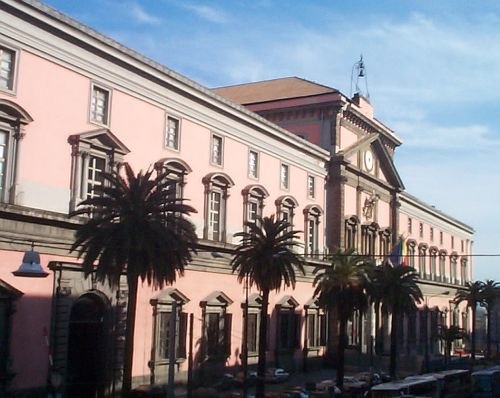
The National Archaeological Museum of Naples is an important Italian archaeological museum. Its collection includes works from Greek, Roman and Renaissance times, and especially Roman artifacts from the nearby Pompeii, Stabiae and Herculaneum sites. From 1816 to 1861, it was known as the Royal Bourbon Museum.
Wikipedia · CC BY-SA 4.0 · 26 May 2026
Jeffmatt at English Wikipedia · Public domain

Minerva's Garden is located in the heart of the old town of Salerno, in a zone known as the "Plaium montis" in the Middle Ages. It is halfway along an ideal route that runs along the axis of the walled and terraced vegetable gardens, climbing from the Municipal Park, near the river Fusandola, towards the Arechi Castle.
Wikipedia · CC BY-SA 4.0 · 16 Jun 2026
Jack56 · CC BY 3.0
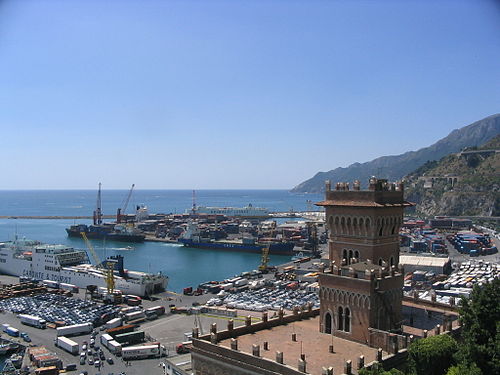
The Port of Salerno is a port serving Salerno, southwestern Italy. The port of Salerno, located in the gulf of the Tyrrhenian Sea, is registered in the class of II category of seaports. It is one of the major domestic ports and plays an important role in the industrial and commercial system of the center-south.
Wikipedia · CC BY-SA 4.0 · 3 Apr 2025
No machine-readable author provided. Giaros assumed (based on copyright claims). · CC BY-SA 3.0

Salerno Cathedral is the main church in the city of Salerno in southern Italy and a major tourist attraction. It is dedicated to Saint Matthew, whose relics are inside the crypt.
Wikipedia · CC BY-SA 4.0 · 12 Jul 2026
Berthold Werner · CC BY-SA 3.0

The State Archives of Salerno is a public archival institution located in Salerno, Italy. It preserves historical records produced by governmental and administrative institutions that operated in the province of Salerno and forms part of the national archival network administered by the Italian Ministry of Culture.
Wikipedia · CC BY-SA 4.0 · 10 Jun 2026
Roquejaw · CC BY-SA 3.0
Sourced stays
Sourced experiences
Fly to Italy
The facts you look up on the plane
Guides about Italy

Italy's digital nomad visa in 2026: the €28,000 income test that is Europe's lowest, the savings consulates expect, and the five-year renewal path.
Tobi Adeyemi · 4 Sep 2026
Italy with kids by age band, with the tourist tax exemption ages that differ in every city, the sights that survive a six-year-old and the ones that do not.
Priya Nair · 3 Sep 2026
Late April to mid-June, and the last week of August into October. What Ferragosto actually shuts, and the Venice fee that only applies on some days.
Tomás Reis · 2 Sep 2026Not going yet? Pin it.
One tap puts it on your map and in your pins, for when you are ready.