 Rare · +250 XP
Best time to visit: Apr–May · Sep–Oct
Daily spend ~$60
Rare · +250 XP
Best time to visit: Apr–May · Sep–Oct
Daily spend ~$60
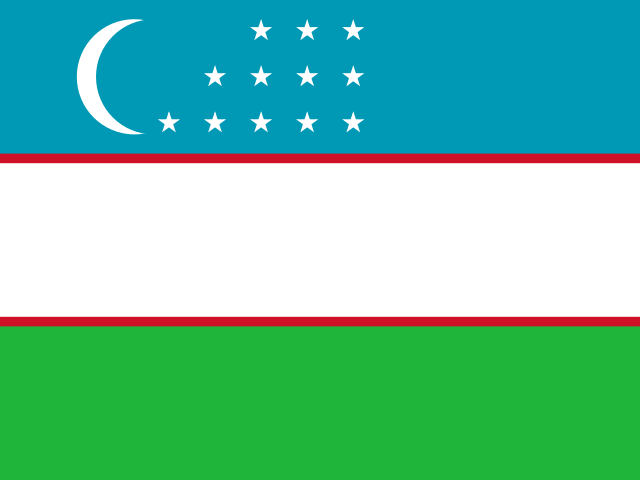
Uzbekistan
The Silk Road cities with their tilework intact — Samarkand, Bukhara, Khiva — and a train between them that does 250 km/h. Astonishing value.
Uzbekistan in ten slides
Wikipedia · 4 Sep 2026


Best time to visit Uzbekistan: Apr–May · Sep–Oct
Where people go in Uzbekistan
- Bukhara2 days is about right
- Samarkand2 days is about right
- Tashkent2 days is about right
- Namangan2 days is about right
- Qarshi1 days is about right
- Shahrisabz1 days is about right
- Andijan
- Fargona
- Qoqon
- Kattaqorgon
What people go to see in Uzbekistan

The Ark of Bukhara is a massive fortress located in the city of Bukhara, Uzbekistan, that was initially built and occupied around the 5th century AD. The Ark's current structure began to develop during the 16th century under the Shaybanid Uzbek dynasty, while all of its existing buildings were constructed in the last three centuries.
Wikipedia · CC BY-SA 4.0 · 8 Jun 2026
ほっきー · CC0

Bolo Haouz Mosque is a historical mosque in Bukhara, Uzbekistan. Built in 1712, on the opposite side of the citadel of Ark in Registan district, it is inscribed in the UNESCO World Heritage Site list along with other parts of the historic city. It served as a Friday mosque during the time when the emir of Bukhara was being subjugated under the Bolshevik Russian rule in the 1920s.
Wikipedia · CC BY-SA 4.0 · 30 Jul 2026
Jean-Pierre Dalbéra from Paris, France · CC BY 2.0

Chashma-Ayub Mausoleum is located near the Samani Mausoleum, in Bukhara, Uzbekistan. Its name means Job's well, due to the legend in which Job (Ayub) visited this place and made a well by striking the ground with his staff. The water of this well is still pure and is considered healing.
Wikipedia · CC BY-SA 4.0 · 25 Jul 2025
Hylgeriak / Wikipedia · CC BY-SA 3.0

The Kalyan Minaret is a minaret of the Po-i-Kalyan mosque complex in Bukhara, Uzbekistan and one of the most prominent landmarks in the city.
Wikipedia · CC BY-SA 4.0 · 18 Jul 2026
Petar Milošević · CC BY-SA 4.0

Lab-i Hauz is the name of the area surrounding one of the few remaining hauz pools that have survived in the city of Bukhara, Uzbekistan. Until the Soviet period, there were many such pools, which were the city's principal source of water, but they were notorious for spreading disease and were mostly filled in during the 1920s and 1930s.
Wikipedia · CC BY-SA 4.0 · 5 May 2026
Mario J. Schwaiger · CC BY-SA 4.0

Po-i-Kalan, or Poi Kalan, is an Islamic religious complex located in Bukhara, Uzbekistan. The complex consists of three parts, the Kalan Mosque, the Kalan Minaret to which the name refers, and the Mir-i-Arab Madrasah.
Wikipedia · CC BY-SA 4.0 · 31 Jul 2026
Официальный веб-сайт Агентства культурного наследия Республики Узбекистан · CC BY 4.0

The Samanid Mausoleum is a mausoleum located in the northwestern part of Bukhara, Uzbekistan, just outside its historic center. It was built in the 10th century CE as the resting place of the powerful and influential Islamic Samanid dynasty that ruled the Samanid Empire from approximately 900 to 1000. It contained three burials, one of whom is known to have been that of Nasr II.
Wikipedia · CC BY-SA 4.0 · 14 May 2026
Apfel51 · Public domain

Sitorai Mokhi-Khosa also known as the "Palace Like the Stars and the Moon," is a country residence of the Emir of Bukhara, built in the late 19th to early 20th century. Currently, it houses a museum of decorative and applied arts.
Wikipedia · CC BY-SA 4.0 · 22 Jul 2026
Bernard Gagnon · CC0

The Amir Timur Square is the main town square in Tashkent, Uzbekistan.
Wikipedia · CC BY-SA 4.0 · 12 Apr 2026
Doris Ingeborg Lohse · CC BY-SA 4.0

Chorsu Bazaar, also called Charsu Bazaar, is the traditional bazaar located in the center of the old town of Tashkent, the capital city of Uzbekistan. Under its blue-colored domed building and the adjacent areas, all daily necessities are sold.
Wikipedia · CC BY-SA 4.0 · 25 Aug 2026
Theklan · CC BY-SA 4.0


The Hazrati Imam complex is an architectural monument dating from the 16th to 20th centuries, located in the Olmazor district of Tashkent city, Uzbekistan. The complex consists of the Moʻyi Muborak madrasa, the Qaffol Shoshi mausoleum, the Baroqxon Madrasa, the Hazrati Imam mosque, the Tillashayx mosque, and the Imam al-Bukhari Islamic Institute.
Wikipedia · CC BY-SA 4.0 · 21 Jun 2026
Ymblanter · CC BY-SA 4.0


Tashkent, also known as Toshkent, is the capital and largest city of Uzbekistan. It is the most populous city in Central Asia, with a population of more than 3.1 million people as of July 1, 2025. It is located in northeastern Uzbekistan.
Wikipedia · CC BY-SA 4.0 · 19 Aug 2026
Muso1996 · CC-BY-SA-4.0

The State Museum of History of Uzbekistan, previously known as the National Museum of Turkestan, was founded in 1876. It is located in Tashkent.
Wikipedia · CC BY-SA 4.0 · 26 Jul 2026
David Stanley from Nanaimo, Canada · CC BY 2.0

Abdulazizkhoja Madrasa is a memorial monument according to the Decree of the President of the Republic of Uzbekistan "On Measures to Radically Improve the Activities in the Field of Preservation of Material Cultural Heritage Objects" dated December 19, 2018, PQ-4068, it was included in the National Register of Immovable Property Objects of the Material and Cultural Heritage of Uzbekistan - taken under state…
Wikipedia · CC BY-SA 4.0 · 22 Apr 2026
Mrjavokh1r · CC BY-SA 4.0

The Bekmir Madrasa is a historical and cultural monument located in the Darvozatutak neighborhood of Qarshi city, Qashqadaryo region, Uzbekistan.
Wikipedia · CC BY-SA 4.0 · 22 Apr 2026
Mrjavokh1r · CC BY-SA 4.0

Chakar Mosque is an architectural monument located in Chakar MFY, Karshi city, Kashkadarya region. In accordance with the decision of the President of the Republic of Uzbekistan "On measures to fundamentally improve activities in the field of protection of tangible cultural heritage objects" dated December 19, 2018.
Wikipedia · CC BY-SA 4.0 · 16 Jul 2026
Mrjavokh1r · CC BY-SA 4.0

Kuk Gumbaz Mosque is an architectural monument located in Shahrisabz, Qashqadaryo Region, Uzbekistan. The mosque was built between 1434 and 1435 by Ulug Beg Mirzo for his father Shah Rukh Mirzo. Historical inscriptions with the names of the Timurids and the time of construction have been preserved in the porch of the mosque.
Wikipedia · CC BY-SA 4.0 · 20 Mar 2026
Mrjavokh1r · CC BY-SA 4.0

Odina Mosque is the oldest preserved architectural monument located in the city of Qarshi, Qashqadaryo region. The mosque is situated in the center of the Qarshi fortress. Timur, during his expedition from Samarkand to Qarshi in 1385-1386, ordered the construction of this mosque.
Wikipedia · CC BY-SA 4.0 · 22 Jul 2026
Mrjavokh1r · CC BY-SA 4.0


The Qilichboy Madrasa is an architectural monument located in Qarshi city, Uzbekistan. This madrasa is considered one of the well-preserved historical buildings in the city. It is under state protection.
Wikipedia · CC BY-SA 4.0 · 22 Apr 2026
Mrjavokh1r · CC BY-SA 4.0

Afrasiyab is an ancient site in northern Samarkand, present-day Uzbekistan, that was occupied from c. 500 BC to 1220 AD prior to the Mongol invasion in the 13th century. The oldest layers date from the middle of the first millennium BC. Today, it is a hilly grass mound located near the Bibi Khanaum Mosque.
Wikipedia · CC BY-SA 4.0 · 18 Jul 2026
Unknown author · Public domain

The Bibi-Khanym Mosque is one of the most important monuments of Samarkand, Uzbekistan. In the 15th century, it was one of the largest and most magnificent mosques in the Islamic world. It is considered a masterpiece of the Timurid Renaissance.
Wikipedia · CC BY-SA 4.0 · 30 Jul 2026
Шухрат Саъдиев · CC BY-SA 4.0


Registan, officially the Registan Square is a historic public square in the city of Samarkand, Uzbekistan. It served as the heart of the Timurid Empire and later as the city's commercial, educational, and ceremonial center.
Wikipedia · CC BY-SA 4.0 · 1 Sep 2026
Registan_-_Gusjer.jpg: Gustavo Jeronimo from Aranjuez, Spain derivative work: MrPanyGoff · CC BY 2.0

Shah-i-Zinda is a necropolis in the north-eastern part of Samarkand, Uzbekistan.
Wikipedia · CC BY-SA 4.0 · 30 Jul 2026
Petar Milošević · CC BY-SA 4.0

Siyob Bazaar, also called Siab Bazaar, is the largest bazaar in Samarkand, Uzbekistan. The building is built in the shape of a dome, under which there are several pavilions with a large number of shopping arcades. The main entrance has a triple arch lined with blue majolica.
Wikipedia · CC BY-SA 4.0 · 7 Dec 2025
Shuhrataxmedov · CC BY-SA 3.0

The Ulugh Beg Observatory is an observatory in modern day Samarkand, Uzbekistan, which was built in the 1420s by the Timurid astronomer Ulugh Beg. This school of astronomy was constructed under the Timurid Empire, and was the last of its kind from the Islamic Medieval period. Islamic astronomers who worked at the observatory include Jamshid al-Kashi, Ali Qushji, and Ulugh Beg himself.
Wikipedia · CC BY-SA 4.0 · 26 Aug 2026
Victoria · CC BY-SA 4.0

Namangan is a district-level city in eastern Uzbekistan. It is the administrative, economic, and cultural center of Namangan Region. Namangan is located in the northern edge of the Fergana Valley, less than 30 km from the border with Kyrgyzstan.
Wikipedia · CC BY-SA 4.0 · 4 Sep 2026
Jamshid Nurkulov · CC BY-SA 4.0
Devona Buva Mausoleum is an architectural monument located in the village of Fayziobod, Uychi District, Namangan Region, Uzbekistan. The mausoleum was built in the 18th century.
Wikipedia · CC BY-SA 4.0 · 22 Jul 2026
The Mavlonbuva Mausoleum is an architectural monument located in the Namangan Region of Uzbekistan. The mausoleum was built in 1806 and is a unique place of worship for poets, who left many verses on its walls.
Wikipedia · CC BY-SA 4.0 · 17 Jul 2026

The Mulla Bozor Okhund Pilgrimage Complex is a shrine located on the banks of the Namangansoy, in the Kurashkhona area, the Labbaytogha district, Namangan in Uzbekistan.
Wikipedia · CC BY-SA 4.0 · 3 Aug 2026
Komilkhuja · CC BY-SA 4.0
The Sirli Mosque is an architectural monument located on Kokand Street in Namangan city, Namangan Region, Uzbekistan. It was built in the 19th century or in the early 20th century in the village of Tepakurgan.
Wikipedia · CC BY-SA 4.0 · 10 Apr 2026

Ak-Saray Palace is a ruined palace and historic site in Shahrisabz, Uzbekistan. The palace was built at the beginning of the Timurid period, between 1380 and 1404, under the reign of Timur. In 2000, the palace was declared a UNESCO World Heritage Site.
Wikipedia · CC BY-SA 4.0 · 2 Sep 2026
upyernoz from Haverford, USA · CC BY 2.0

Dor-i-Tilavat - in the center of Shahrisabz, in the west of the Darussiodat complex, there is a complex consisting of ancient structures belonging to the Timurid dynasty - the tomb of Shamsuddin Kulol, Gumbazi Sayyidon, and the Blue Dome Mosque, built on the site of the old madrasa here.
Wikipedia · CC BY-SA 4.0 · 24 Oct 2025
Faqscl · CC BY-SA 3.0

Gumbazi Sayidon is an architectural monument located in Shahrisabz. This mausoleum is also popularly known as Sayidlar Gumbaz, Ulugbek's mausoleum, Gumbazi Seyidon.
Wikipedia · CC BY-SA 4.0 · 16 Jul 2026
Jean Housen · CC BY-SA 4.0
Kuk Gumbaz Mosque is an architectural monument located in Shahrisabz, Qashqadaryo Region, Uzbekistan. The mosque was built between 1434 and 1435 by Ulug Beg Mirzo for his father Shah Rukh Mirzo. Historical inscriptions with the names of the Timurids and the time of construction have been preserved in the porch of the mosque.
Wikipedia · CC BY-SA 4.0 · 20 Mar 2026
Mrjavokh1r · CC BY-SA 4.0

Shamsuddin Kulol Mausoleum is a 15th-century architectural monument in the city of Shahrisabz, Qashqadaryo Region, Uzbekistan. It was built on the grave of Amir Temur's father Amir Taragoi and Shamsuddin Kulol, Temur's teacher.
Wikipedia · CC BY-SA 4.0 · 21 Mar 2026
Mrjavokh1r · CC BY-SA 4.0
Sourced stays
Sourced experiences
Fly to Uzbekistan
The facts you look up on the plane
Not going yet? Pin it.
One tap puts it on your map and in your pins, for when you are ready.