 Common · +100 XP
Best time to visit: Apr–May · Sep–Oct
Daily spend ~$95
Common · +100 XP
Best time to visit: Apr–May · Sep–Oct
Daily spend ~$95
Spain
Dinner at ten, cities built for walking, and a different language every few hundred kilometres.
Spain in ten slides
Wikipedia · 3 Sep 2026


Best time to visit Spain: Apr–May · Sep–Oct
Where people go in Spain
What people go to see in Spain

Las Siete Calles or Casco Viejo in Spanish or Zazpikaleak or Alde Zaharra in Basque are different names for the medieval neighbourhood of Bilbao, part of the Ibaiondo district. The walled section of the town existed until the end of the 19th century and was known by the names Seven Streets or Old Town, respectively.
Wikipedia · CC BY-SA 4.0 · 2 Jul 2026
dalbera from Paris, France · CC BY 2.0

The Guggenheim Museum Bilbao is a museum of modern and contemporary art in Bilbao, Biscay, Spain. It is one of several museums affiliated to the Solomon R. Guggenheim Foundation and features permanent and visiting exhibits of works by Spanish and international artists.
Wikipedia · CC BY-SA 4.0 · 10 Jul 2026
Naotake Murayama · CC BY 2.0

The Mercado de la Ribera is a market square in Bilbao, the capital of the Basque Province of Viscay in the north of Spain. It is on the right bank of the Nervion River, next to Casco Viejo. Its built area of 10,000 square metres (110,000 sq ft) makes it the biggest covered market in Europe.
Wikipedia · CC BY-SA 4.0 · 22 Mar 2026
PA · CC BY-SA 4.0

Mount Artxanda is one of the two small mountain ranges that delimit the municipality of Bilbao, the other one being Pagasarri. Of the two, it is the lower one, the closer one to the center of the city, and the one that has suffered from more intense urbanization. The pass of Santo Domingo separates the main part of Artxanda from Monte Avril, 400m high.
Wikipedia · CC BY-SA 4.0 · 15 Aug 2026
Unknown · CC BY-SA 3.0

The Bilbao Fine Arts Museum is an art museum located in the city of Bilbao, Spain. The building of the museum is located entirely inside the city's Doña Casilda Iturrizar Park.
Wikipedia · CC BY-SA 4.0 · 30 Aug 2026
MuseoBBAABilbao · CC BY-SA 3.0

The Zubizuri, also called the Campo Volantin Bridge or Puente del Campo Volantin, is a tied arch footbridge across the Nervion River in Bilbao, Spain. Designed by architect Santiago Calatrava, the bridge links the Campo Volantin right bank and Uribitarte left bank of the river.
Wikipedia · CC BY-SA 4.0 · 25 Aug 2026
The original uploader was Leland at English Wikipedia. · CC BY-SA 3.0


The Alhambra is a palace and fortress complex located in Granada, Spain. It is one of the most famous monuments of Islamic architecture and the only well-preserved palace from the medieval Islamic world. Additionally, the palace contains notable examples of Spanish Renaissance architecture.
Wikipedia · CC BY-SA 4.0 · 31 Aug 2026
Jebulon · CC0

The Generalife was a summer palace and country estate of the Nasrid rulers of the Emirate of Granada in Al-Andalus. It is located directly east of and uphill from the Alhambra palace complex in Granada, Spain.
Wikipedia · CC BY-SA 4.0 · 21 Jun 2026
Daderot · CC BY-SA 4.0

The Metropolitan Cathedral-Basilica of the Incarnation is a Roman Catholic cathedral in the city of Granada, Spain. The cathedral is the seat of the Archdiocese of Granada. Like many other cathedrals in Andalusia, it was built on top of the city's main mosque after the reconquest of Granada.
Wikipedia · CC BY-SA 4.0 · 6 Jul 2026
Ingo Mehling · CC BY-SA 4.0
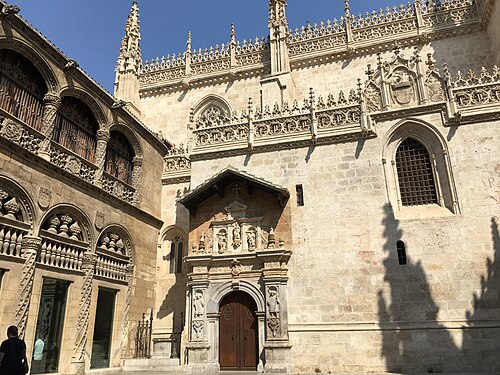
The Royal Chapel of Granada is an Isabelline style building in Granada, Spain. Constructed between 1505 and 1517, it was originally integrated in the complex of the neighbouring Granada Cathedral. It is the burial place of the Spanish monarchs, Queen Isabella I and King Ferdinand, the Catholic Monarchs.
Wikipedia · CC BY-SA 4.0 · 29 Nov 2025
Heparina1985 · CC BY-SA 4.0

Sacromonte, sometimes also called Sacramonte, is a traditional neighbourhood in the eastern area of the city of Granada in Andalusia, Spain. It is one of the six neighbourhoods that make up the urban district of Albayzín and borders the neighbourhoods of Albayzín, San Pedro, Realejo-San Matías, El Fargue and Haza Grande.
Wikipedia · CC BY-SA 4.0 · 27 Aug 2026
Jebulon · CC0

The Retiro Park, also known as Buen Retiro Park or simply El Retiro, is one of the largest city parks in Madrid, Spain. The park belonged to the Spanish monarchy until 1868, when it became a public park following the Glorious Revolution. The park is located at the edge of the city centre, near both the Alcalá Gate and the Museo del Prado, and covers 1.4 km2.
Wikipedia · CC BY-SA 4.0 · 6 Mar 2026
Max Alexander / PromoMadrid · CC BY-SA 2.0

The Museo del Prado, officially known as Museo Nacional del Prado, is the main Spanish national art museum, located in central Madrid. It houses collections of European art, dating from the 12th century to the early 20th century, based on the former Spanish royal collection, and the single best collection of Spanish art.
Wikipedia · CC BY-SA 4.0 · 10 Jul 2026
Emilio J. Rodríguez Posada · CC BY-SA 2.0

The Museo Nacional Centro de Arte Reina Sofía is Spain's national museum of 20th-century art. The museum was officially inaugurated on September 10, 1992, and is named for Queen Sofía. It is located in Madrid, near the Atocha train and metro stations, at the southern end of what is known as the Golden Triangle of Art.
Wikipedia · CC BY-SA 4.0 · 17 Aug 2026
Unknown author · Public domain

The Plaza Mayor is the principal public square in the heart of Madrid, the capital of Spain. It was once the centre of Old Madrid. It was first built (1580–1619) during the reign of Philip III.
Wikipedia · CC BY-SA 4.0 · 22 Jul 2026
Jorge Franganillo · CC BY 2.0

The Puerta del Sol is a public square in Madrid, one of the best known and busiest places in the city. This is the centre of the radial network of Spanish roads. The square also contains the famous clock whose bells mark the traditional eating of the Twelve Grapes and the beginning of a new year.
Wikipedia · CC BY-SA 4.0 · 1 Jan 2026
Tomás Fano · CC BY-SA 2.0

The Royal Palace of Madrid is the official residence of the Spanish royal family and is used primarily for state ceremonies. With over 135,000 m2 (1,450,000 sq ft) of floor space and 3,418 rooms, the Royal Palace of Madrid is the largest palace in Western Europe, the largest royal palace in Europe, and among the largest palaces in the world.
Wikipedia · CC BY-SA 4.0 · 6 Jul 2026
Tim Adams · CC BY-SA 4.0

The Cathedral Church of Saint Mary in Murcia, commonly called the Cathedral of Murcia, is a Catholic church in the city of Murcia, Spain. It is the cathedral of the Roman Catholic Diocese of Cartagena.
Wikipedia · CC BY-SA 4.0 · 30 Jul 2026
Fernando · CC BY-SA 4.0

The Plaza de Toros de Murcia is a bullring in Murcia, Spain. As of June 2015, it is used for bullfighting. The stadium holds 15,000 people.
Wikipedia · CC BY-SA 4.0 · 8 Oct 2024
Antoniojose candel · CC BY-SA 4.0

The Puente de los Peligros or also known as the Puente Viejo is an arched stone bridge, completed in 1742, that spans the River Segura in the city of Murcia.
Wikipedia · CC BY-SA 4.0 · 4 Sep 2025
Murcianboy · CC BY-SA 3.0

The Qasaba of Murcia was the military headquarters of the Emirate of Murcia. After the conquest by Castille it became a church and later part of a Templar hospital, and is now the San Juan de Dios museum.
Wikipedia · CC BY-SA 4.0 · 3 Mar 2025
Gregorico · CC BY-SA 3.0

The Royal Monastery of Saint Clare is a monastery of the Poor Clares located in Murcia, Spain. Originating in the 14th century and occupying the site of a 13th century Muslim palace, it is one of the most historically significant buildings in the city. It contains remains of the Arab palace, which are among the most important examples of Islamic art in Murcia.
Wikipedia · CC BY-SA 4.0 · 4 Sep 2025
Morini33 · CC BY-SA 3.0 es

The Museum of the Church of San Juan de Dios in Murcia, Region of Murcia, Spain, is one of the locations of the Museum of Fine Arts of Murcia (MUBAM). It houses an important collection of religious imagery from the 15th to the 20th century. The 18th century former church is in a traditional square near the Cathedral in the historic center of Murcia.
Wikipedia · CC BY-SA 4.0 · 22 Mar 2026
Gregorico · CC BY-SA 3.0

The Giralda is the bell tower of Seville Cathedral in Seville, Spain. It was built as the minaret for the Great Mosque of Seville in al-Andalus, during the reign of the Almohad dynasty, with a Renaissance-style belfry added by the Catholics after the expulsion of the Muslims from the area.
Wikipedia · CC BY-SA 4.0 · 30 Aug 2026
Ingo Mehling · CC BY-SA 4.0

The Setas de Sevilla or Las Setas, initially titled Metropol Parasol, is a large, predominantly wood structure located at La Encarnación square in the old quarter of Seville, Spain. It accommodates a traditional market, restaurants, a performance square, archaeological museum, a venue for MICE events Metropol Eventos — and 'rooftop' terrace with a panoramic view of Seville's old city.
Wikipedia · CC BY-SA 4.0 · 24 Aug 2026
Anual · CC BY-SA 3.0

The Plaza de España is a plaza in Maria Luisa Park in Seville, Spain. It was built in 1928 for the Ibero-American Exposition of 1929. It is a landmark example of Regionalism Architecture, mixing elements of the Baroque Revival, Renaissance Revival and Moorish Revival (Neo-Mudéjar) styles of Spanish architecture.
Wikipedia · CC BY-SA 4.0 · 6 Jul 2026
Carlos Delgado · CC BY-SA 4.0

The Alcázar of Seville, officially called Royal Alcázar of Seville, is a historic royal palace in Seville, Spain and one of the official residences of the Spanish royal family. It was formerly the site of the Islamic-era citadel of the city, begun in the 10th century under the Umayyads and then developed into a larger palace complex by the Abbadid dynasty and the Almohads.
Wikipedia · CC BY-SA 4.0 · 21 Jul 2026
Ajay Suresh from New York, NY, USA. Edited by MenkinAlRire · CC BY 2.0

The Cathedral of Saint Mary of the See, better known as Seville Cathedral, is a Catholic cathedral in Seville, Andalusia, Spain. It was registered in 1987 by UNESCO as a World Heritage Site, along with the adjoining Alcázar palace complex and the General Archive of the Indies. It is one of the largest churches in the world and the largest Gothic cathedral.
Wikipedia · CC BY-SA 4.0 · 1 Sep 2026
Ingo Mehling · CC BY-SA 4.0

Triana is a neighbourhood and administrative district on the west bank of the Guadalquivir River in the city of Seville, Spain. Like other neighbourhoods that were historically separated from the main city, it was known as an arrabal. Triana is located on a peninsula between two branches of the Guadalquivir, narrowly linked to the mainland in the north.
Wikipedia · CC BY-SA 4.0 · 19 May 2026
Ajay Suresh from New York, NY, USA · CC BY 2.0

The Fortress of O Castro is a fortification located in Vigo, Spain built in 1665 by the Spanish Empire in the province of Pontevedra during the Portuguese Restoration War to defend the region from potential attacks by English forces.
Wikipedia · CC BY-SA 4.0 · 19 Jul 2026
Pablofcn · CC BY-SA 3.0

Garcia Barbon Theatre, also known as Afundacion Vigo Theatre for sponsorship reasons, is a 994-seat performing arts center in Vigo, Spain. Designed by Spanish architect Antonio Palacios, it was built in 1927 on the site formerly occupied by the Rosalia de Castro Theatre, destroyed by fire in 1910.
Wikipedia · CC BY-SA 4.0 · 14 Jul 2026
HombreDHojalata · CC BY-SA 3.0

The Vigo Museum of Contemporary Art is an art museum in Vigo,, Spain. It displays changing exhibitions of contemporary art, but has no permanent collection.
Wikipedia · CC BY-SA 4.0 · 18 Mar 2026
Elisardojm2 · CC BY-SA 2.0

Port of Vigo is located in Vigo, Pontevedra, Galicia, Spain.
Wikipedia · CC BY-SA 4.0 · 28 Oct 2024
User:Dantadd · CC BY-SA 2.5

The Rande Bridge is a cable-stayed bridge 9 kilometres from the city of Vigo and 18 kilometres from the city of Pontevedra, in the Province of Pontevedra, Spain. It spans Vigo bay across the Rande Strait, linking the municipalities of Redondela and Moaña.
Wikipedia · CC BY-SA 4.0 · 30 Oct 2024
Aitor 3187 · CC BY-SA 3.0

Samil Beach is a beach in the parish of Navia, Vigo, Galicia, north-west Spain. At 1,250 metres (4,100 ft) in length and approximately 60 metres wide, it is the largest beach in the city. The Cíes Islands, part of the Atlantic Islands of Galicia National Park, are visible from the shore and act as a natural barrier that shelters the bay from open Atlantic swells.
Wikipedia · CC BY-SA 4.0 · 14 Mar 2026
JMSE (Jsanchezes) · Public domain

The Aljafería Palace is a fortified medieval palace built during the second half of the 11th century in the Taifa of Zaragoza in Al-Andalus, present day Zaragoza, Aragon, Spain. It was the residence of the Arab Banu Hud dynasty during the era of Abu Jaffar Al-Muqtadir. The palace reflects the splendor attained by the Taifa of Zaragoza at its height.
Wikipedia · CC BY-SA 4.0 · 26 Jul 2026
Fernando · CC BY-SA 4.0

The Cathedral Basilica of Our Lady of the Pillar is a Catholic church in the city of Zaragoza, Aragon. It is dedicated to the Blessed Virgin Mary under the title of Our Lady of the Pillar, praised as "Mother of the Hispanic Peoples" by Pope John Paul II. It is reputed to be the first-ever church dedicated to Mary.
Wikipedia · CC BY-SA 4.0 · 5 Aug 2026
Moahim · CC BY-SA 4.0

The Cathedral of the Savior or La Seo de Zaragoza is a Catholic cathedral in Zaragoza, in Aragon, Spain. It is part of the World Heritage Site Mudéjar Architecture of Aragon.
Wikipedia · CC BY-SA 4.0 · 6 Aug 2026
Näystin · CC BY-SA 2.0

The Museo Goya - Colección Ibercaja - Museo Camón Aznar is a fine arts museum in Zaragoza, Spain. It opened in 1979 under the name Museo Camón Aznar, after José Camón Aznar, an art historian and art collector from the city who had contributed the nucleus of its collection. It houses also a collection of paintings and engravings by Francisco Goya.
Wikipedia · CC BY-SA 4.0 · 22 Jun 2026
Escarlati · CC BY 2.5

The Plaza of Our Lady of the Pillar is one of the busiest popular places in Zaragoza, Spain. In it is the Cathedral-Basilica of Our Lady of the Pillar, where the homonymous Marian invocation is venerated. It is known by the nickname of "El salón de la ciudad", since many public parties are held there.
Wikipedia · CC BY-SA 4.0 · 4 Aug 2025
Escarlati · CC BY 2.5


Casa Batlló is a building in the center of Barcelona, Spain. It was designed by Antoni Gaudí, and is considered one of his masterpieces. A remodel of a previously built house, it was redesigned in 1904 by Gaudí and has been refurbished several times since.
Wikipedia · CC BY-SA 4.0 · 13 Jul 2026
ChristianSchd · CC BY-SA 3.0

The Gothic Quarter is the historic centre of the old city of Barcelona. It stretches from La Rambla to Via Laietana, and from the Mediterranean seafront to the Ronda de Sant Pere. It is a part of Ciutat Vella district.
Wikipedia · CC BY-SA 4.0 · 19 May 2026
Llull · CC BY-SA 2.0

The Mercat de Sant Josep de la Boqueria, usually simply referred to as La Boqueria, is a large public market in the Ciutat Vella district of Barcelona, Catalonia, Spain, and one of the city's foremost tourist landmarks, with an entrance from La Rambla, not far from the Liceu, Barcelona's opera house. The market has a very diverse selection of goods.
Wikipedia · CC BY-SA 4.0 · 31 Aug 2026
Didier Descouens · CC BY-SA 4.0

Park Güell is a complex of parks and gardens in Barcelona with architectural elements, located in the La Salut neighborhood of the Gràcia district in Barcelona, Catalonia, Spain. It is situated on the southern slope of the Turó del Carmel hill, part of the Collserola mountain range, overlooking the city. The separate Parc del Carmel lies on the northern side of the same hill.
Wikipedia · CC BY-SA 4.0 · 8 Jun 2026
essetefano · CC BY 3.0

Basílica i Temple Expiatori de la Sagrada Família, or simply Sagrada Família, is a Catholic church under construction in the Eixample district of Barcelona, Catalonia, Spain. Designed by the Catalan architect Antoni Gaudí, it is the tallest church in the world. On 7 November 2010, Pope Benedict XVI consecrated the church and proclaimed it a basilica.
Wikipedia · CC BY-SA 4.0 · 29 Aug 2026
Canaan · CC BY-SA 4.0

The Alcazaba is a palatial fortification in Málaga, Spain, built during the period of Muslim-ruled Al-Andalus. The current complex was begun in the 11th century and was modified or rebuilt multiple times up to the 14th century. It is one of the best-preserved alcazabas in Spain.
Wikipedia · CC BY-SA 4.0 · 19 Jul 2026
Fernando · CC BY-SA 4.0


The Cathedral of Málaga is a Roman Catholic church in the city of Málaga in Andalusia in southern Spain. It is in the Renaissance architectural tradition. The cathedral is located within the limits defined by a now missing portion of the medieval Moorish walls, the remains of which surround the nearby Alcazaba and the Castle of Gibralfaro.
Wikipedia · CC BY-SA 4.0 · 12 Jul 2026
mahr · CC BY 2.0

The Museo Picasso Málaga is a museum in Málaga, Andalusia, Spain, the city where artist Pablo Ruiz Picasso was born. The museum opened in 2003 in the Buenavista Palace, and received 285 works donated by members of Picasso's family.
Wikipedia · CC BY-SA 4.0 · 23 Jul 2026
Llecco · CC BY-SA 3.0

The City of Arts and Sciences is a cultural and architectural complex in the city of Valencia, Spain. It is the most important modern tourist destination in the city of Valencia and one of the 12 Treasures of Spain.
Wikipedia · CC BY-SA 4.0 · 30 Aug 2026
Unknown author · Public domain

The Lonja de la Seda ; or Llotja de la Seda (Valencian: [ˈʎɔdʒa ðe la ˈseða]; or alternatively in English "Silk Exchange", is a late Valencian Gothic-style civil building in Valencia, Spain. It is a principal tourist attraction in the city.
Wikipedia · CC BY-SA 4.0 · 11 Aug 2026
Felivet · Public domain

Mercado Central or Mercat Central is a public market located across from the Llotja de la Seda and the Church of Santos Juanes in central Valencia, Spain. It is one of the main works of the Valencian Art Nouveau.
Wikipedia · CC BY-SA 4.0 · 22 Aug 2026
Felivet · Public domain

The Turia Garden is a public urban park located in the former riverbed of the Turia River in the city of Valencia, Spain. The park spans approximately 136 hectares, with plans to expand to 160.5 hectares in the future. It stretches nearly 8.5 kilometers in length, which will extend to almost 10 kilometers upon completion of the final section, with an average width of about 160 meters.
Wikipedia · CC BY-SA 4.0 · 5 Jul 2026
Joanbanjo · CC BY-SA 3.0

Valencia Cathedral, at greater length the Metropolitan Cathedral–Basilica of the Assumption of Our Lady of Valencia, also known as St Mary's Cathedral, is a Catholic church in Valencia, Spain.
Wikipedia · CC BY-SA 4.0 · 18 May 2026
Fernando Pascullo · CC BY-SA 4.0
Sourced stays
Sourced experiences
Fly to Spain
The facts you look up on the plane
Guides about Spain

The best time to visit Spain by region, with the 2027 festival dates, the Andalusian heat records and the quiet fortnight between Semana Santa and the Feria.
Tomás Reis · 3 Sep 2026
Spain's nomad visa asks €2,849 a month. Apply from inside Spain and you get three years; apply at a consulate and you get one. Plus the 24% tax election.
Tobi Adeyemi · 2 Sep 2026
Barcelona, Madrid, Seville and Granada in 10 days. Three operators race the same tracks from about €9, and the nightly tax varies by region.
Tomás Reis · 2 Sep 2026Not going yet? Pin it.
One tap puts it on your map and in your pins, for when you are ready.