 Rare · +250 XP
Best time to visit: Apr–Jun · Sep–Oct
Daily spend ~$50
Rare · +250 XP
Best time to visit: Apr–Jun · Sep–Oct
Daily spend ~$50
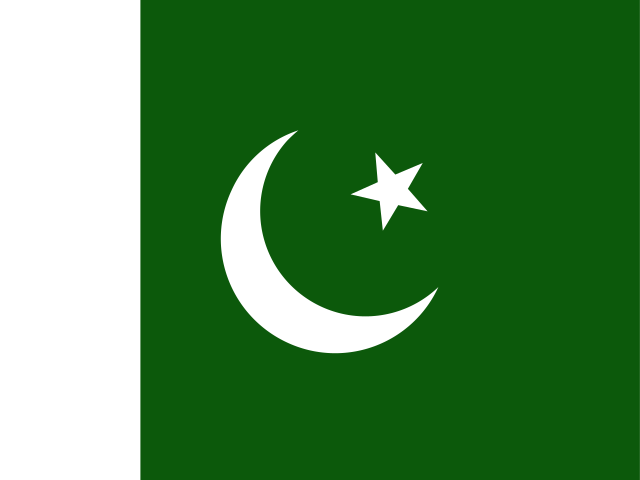
Pakistan
Some of the highest mountains on earth meet in one valley here, and the Karakoram Highway runs up through them. Check the advisory by region, not by country.
Pakistan in ten slides
Wikipedia · 4 Sep 2026


Best time to visit Pakistan: Apr–Jun · Sep–Oct
Where people go in Pakistan
- Lahore3 days is about right
- Karachi2 days is about right
- Rawalpindi2 days is about right
- Multan2 days is about right
- Peshawar2 days is about right
- Hyderabad2 days is about right
- Saidu2 days is about right
- Faisalabad1 days is about right
- Quetta
- Gujranwala
What people go to see in Pakistan
Clifton is an upscale and historic seaside locality in Karachi, Pakistan. It is one of the most affluent parts of the city, home to some of Karachi's most expensive real estates. It is home to several foreign consulates, while its commercial centres are amongst the most high-end in Pakistan, with a strong presence of international brands.
Wikipedia · CC BY-SA 4.0 · 28 Aug 2026
The Empress Market is a marketplace situated in the Saddar Town locality of Karachi, Pakistan. The market traces its origins to the British Raj era, when it was first constructed. Today, it is amongst the most popular and busy places for shopping in Karachi.
Wikipedia · CC BY-SA 4.0 · 22 Apr 2026
Frere Hall is a building in Karachi, Pakistan that dates from the early British colonial era in Sindh. Completed in 1865, Frere Hall was originally intended to serve as Karachi's town hall, and now serves as an exhibition space and library.
Wikipedia · CC BY-SA 4.0 · 22 Mar 2026

The Karachi Port Trust Building, also referred to as the KPT Building, is a building in Karachi, Sindh, Pakistan that serves as headquarters for the Karachi Port Trust, which administers the Port of Karachi. The building dates from the height of the British Raj, and was inaugurated on 5 January 1916.
Wikipedia · CC BY-SA 4.0 · 26 Jul 2026
Ali Shaikh Abbas · CC BY-SA 4.0
Masjid-e-Tooba also known as Gol Masjid, is a mosque located in the city of Karachi in Sindh province of Pakistan. It is situated near the main Korangi Road in Phase II of the Defence Housing Authority, Karachi.
Wikipedia · CC BY-SA 4.0 · 30 Jul 2026
Mazar-e-Quaid, also known as Jinnah Mausoleum or the National Mausoleum, is the final resting place of Muhammad Ali Jinnah, the founder of Pakistan. Designed in a traditional style with a minor influence of modernist style, it was completed in 1971, and is an iconic symbol of Karachi alongside being one of the most popular tourist sites in the city.
Wikipedia · CC BY-SA 4.0 · 15 Aug 2026
Clifton is an upscale and historic seaside locality in Karachi, Pakistan. It is one of the most affluent parts of the city, home to some of Karachi's most expensive real estates. It is home to several foreign consulates, while its commercial centres are amongst the most high-end in Pakistan, with a strong presence of international brands.
Wikipedia · CC BY-SA 4.0 · 28 Aug 2026
The Quaid-e-Azam House, also known as Flagstaff House, is a house museum dedicated to the personal life of Muhammad Ali Jinnah, the founder of Pakistan. Located in Karachi, Sindh, Pakistan, it was designed by British architect Moses Somake.
Wikipedia · CC BY-SA 4.0 · 17 Jul 2026

Anarkali Bazaar is a major bazaar in Lahore, Punjab, Pakistan. Anarkali also serves as a neighbourhood and union council of Data Gunj Buksh Tehsil of Lahore. It is situated in the region that extends from the south of Lahori Gate of the Walled City to across the Mall Road.
Wikipedia · CC BY-SA 4.0 · 29 Apr 2026
Ali lahoti · CC BY-SA 4.0

The Badshahi Mosque is a Mughal-era imperial mosque located in Lahore, Punjab, Pakistan. It was constructed between 1671 and 1673 by the Mughal emperor Aurangzeb, opposite to the Lahore Fort in the northern outskirts of the historic Walled City. It is widely considered to be an iconic landmark of the country.
Wikipedia · CC BY-SA 4.0 · 26 Aug 2026
Romero Maia · CC BY-SA 4.0

The Lahore Fort is a citadel in the walled interior of Lahore in Punjab, Pakistan. The fortress is located at the northern end of the Walled City and is spread over an area greater than 20 hectares. It contains 21 notable monuments, some of which date to the era of Emperor Akbar.
Wikipedia · CC BY-SA 4.0 · 14 Aug 2026
Rohaan Bhatti · CC BY-SA 3.0
The Lahore Museum is a museum located in Lahore, Punjab, Pakistan. Founded in 1865 at a smaller location and opened in 1894 at its current location on The Mall in Lahore during the British colonial period, Lahore Museum is Pakistan's largest museum, as well as one of its most visited ones.
Wikipedia · CC BY-SA 4.0 · 25 Jul 2026

The Minar-e-Pakistan is a public monument tower located in Lahore, Punjab, Pakistan. The tower stands in the Greater Iqbal Park, an urban park in Lahore.
Wikipedia · CC BY-SA 4.0 · 1 Sep 2026
King Eliot · CC BY-SA 4.0

The Shalamar Gardens or Shalimar Gardens are a Mughal garden complex besides Baghbanpura, located in Lahore, Punjab, Pakistan. The gardens date from the period when the Mughal Empire was at its artistic and aesthetic zenith, and are now one of Pakistan's most popular tourist destinations.
Wikipedia · CC BY-SA 4.0 · 26 Jul 2026
Muhammad Ashar · CC BY-SA 3.0

The Tomb of Anarkali is an octagonal 16th-century Mughal monument in Lahore, Punjab, Pakistan.
Wikipedia · CC BY-SA 4.0 · 2 Jul 2026
King Eliot · CC BY-SA 4.0

The Wazir Khan Mosque is a 17th-century Mughal mosque located in the city of Lahore, Punjab, Pakistan. The mosque was commissioned by the then governor of Punjab, Wazir Khan, during the reign of the Mughal Emperor Shah Jahan as a part of an ensemble of buildings that also included the nearby Shahi Hammam baths. Construction of the mosque began in 1634, and was completed in 1641.
Wikipedia · CC BY-SA 4.0 · 23 Aug 2026
Moiz Ismaili · CC BY-SA 4.0

Clock Tower, formerly known as Northbrook Tower, is a clock tower and city government headquarters of Multan in the Punjab province of Pakistan.
Wikipedia · CC BY-SA 4.0 · 22 Mar 2026
Junaidahmadj · CC BY-SA 3.0

Multan is a city in the Punjab province of Pakistan. Located along the eastern bank of the Chenab River, it is the sixth-largest city in the country; and serves as the administrative headquarters of its eponymous division and district. A major cultural, religious and economic centre of the Punjab region, Multan is one of the oldest continuosly inhabited cities in Asia, with a history stretching deep into antiquity.
Wikipedia · CC BY-SA 4.0 · 3 Sep 2026
Yaarahmadd · CC BY-SA 4.0
Prahladpuri Temple was a Hindu temple located in Multan city of Punjab province in Pakistan. The temple was located on top of a raised platform (mandapa) at the southern tip of the Multan Fort, adjacent to the Shrine of Bahauddin Zakariya. Named after Prahlada, it was dedicated to the Hindu deity Narasimha.
Wikipedia · CC BY-SA 4.0 · 1 Aug 2026

Saint Mary's Cathedral is a cathedral and historical monument in Multan, Pakistan.
Wikipedia · CC BY-SA 4.0 · 16 May 2026
Tahsin Shah · CC BY-SA 4.0


The Shrine of Bahauddin Zakariya is a 13th-century shrine located in Multan, Punjab, Pakistan. The tomb is dedicated to the Sufi mystic Bahauddin Zakariya, of the Suhrawardiyya order of Sufism. It considered to be one of the most important Muslim shrines in the wider Punjab region, and is the prototype for Multan's classical architectural style.
Wikipedia · CC BY-SA 4.0 · 2 Jul 2026
Noor Hussain · CC BY-SA 4.0

The Tomb of Shah Ali Akbar is a tomb in Suraj Miani Multan, in Punjab province, Pakistan.
Wikipedia · CC BY-SA 4.0 · 19 Jul 2026
Fareed Roomi · CC BY-SA 4.0

The tomb of Shah Rukn-e-Alam is the mausoleum of the 14th century Sufi saint Shah Rukn-e-Alam located in Multan, Punjab, Pakistan, at the northwestern edge of the Multan Fort. The shrine is considered to be the earliest example of Tughluq architecture, and is one of the most impressive shrines in the Indian subcontinent.
Wikipedia · CC BY-SA 4.0 · 2 Jul 2026
ZainShahid117 · CC BY-SA 3.0

Mukhi House, also known as Mukhi Mahal, is a museum located in Hyderabad, Sindh, Pakistan. For a brief period, it housed a government school named Khadija Girls School.
Wikipedia · CC BY-SA 4.0 · 22 Mar 2026
Sara Yaqoob Siddiqui (s.Y.s) · CC BY-SA 4.0
The Rani Bagh, previously known as Das Garden, is a zoological garden located in Hyderabad, Sindh, Pakistan. The garden was re-christened in honour of Queen Victoria. It was established as a botanical garden in 1861 by the then Agro-horticultural Society and later animals were moved in.
Wikipedia · CC BY-SA 4.0 · 30 Jun 2026
Shahi Bazaar is a bazaar situated in Hyderabad, Sindh. It is one of the longest bazaars in Asia. The market begins from Pacco Qillo and concludes at Market Tower.
Wikipedia · CC BY-SA 4.0 · 30 Apr 2026
St. Francis Xavier Cathedral, Hyderabad, Pakistan is the cathedral church of the Roman Catholic Diocese of Hyderabad, 1040 kilometers south of the capital, Islamabad.
Wikipedia · CC BY-SA 4.0 · 2 Aug 2026

Tomb of Tharo Khan is the tomb of Tharo Khan Talpur, located in Mirpur Khas, in Sindh, Pakistan. The tomb is related to the Tombs of Talpur Mirs complex, built in the eighteenth century in the city of Hyderabad. The tombs are of the ruling Talpur Mirs of Sindh.
Wikipedia · CC BY-SA 4.0 · 30 Jul 2026
Saqib Qayyum · CC BY-SA 3.0
The Tombs of Talpur Mirs are a complex of tombs of the Talpur Mirs of Sindh who reigned from 1784 to 1843. The tombs are also known as Cubbas. These tombs are located in Hirabad, Hyderabad in the Sindh province of Pakistan.
Wikipedia · CC BY-SA 4.0 · 21 Jun 2026

Christ Church is an Anglican church situated on the main square adjacent to the GHQ, formerly the British Northern Command Headquarters, in Rawalpindi, Pakistan.
Wikipedia · CC BY-SA 4.0 · 16 May 2026
Muhammad Bin Naveed · CC BY-SA 3.0

The Shri Krishna mandir, or the Krishna Temple, is a Hindu temple located in Rawalpindi in the Punjab province of Pakistan. It is situated between the Rawalpindi railway station and Kabari Bazaar in Saddar. It is one of the 3 main Hindu temple in the Rawalpindi district, others being Lal Kurti Temple and the Valmik Swamiji Mandir in Gracy lines.
Wikipedia · CC BY-SA 4.0 · 1 Aug 2026
Banksboomer · CC BY-SA 4.0
Liaqat National Bagh, formerly known as Company Bagh, usually just referred to as Liaqat Bagh, is a park on Murree Road in the city of Rawalpindi, Punjab, Pakistan. It is close to 'Arya Mohalla' and Government Gordon College, which are two well-known residential and commercial areas of Rawalpindi.
Wikipedia · CC BY-SA 4.0 · 5 Jul 2026

Pakistan Army Museum is a military museum located in Rawalpindi. It was opened on October 24, 1961 to preserve Pakistan Army's past through relics and pictures and is one of the largest museums of Pakistan.
Wikipedia · CC BY-SA 4.0 · 11 Jul 2026
Ahmed Bin Mazhar · CC BY-SA 3.0

Poonch House is a mansion in Rawalpindi, Pakistan.
Wikipedia · CC BY-SA 4.0 · 30 Apr 2026
Fahads1982 · CC BY-SA 4.0

Rawalpindi, colloquially known as Pindi, is the third-largest city in the Pakistani province of Punjab and the fourth-most populous city in Pakistan. Located along the Soan River in north-western Punjab, Rawalpindi lies adjacent to Pakistan's capital, Islamabad, and the two are jointly known as the "twin cities".
Wikipedia · CC BY-SA 4.0 · 28 Aug 2026
Miiqbal · CC BY-SA 3.0
St. Joseph's Cathedral, Rawalpindi, Pakistan, is the main church of the Roman Catholic Diocese of Islamabad-Rawalpindi.
Wikipedia · CC BY-SA 4.0 · 30 Jul 2026

Bala Hissar, also spelt Bala Hisar, is a historic fortress located in Peshawar, Khyber Pakhtunkhwa, Pakistan. The existence of a fort at the location was first mentioned by 7th-century explorer Xuanzang; the fort was used as a royal residence for the Durrani Empire since 1772, when Timur Shah Durrani made Peshawar his capital.
Wikipedia · CC BY-SA 4.0 · 17 Apr 2026
NoahOmarY · CC BY-SA 4.0

The Cunningham Clock Tower in Peshawar, Khyber-Pakhtunkhwa, Pakistan, was built in 1900, "in commemoration of Her Majesty the Queen Empress Victoria". The tower was named after the Commissioner of Peshawar, Sir Alexander Frederick Douglas Cunningham, not to be confused with Sir George Cunningham, former British governor and political agent in the province.
Wikipedia · CC BY-SA 4.0 · 12 Oct 2025
Junaid Khalid · CC BY-SA 4.0

Gor Khatri is an archeological site located in Peshawar, Pakistan. It was built in the Mughal-era by Jehan Ara Begum, daughter of Shah Jahan, as a caravanserai.
Wikipedia · CC BY-SA 4.0 · 2 Jun 2026
Tan Afridi · CC BY-SA 3.0

The Mahabat Khan Mosque, sometimes spelt Mohabbat Khan Mosque, is a 17th-century Mughal-era mosque in Peshawar, Khyber Pakhtunkhwa, Pakistan. The mosque was built in 1630, and named after the Mughal governor of Peshawar, Mahabat Khān. The mosque's white marble façade is considered to be one of Peshawar's most iconic sights.
Wikipedia · CC BY-SA 4.0 · 1 Aug 2026
US Embassy Pakistan · Public domain

Peshawar is the capital and largest city of the Pakistani province of Khyber Pakhtunkhwa. It is the eighth-most populous Pakistani city, with a population of over 1.9 million. It is located in the north-west of the country, lying in the Valley of Peshawar, a broad area situated east of the Khyber Pass.
Wikipedia · CC BY-SA 4.0 · 3 Sep 2026
Zafarmaini · CC BY-SA 4.0

The Qissa Khwani or Kissa Khwani Bazaar is a bazaar in Peshawar, the capital of the Khyber Pakhtunkhwa province of Pakistan.
Wikipedia · CC BY-SA 4.0 · 27 Aug 2026
Omer Wazir · CC BY-SA 2.0
The Cathedral of Sts. Peter and Paul is the main church of the Roman Catholic Diocese of Faisalabad, 250 kilometers south of Islamabad, Pakistan.
Wikipedia · CC BY-SA 4.0 · 30 Jul 2026

The Faisalabad Clock Tower, formerly known as the Lyallpur Clock Tower, is a clock tower in Faisalabad, Punjab, Pakistan. Built in 1905, it is one of the city's oldest monuments still standing in its original state.
Wikipedia · CC BY-SA 4.0 · 2 Jul 2026
Khalid Mahmood · CC BY-SA 3.0

The Gumti Water Fountain is a monument in Faisalabad, Pakistan preserved from the British Raj era. It was built during the early nineteenth century and was a general meeting place of the city folk for local town meetings.
Wikipedia · CC BY-SA 4.0 · 30 Apr 2026
Minhajian at English Wikipedia · CC BY-SA 3.0
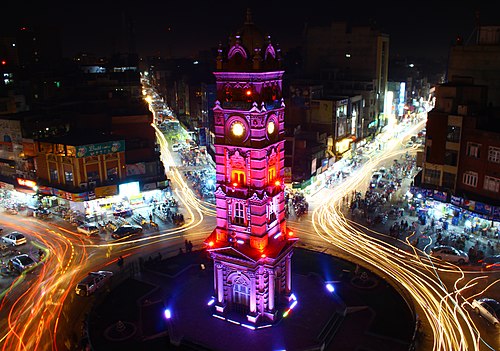
Faisalabad, formerly known as Lyallpur, is the second-largest city and primary industrial center of the Pakistani province of Punjab. Located in the Rachna Doab of the central Punjab, it is the third-most populous city in Pakistan.
Wikipedia · CC BY-SA 4.0 · 1 Sep 2026
Usman Nadeem · CC BY-SA 4.0
The Qaisery Gate was the gate into the eight markets with the Faisalabad Clock Tower at the centre. It was built in 1897 under the commission of the British Raj in the then newly-emerging city of Faisalabad, Punjab.
Wikipedia · CC BY-SA 4.0 · 27 Aug 2025
Minhajian at English Wikipedia · CC BY-SA 3.0

The Butkara Stupa is an important Buddhist stupa near Mingora, in the area of Swat, Pakistan. It may have been built by the Mauryan emperor Ashoka, but it is generally dated slightly later to the 2nd century BCE.
Wikipedia · CC BY-SA 4.0 · 18 Jul 2026
Muhammad Zahir · CC BY-SA 3.0

Mingora is a city in the Swat District of Khyber Pakhtunkhwa, Pakistan. Located on the Swat River, it is the third largest city in Khyber Pakhtunkhwa and the 26th largest in Pakistan. Mingora is the largest city and the epicenter of social, cultural, and economic activities in Malakand Division, and also the largest in the northern part of Khyber Pakhtunkhwa.
Wikipedia · CC BY-SA 4.0 · 3 Sep 2026
Imranrashid26 · CC BY-SA 3.0

Saidū Sharīf, also known as Saidu Baba, or simply as Saidu, is the capital of the Swat district, Khyber Pakhtunkhwa, Pakistan. The city also serves as the capital of the Malakand Division. It was named after Saidu Baba, a prominent leader of the former state of Swat.
Wikipedia · CC BY-SA 4.0 · 30 May 2026
Isruma · CC BY-SA 3.0
Saidū Sharīf, also known as Saidu Baba, or simply as Saidu, is the capital of the Swat district, Khyber Pakhtunkhwa, Pakistan. The city also serves as the capital of the Malakand Division. It was named after Saidu Baba, a prominent leader of the former state of Swat.
Wikipedia · CC BY-SA 4.0 · 30 May 2026
Isruma · CC BY-SA 3.0
Saidū Sharīf, also known as Saidu Baba, or simply as Saidu, is the capital of the Swat district, Khyber Pakhtunkhwa, Pakistan. The city also serves as the capital of the Malakand Division. It was named after Saidu Baba, a prominent leader of the former state of Swat.
Wikipedia · CC BY-SA 4.0 · 30 May 2026
Isruma · CC BY-SA 3.0
Sourced stays
Sourced experiences
Fly to Pakistan
The facts you look up on the plane
Not going yet? Pin it.
One tap puts it on your map and in your pins, for when you are ready.