 Common · +100 XP
Best time to visit: Oct–Mar
Daily spend ~$60
Common · +100 XP
Best time to visit: Oct–Mar
Daily spend ~$60
Egypt
Five thousand years stacked along one river, and the river is still how the country makes sense. The Nile between Luxor and Aswan is the trip; Cairo is the shock at either end.
Egypt in ten slides
Wikipedia · 3 Sep 2026


Best time to visit Egypt: Oct–Mar
Where people go in Egypt
- Cairo4 days is about right
- Luxor3 days is about right
- Alexandria2 days is about right
- Sohag2 days is about right
- Bur Said2 days is about right
- Suez1 days is about right
- Damanhûr
- El Mansura
- El Minya
- Ismaïlia
What people go to see in Egypt
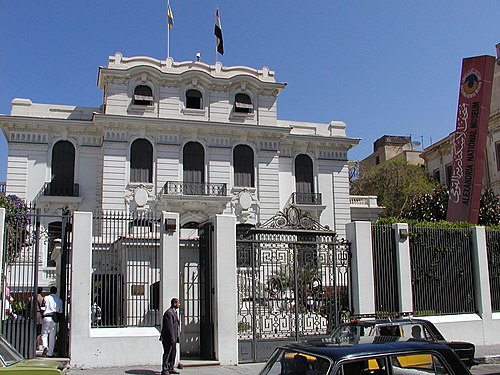
The Alexandria National Museum (ANM) is a museum in Alexandria, Egypt. It was inaugurated the 31 December 2003 by Hosni Mubarak and it is located in a renovated Italian style palace in Tariq Al-Horreya Street (former Rue Fouad). The building used to be home to the United States consulate.
Wikipedia · CC BY-SA 4.0 · 10 Jul 2026
Néfermaât · CC BY-SA 2.5

The Bibliotheca Alexandrina (BA) is a major library and cultural center on the shore of the Mediterranean Sea in Alexandria, Egypt. It is a commemoration of the Library of Alexandria, once one of the largest libraries worldwide, which was lost in antiquity.
Wikipedia · CC BY-SA 4.0 · 29 Aug 2026
Shivani Singh04 · CC-BY-SA-4.0

The catacombs of Kom El Shoqafa are a historical archaeological site located in Alexandria, Egypt, and are considered one of the Seven Wonders of the Middle Ages.
Wikipedia · CC BY-SA 4.0 · 8 Jul 2026
Bilal Detailz · CC BY-SA 4.0

The Citadel of Qaitbay is a 15th-century defensive fortress located on the Mediterranean sea coast, on Pharos Island in Alexandria, Egypt. It was built from 1477 to 1479 AD by Sultan Al-Ashraf Sayf al-Din Qaitbay. The Citadel is situated on the eastern side of the northern tip of Pharos Island at the mouth of the Eastern Harbour.
Wikipedia · CC BY-SA 4.0 · 1 Aug 2026
Hmkree · CC BY-SA 4.0

Montaza Palace is a palace, museum and extensive gardens in the Montaza district of Alexandria, Egypt. It was built on a low plateau east of central Alexandria overlooking a beach on the Mediterranean Sea.
Wikipedia · CC BY-SA 4.0 · 30 Aug 2026
Ashraf f. bakry · CC BY-SA 4.0

Pompey's Pillar is a Roman triumphal column in Alexandria, Egypt. Despite its modern name, it was actually set up in honour of the Roman emperor Diocletian between 298–302 AD. The giant Corinthian column originally supported a colossal porphyry statue of the emperor in armour.
Wikipedia · CC BY-SA 4.0 · 8 Aug 2026
Roland Unger · CC BY-SA 3.0

Church of Saint Eugénie in Port Said is the oldest church in Port Said, Egypt.
Wikipedia · CC BY-SA 4.0 · 9 Jun 2026
Hatem Moushir · CC BY-SA 4.0
The Port Said Cultural Entertainment Center, also known as the Port Said Opera House, is an opera house, theatre, and cinema in Port Said, Egypt. It opened in December 2016 and was inaugurated by Egyptian president Abdel Fattah el-Sisi. The main theatre, named for the Egyptian actor Mahmoud Yassin, has a capacity of 1,200 people.
Wikipedia · CC BY-SA 4.0 · 30 Aug 2026


Port Fuad or Port Fouad is a city in Port Said Governorate, Egypt. Port Fuad is located in northeastern Egypt at the northwesternmost tip of the Sinai Peninsula on the Asian side of the Suez Canal, across from the city of Port Said. Port Fuad is considered a suburb of Port Said and together they form a metropolitan area of over one million residents.
Wikipedia · CC BY-SA 4.0 · 21 Aug 2026
See below · Public domain

Port Said Lighthouse is one of the most important architectural and tourist landmarks in the city of Port Said in Egypt. Considered a unique example for the evolution of architecture during the nineteenth century in the city, the lighthouse was designed by François Coignet at the request of the Khedive of Egypt and Sudan, Ismail the Magnificent.
Wikipedia · CC BY-SA 4.0 · 4 Dec 2025
Michael Tyler · CC BY-SA 2.0
Tennis or Tinnīs was a medieval city in Egypt which no longer exists. It was most prosperous from the 9th century to the 11th century until its abandonment. It was located at 31°12′N 32°14′E, on an island in Lake Manzala, southwest of Port Said.
Wikipedia · CC BY-SA 4.0 · 7 Apr 2026

Al-Azhar Mosque, known in Egypt simply as al-Azhar, is a mosque in the historic Islamic core of the city of Cairo, Egypt. Commissioned as the new capital of the Fatimid Caliphate in 970 CE, it was the first mosque established in a city that eventually earned the nickname "the City of a Thousand Minarets". Its name is usually thought to derive from az-Zahrāʾ, a title given to Fatima, the daughter of Muhammad.
Wikipedia · CC BY-SA 4.0 · 30 Jul 2026
Wildoo78 · CC BY-SA 4.0

The Citadel of Cairo or Citadel of Saladin is a medieval Islamic-era fortification in Cairo, Egypt. Its construction was begun by Salah ad-Din (Saladin) in 1176 and continued by subsequent Egyptian rulers. It was the seat of government in Egypt and the residence of its rulers for nearly 700 years from the 13th century until the construction of Abdeen Palace in the 19th century.
Wikipedia · CC BY-SA 4.0 · 19 Jul 2026
Ahmed Al.Badawy from Cairo, Egypt · CC BY-SA 2.0

Coptic Cairo is a part of Old Cairo which encompasses the Babylon Fortress, the Coptic Museum, the Hanging Church, the Greek Church of St. George and many other Coptic churches and historical sites. It is believed in Christian tradition that the Holy Family visited this area and stayed at the site of Saints Sergius and Bacchus Church.
Wikipedia · CC BY-SA 4.0 · 27 Oct 2025
Berthold Werner · CC BY-SA 3.0

The Giza pyramid complex in Egypt is home to the Great Pyramid, the pyramid of Khafre, and the pyramid of Menkaure, along with their associated pyramid complexes and the Great Sphinx. All were built during the Fourth Dynasty of the Old Kingdom of ancient Egypt, between c. 2600 – c. 2500 BC. The site also includes several temples, cemeteries, and the remains of a workers' village.
Wikipedia · CC BY-SA 4.0 · 22 Aug 2026
KennyOMG · CC BY-SA 4.0

The Grand Egyptian Museum is a national archaeological museum in Giza, Egypt. Dedicated to Ancient Egypt and its culture, society, and artifacts, the GEM is the largest museum in the world for a single civilization.
Wikipedia · CC BY-SA 4.0 · 10 Jul 2026
Atelier Brückner (company) · Public domain

Khan el-Khalili is a famous bazaar in the historic center of Cairo, Egypt. Established as a center of trade in the Mamluk era and named for one of its several historic caravanserais, the bazaar district has since become one of Cairo's main attractions for tourists and Egyptians alike. It is also home to many Egyptian artisans and workshops involved in the production of traditional crafts and souvenirs.
Wikipedia · CC BY-SA 4.0 · 21 Jul 2026
Heba otefy · CC BY-SA 4.0

The Colossi of Memnon are two large stone statues of the Pharaoh Amenhotep III, which stand at the front of the ruined Mortuary Temple of Amenhotep III, the largest temple in the Theban Necropolis. They have stood since 1350 BC, and were well known to ancient Greeks and Romans, as well as early modern travelers and Egyptologists.
Wikipedia · CC BY-SA 4.0 · 5 Jul 2026
MusikAnimal · CC BY-SA 4.0

The Karnak Temple Complex, commonly known as Karnak, comprises a vast mix of temples, pylons, chapels, and other buildings near Luxor, Egypt. Construction at the complex began during the reign of Senusret I in the Middle Kingdom and continued into the Ptolemaic Kingdom, although most of the extant buildings date from the New Kingdom.
Wikipedia · CC BY-SA 4.0 · 20 Jul 2026
René Hourdry · CC BY-SA 4.0

The Luxor Temple is a large Ancient Egyptian temple complex located on the east bank of the Nile River in the city of Luxor and was constructed approximately 1400 BCE. In the Egyptian language it was known as ipet resyt, "the southern sanctuary". It was one of the two primary temples on the east bank, the other being Karnak.
Wikipedia · CC BY-SA 4.0 · 12 Aug 2026
Holger Uwe Schmitt · CC BY-SA 4.0

The mortuary temple of Hatshepsut was built during the reign of Pharaoh Hatshepsut of the Eighteenth Dynasty of Egypt. Located opposite the city of Luxor, it is considered to be a masterpiece of ancient architecture. Its three massive terraces rise above the desert floor and into the cliffs of Deir el-Bahari.
Wikipedia · CC BY-SA 4.0 · 20 Jul 2026
Diego Delso · CC BY-SA 4.0

The Valley of the Kings, also known as the Valley of the Gates of the Kings, is an area in Egypt where, for a period of nearly 500 years from the Eighteenth Dynasty to the Twentieth Dynasty, rock-cut tombs were excavated for pharaohs and powerful nobles under the New Kingdom of ancient Egypt.
Wikipedia · CC BY-SA 4.0 · 25 Aug 2026
Fotograf/Photographer: Peter J. Bubenik (1995) · CC BY-SA 2.0

The Valley of the Queens is a site in Egypt, in which queens, princes, princesses, and other high-ranking officials were buried from roughly 1560 BC to 1130 BC. Pharaohs were buried in the Valley of the Kings. The Valley of the Queens was known anciently as Ta-Set-Neferu, which has a double meaning of "The Place of Beauty" and/or "the Place of the Royal Children".
Wikipedia · CC BY-SA 4.0 · 19 Jul 2026
Zureks · CC BY-SA 3.0

Akhmim is a city in the Sohag Governorate of Upper Egypt. Referred to by the ancient Greeks as Khemmis or Chemmis and Panopolis, it is located on the east bank of the Nile, 6 kilometres (4 mi) to the northeast of Sohag.
Wikipedia · CC BY-SA 4.0 · 21 Mar 2026
أبو الدهب · CC BY-SA 4.0
Athribis, also known to the ancient Greeks as Triphieion or Tripheion, and to the ancient Egyptians as Hut-Repyt, was an ancient city of Egypt, in the Panopolite nome. The modern villages of Wannina and Nag' Hamad in the Sohag Governorate are situated nearby. It is located some 10 km (6 mi) southwest of the city of Akhmim and about 3 km (2 mi) south of the White Monastery, on the west bank of the Nile.
Wikipedia · CC BY-SA 4.0 · 6 Mar 2026

The Red Monastery or The Monastery of Apa Pshay is a Coptic Orthodox monastery named after an Egyptian saint named Pshay or Pishay, not to be confused with Pishoy, Bishop of Sketis. It is located near the Upper Egyptian city of Souhag, and about two and a half miles (4.0 km) north-west of the White Monastery.
Wikipedia · CC BY-SA 4.0 · 3 Jul 2026
Roland Unger · CC BY-SA 3.0
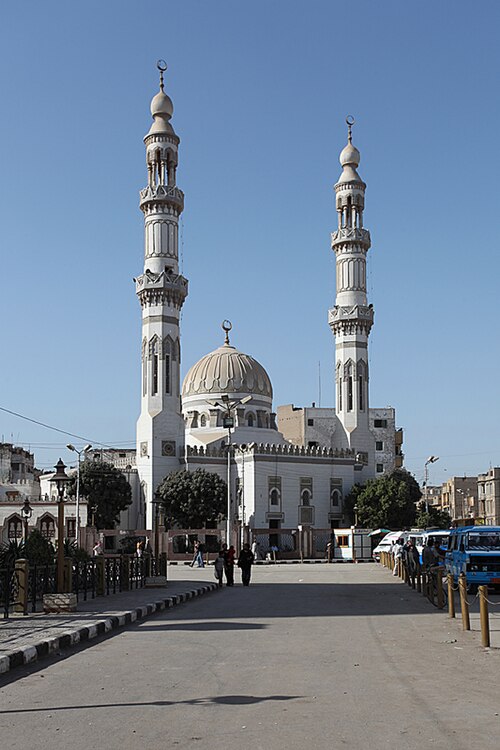
The Sidi Arif Mosque is a mosque and mausoleum, located in Sohag, in the Sohag Governorate of Egypt. It was completed in the 14th century CE and was reconstructed several times; including in 1968 and in 1998. The mosque was named after the Sufi mystic buried in it, Sidi Arif, also known as Ismail ibn Ali ibn Abdussami, a member of the Ashraf family of mystics.
Wikipedia · CC BY-SA 4.0 · 30 Jul 2026
Roland Unger · CC BY-SA 3.0

The Coptic White Monastery, also The Monastery of Abba Shenouda and The Athribian Monastery is a Coptic Orthodox monastery named after Saint Shenoute. It is located near the Upper Egyptian cities of Tahta and Sohag, and about two and a half miles (4.0 km) south-east of the Red Monastery.
Wikipedia · CC BY-SA 4.0 · 3 Jul 2026
Roland Unger · CC BY-SA 3.0

The Ahmed Hamdi Tunnel is a 1.63-kilometre-long (1.01 mi) car tunnel under the Suez Canal at Shallufa. The tunnel is named after Ahmed Hamdi, an Egyptian engineer and general martyred in action during the October war. It has two lanes of traffic, one in each direction, and it connects the Asian Sinai Peninsula to the town of Suez on the African mainland.
Wikipedia · CC BY-SA 4.0 · 23 Jul 2026
Zehnfinger · CC BY-SA 3.0
Clysma was an ancient city and bishopric in Egypt. It was located at the head of the Gulf of Suez.
Wikipedia · CC BY-SA 4.0 · 20 Jul 2026

The Port Tewfik Memorial was originally situated at Port Tewfik, now called Suez Port, on the Suez Canal. It was unveiled in May 1926 for the Imperial War Graves Commission and commemorated 4,000 officers and men of the Indian Army killed during the Sinai and Palestine Campaign during the First World War. The original memorial was designed by Scottish architects John James Burnet and Thomas S.
Wikipedia · CC BY-SA 4.0 · 20 Nov 2024
Buonasera · CC BY-SA 3.0

The Suez Port is an Egyptian port located at the northern tip of the Gulf of Suez on the Red Sea at southern entrance of the Suez Canal, serving the canal and the city of Suez. It is owned and operated by the Ministry of Transport's General Authority of Red Sea Ports, and is home to the Suez Canal Authority (SCA) shipyards.
Wikipedia · CC BY-SA 4.0 · 30 Aug 2026
TheEgyptian at English Wikipedia · CC BY-SA 3.0
Sourced stays
Sourced experiences
Fly to Egypt
The facts you look up on the plane
Guides about Egypt

Cairo is workable most of the year and Luxor decides your dates. The month table, the Ramadan effect, and the two solar alignments worth planning around.
Yasmine Belkacem · 2 Sep 2026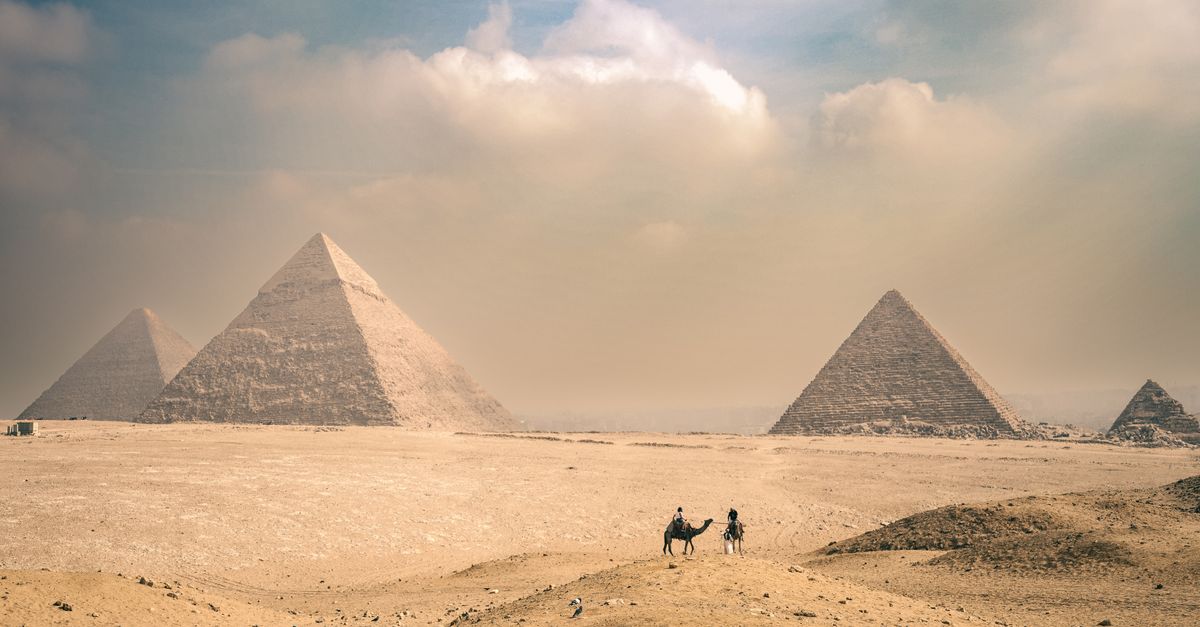
The Grand Egyptian Museum opened in November 2025 and it changes the Cairo half. A ten-day route, what the museum costs, and the cruise question answered.
Yasmine Belkacem · 2 Sep 2026Not going yet? Pin it.
One tap puts it on your map and in your pins, for when you are ready.