 Uncommon · +150 XP
Best time to visit: Dec–Apr
Daily spend ~$80
Uncommon · +150 XP
Best time to visit: Dec–Apr
Daily spend ~$80
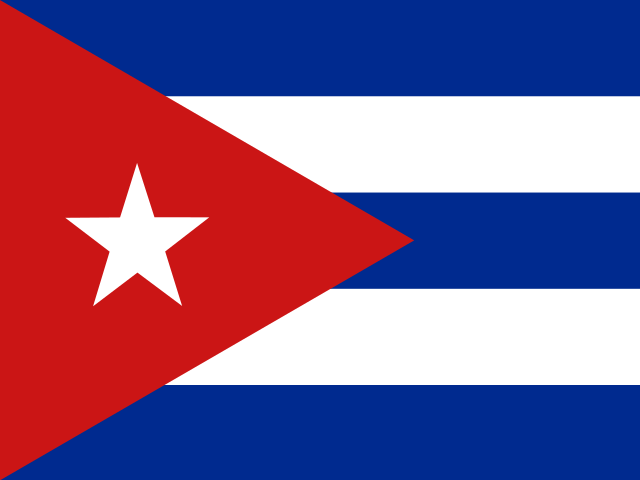
Cuba
A country preserved by embargo and now visibly changing. Live music everywhere, roads with no traffic, and shortages that shape every day of a trip.
Cuba in ten slides
Wikipedia · 3 Sep 2026


Best time to visit Cuba: Dec–Apr
Where people go in Cuba
- Havana3 days is about right
- Santa Clara2 days is about right
- Santiago de Cuba2 days is about right
- Camagüey
- Guantánamo
- Holguín
- Las Tunas
What people go to see in Cuba

The Castillo de los Tres Reyes del Morro, also known as Castillo del Morro, is a fortress guarding the entrance to the Havana harbor. The design is by the Italian engineer Battista Antonelli (1547–1616). Originally under the control of Spain, the fortress was captured by the British in 1762 and returned to Spain under the Treaty of Paris (1763) a year later.
Wikipedia · CC BY-SA 4.0 · 16 Jul 2026
National Photo Company Collection · Public domain

The National Capitol of Cuba, also known as Capitolio Nacional de La Habana , and often simply referred to as El Capitolio (The Capitol), is a public edifice in Havana, the capital of Cuba. The building was commissioned by Cuban president Gerardo Machado and built from 1926 to 1929 under the direction of Eugenio Rayneri Piedra.
Wikipedia · CC BY-SA 4.0 · 6 Jul 2026
Nigel Pacquette · CC BY-SA 3.0

Gran Teatro de La Habana is a theater in Havana, Cuba, home to the Cuban National Ballet. It was designed by the Belgian architect Paul Belau and built by Purdy and Henderson, Engineers in 1914 at the site of the former Teatro Tacón. Its construction was paid for by the Galician immigrants of Havana to serve as a community-social center.
Wikipedia · CC BY-SA 4.0 · 30 Aug 2026
Tacorontey · CC BY-SA 4.0

Havana Cathedral is one of eleven Catholic cathedrals on the island. It is located in the Plaza de la Catedral on Calle Empedrado, between San Ignacio y Mercaderes, Old Havana, Havana, Cuba. The thirty by forty-nine meters rectangular church serves as the seat of the Archdiocese of San Cristóbal de la Habana.
Wikipedia · CC BY-SA 4.0 · 8 Aug 2026
akasenn · CC BY-SA 3.0

The Malecón is a broad esplanade, roadway, and seawall that stretches for 8 km along the coast in Havana, Cuba, from the mouth of Havana Harbor in Old Havana, along the north side of the Centro Habana neighborhood and the Vedado neighborhood, ending at the mouth of the Almendares.
Wikipedia · CC BY-SA 4.0 · 17 Jul 2026
Lukas Mathis · CC BY-SA 2.0

The Museum of the Revolution is located in the Old Havana section of Havana, Cuba, in what was the presidential palace of all Cuban presidents from Mario García Menocal to Fulgencio Batista. The building became the Museum of the Revolution during the years following the Cuban Revolution. The palace building was attacked by the Directorio Revolucionario 13 de Marzo in 1957.
Wikipedia · CC BY-SA 4.0 · 17 Jul 2026
Paul Mannix · CC BY-SA 2.0

Old Havana is the city-center (downtown) and one of the 15 municipalities forming Havana, Cuba. It has the second highest population density in the city and contains the core of the original city of Havana. The positions of the original Walls of Havana are the modern boundaries of Old Havana.
Wikipedia · CC BY-SA 4.0 · 13 Aug 2026
Dэя-Бøяg · CC BY-SA 3.0

Plaza de la Catedral is one of the four main squares in Old Havana and the site of the Cathedral of Havana from which it takes its name. Originally a swamp, it was later drained and used as a naval dockyard. Following the construction of the Cathedral in 1727, it became the site of some of the city's grandest mansions.
Wikipedia · CC BY-SA 4.0 · 24 Sep 2025
Gorupdebesanez · CC BY-SA 3.0

The Che Guevara Mausoleum is a memorial in Santa Clara, Cuba, located in "Plaza Che Guevara". It houses the remains of the revolutionary Ernesto "Che" Guevara and 29 fellow combatants killed in 1967 during Guevara's attempt to spur an armed uprising in Bolivia. The full area, which contains a bronze 22-foot statue of Guevara, is referred to as the Ernesto Guevara Sculptural Complex.
Wikipedia · CC BY-SA 4.0 · 9 Jul 2026
Man-ucommons · CC BY-SA 3.0

El Mejunje, also known as El Mejunje de Silverio after the surname of its founder and director, Ramón Silverio, is a Cuban LGBT cultural center and space located in the city of Santa Clara. It lies on the central Calle Marta Abreu, near the corner with Calle Juan Bruno Zayas, close to the Parque Vidal and La Caridad Theatre, next to the Saint Claire of Assisi Cathedral.
Wikipedia · CC BY-SA 4.0 · 4 Mar 2026
Dэя-Бøяg · CC BY-SA 4.0

Loma del Capiro is a group of three small peaks located in the city of Santa Clara, Cuba.
Wikipedia · CC BY-SA 4.0 · 3 Mar 2026
Lezumbalaberenjena at English Wikipedia · Public domain

Parque Vidal is a park located in the center of Santa Clara, Cuba, covering an entire square block of the city. Due to its surrounding architecture, combining eclectic neo-classical and colonial-style buildings, as well as the large number of historic monuments dating from different historical periods, the park was designated as a National Monument in a ceremony in 1998.
Wikipedia · CC BY-SA 4.0 · 15 Feb 2025
User:Lezumbalaberenjena · Public domain

Teatro de La Caridad or Teatro La Caridad, located in Santa Clara, is one of the few remaining colonial theatres in Cuba. It is a National Monument of Cuba.
Wikipedia · CC BY-SA 4.0 · 31 Aug 2026
Lezumbalaberenjena at en.wikipedia · Public domain

The Tren Blindado is a national monument, memorial park, and museum of the Cuban Revolution, located in the city of Santa Clara, Cuba. It was created by the Cuban sculptor José Delarra on the site of and in memory of the capture of an armoured train on 29 December 1958, during the Battle of Santa Clara.
Wikipedia · CC BY-SA 4.0 · 13 Aug 2026
Dэя-Бøяg · CC BY-SA 4.0

Villa Clara is one of the provinces of Cuba. It is located in the central region of the island bordering on the Atlantic Ocean to the north, Matanzas Province to the west, Sancti Spiritus Province to the east, and Cienfuegos Province to the South. Villa Clara shares with Cienfuegos and Sancti Spiritus on the south the Escambray Mountain Range.
Wikipedia · CC BY-SA 4.0 · 18 Aug 2026
CubanoBoi · CC0

The Castillo de San Pedro de la Roca is a fortress located on the coast of the Cuban city of Santiago de Cuba. About 6 miles (10 km) southwest of the city centre, it overlooks the bay. The fortress was declared a World Heritage Site by UNESCO in 1997, cited as the best preserved and most complete example of Spanish-American military architecture.
Wikipedia · CC BY-SA 4.0 · 21 Dec 2025
Glogg, Peter, Switzerland · CC BY 2.0

El Caney is a small village six kilometers to the northeast of Santiago, Cuba. "Caney" means longhouse in Taíno.
Wikipedia · CC BY-SA 4.0 · 4 May 2026
Unknown author · Public domain

San Juan Hill is a series of hills to the east of Santiago, Cuba, running north to south. It is located in the province of Santiago de Cuba, in the southeastern part of the country, 800 km east of Havana, the capital of the country. San Juan Hill is located 633 meters above sea level.
Wikipedia · CC BY-SA 4.0 · 3 Jun 2026
US Government · Public domain

Sourced stays
Sourced experiences
Fly to Cuba
The facts you look up on the plane
Not going yet? Pin it.
One tap puts it on your map and in your pins, for when you are ready.