 Common · +100 XP
Best time to visit: Apr–May · Sep–Oct
Daily spend ~$80
Common · +100 XP
Best time to visit: Apr–May · Sep–Oct
Daily spend ~$80
China
Vast, fast-changing, and far easier to travel than its reputation suggests. High-speed rail collapses the distances, and the food changes completely every province.
China in ten slides
Wikipedia · 3 Sep 2026


Best time to visit China: Apr–May · Sep–Oct
Where people go in China
What people go to see in China

The Forbidden City is the imperial palace complex in the center of the Imperial City in Beijing, China. It was the residence of 24 Ming and Qing dynasty Emperors, and the center of political power in China for over 500 years from 1420 to 1924. The palace is now administered by the Palace Museum and has been a UNESCO World Heritage Site since 1987.
Wikipedia · CC BY-SA 4.0 · 28 Aug 2026
Pixelflake · CC BY-SA 3.0

Mutianyu is a section of the Great Wall of China located in Huairou District within the city limits of Beijing 70 kilometers (43 mi) northeast of the center of the city. The Mutianyu section of the Great Wall is connected with Jiankou in the west and Lianhuachi in the east.
Wikipedia · CC BY-SA 4.0 · 7 May 2026
Velatrix · CC0

Hutong are a type of narrow street or alley commonly associated with northern Chinese cities, especially Beijing.
Wikipedia · CC BY-SA 4.0 · 1 Mar 2026
Geoff McKim · CC BY-SA 2.0

The Summer Palace or Yihe Garden was a pavilion built by the Chinese Empress Dowager Cixi for quiet retreat. It consists of a vast ensemble of lakes, gardens and palaces located in Beijing. An imperial garden during the Qing dynasty, it includes Longevity Hill, Kunming Lake, and Seventeen Hole Bridge.
Wikipedia · CC BY-SA 4.0 · 30 Aug 2026
xiquinhosilva · CC BY 2.0

The Temple of Heaven is a complex of imperial religious Confucian buildings situated in the southeastern part of central Beijing. The complex was visited by the Emperors of the Ming and then later restored by the Qing dynasties for annual ceremonies of prayer to Heaven for a good harvest and other seasonal rites.
Wikipedia · CC BY-SA 4.0 · 22 Jul 2026
Shujianyang · CC BY-SA 4.0

Tiananmen Square or Tian'anmen Square is a city square in the city centre of Beijing, China, named after the Tiananmen located to its north, which separates it from the Forbidden City imperial palace complex. The square holds the Monument to the People's Heroes, the Great Hall of the People, the National Museum of China, and the Chairman Mao Memorial Hall.
Wikipedia · CC BY-SA 4.0 · 25 Aug 2026
xiquinhosilva · CC BY 2.0

Du Fu Thatched Cottage is a 24-acre (97,000 m2) park and museum in honour of the Tang dynasty poet Du Fu at the western outskirts of Chengdu, adjacent to the Huanhua Xi. In 1961 the Chinese government made the cottage a National Heritage site.
Wikipedia · CC BY-SA 4.0 · 10 Jul 2026
User:唐戈 · CC BY-SA 3.0

Jinli is a street in Chengdu, Sichuan, China. Its history can be traced back to the pre-Qin Dynasty era more than 1800 years ago. Jinli was ranked first in "the world's most beautiful streets" published by CNN Travel in 2019.
Wikipedia · CC BY-SA 4.0 · 28 Jul 2026
Unknown · CC BY 1.0

Jinsha is a Chinese archaeological site located in Qingyang, Chengdu, the capital of the Chinese province of Sichuan. The site is one of the major archaeological discoveries in China during the 21st century. It is listed on the UNESCO World Cultural Heritage Tentative List and Major Sites Protected at the National Level.
Wikipedia · CC BY-SA 4.0 · 12 Aug 2026
xiquinhosilva · CC BY 2.0

The Chengdu Research Base of Giant Panda Breeding is a government-funded non-profit breeding and research institute for giant pandas, red pandas, and other rare animals, located in Chengdu, Sichuan, China.
Wikipedia · CC BY-SA 4.0 · 19 Apr 2026
Kreisverkehrsampel · CC BY-SA 3.0

People's Park is an urban public park in central Chengdu, capital of Sichuan province, China. Built in 1911 as Shaocheng Park (少城公园), it is the first public park in the city. The Railway Protection Movement Monument in the park is designated a Major Historical and Cultural Site of China.
Wikipedia · CC BY-SA 4.0 · 5 Jul 2026
Daderot · CC0


Baiyun Mountain, also known as White Cloud Mountain, is a mountain located a few miles to the north of Guangzhou, China. It has a height of 427 metres (1,401 ft).
Wikipedia · CC BY-SA 4.0 · 27 May 2026
User:Popolon · CC BY-SA 3.0

The Canton Tower, formally Guangzhou TV Astronomical and Sightseeing Tower, is a 600-metre-tall (2,000 ft) multipurpose observation tower in the Haizhu District of Guangzhou, China. The tower was topped out in 2009 and it became operational on 29 September 2010 in time for the 2010 Asian Games.
Wikipedia · CC BY-SA 4.0 · 17 Jul 2026
Tim Wu · CC BY-SA 4.0

The Chen Clan Ancestral Hall or Chen Clan Academy is an academic temple in Guangzhou, China, built by the 72 Chen clans for their juniors' accommodation and preparation for the imperial examinations in 1894 during the Qing dynasty. Later it was changed to be the Chen Clan's Industry College, and then middle schools afterward. Now it houses the Guangdong Folk Art Museum.
Wikipedia · CC BY-SA 4.0 · 9 Jul 2026
Shujianyang · CC BY-SA 4.0


The Sun Yat-sen or Zhongshan Memorial Hall is an octagon-shaped building in Guangzhou, capital of China's Guangdong Province. The hall was designed by Lu Yanzhi and was built with funds raised by local and overseas Chinese people in memory of Sun Yat-sen. Construction work commenced in 1929 and completed in 1931.
Wikipedia · CC BY-SA 4.0 · 2 Jul 2026
Shujianyang · CC BY 4.0

Yuexiu Hill, also known as Yut Sau Shan, Yut Sau Hill, or Mount Yuexiu, is located in Yuexiu District, Guangzhou. It once formed the northern end of the old walled city, though most of the walls have been dismantled and the city has now expanded far beyond it.
Wikipedia · CC BY-SA 4.0 · 7 May 2026
Original uploader was Df112001 at zh.wikipedia · CC BY-SA 3.0

The Shanghai French Concession was a foreign concession in Shanghai, China, from 1849 until 1943. For much of the 20th century, the area covered by the former French Concession remained the premier residential and retail district of Shanghai. It was also one of the centers of Catholicism in China.
Wikipedia · CC BY-SA 4.0 · 2 Aug 2026
Original: Unknown Vector: SKopp · Public domain

Nanjing Road is a road in Shanghai, the eastern part of which is the main shopping district of Shanghai. It is one of the world's busiest shopping streets, along with Fifth Avenue, Oxford Street, Orchard Road, Takeshita Street and the Champs-Élysées. The street is named after Nanjing, capital of Jiangsu province and the former capital of the Republic of China.
Wikipedia · CC BY-SA 4.0 · 7 May 2026
Melvin Loi · CC BY-SA 2.0

The Oriental Pearl Tower is a futurist TV tower in Lujiazui, Shanghai. Built from 1991 to 1994, the tower was the tallest structure in China until the completion of nearby World Financial Center in 2007. Its status as Shanghai's first AAAAA tourist attraction, the tower's unique architecture, height, and fifteen observation decks have made it a cultural icon of the city.
Wikipedia · CC BY-SA 4.0 · 1 Jun 2026

The Shanghai Museum is a public municipal museum of ancient Chinese art, situated on the People's Square in the Huangpu District of Shanghai, China. It is funded by the Shanghai Municipal Culture and Tourism Bureau.
Wikipedia · CC BY-SA 4.0 · 10 Jul 2026
Hanjiang 2009 (寒江2009) · CC BY 2.0

The Bund is a waterfront area and a protected historical district in central Shanghai. The area centers on a section of Zhongshan Road within the former Shanghai International Settlement, which runs along the western bank of the Huangpu River in the eastern part of Huangpu. The area along the river faces the modern skyscrapers of Lujiazui in Pudong.
Wikipedia · CC BY-SA 4.0 · 2 Sep 2026
钉 · CC BY-SA 4.0

Yu Garden or Yuyuan Garden is an extensive Chinese garden located beside the City God Temple in the northeast of the Old City of Shanghai at Huangpu District, Shanghai. It abuts the Yuyuan Tourist Mart, the Huxinting Teahouse and the Yu Garden Bazaar.
Wikipedia · CC BY-SA 4.0 · 10 Aug 2026
Stefan Fussan · CC BY-SA 3.0
Ci'en Temple is a Buddhist temple located in Shenhe District of Shenyang, Liaoning, China. Ci'en Temple is the site of the headquarters of the Shenyang Buddhist Association.
Wikipedia · CC BY-SA 4.0 · 30 Jul 2026

The Liaoning Provincial Museum is a prominent museum of history and fine arts located in Shenyang, the capital of China's Liaoning province.
Wikipedia · CC BY-SA 4.0 · 10 Jul 2026
Tonyxy1992 · CC BY-SA 4.0
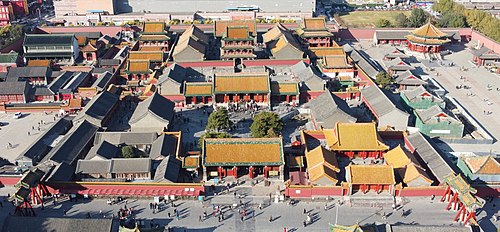
Mukden Palace, or Shenyang Imperial Palace, is the former palace of the Later Jin dynasty and the early Qing dynasty. It was built in 1625, and the first three Qing emperors lived there from 1625 to 1644. Since the collapse of imperial rule in China, the palace has been converted to a museum that now lies in the center of Shenyang, Liaoning.
Wikipedia · CC BY-SA 4.0 · 10 Jul 2026
Techyan · CC BY-SA 4.0

The Cathedral of the Sacred Heart of Jesus in Shenyang is a Roman Catholic cathedral in Shenyang, Liaoning Province, China. It is the seat of the Diocese of Shenyang. It is commonly called Nanguan Catholic Church and Xiaonan Catholic Church.
Wikipedia · CC BY-SA 4.0 · 18 May 2026
User:Roscoe x · CC BY-SA 3.0

Xita is a neighborhood in Shenyang, China.
Wikipedia · CC BY-SA 4.0 · 28 Jul 2026
Yoshi Canopus · CC BY-SA 3.0


Dafen is a suburb of Buji, Longgang, Shenzhen, in the province of Guangdong, China. Since 1989, the area has been an artists' village for the production of replicas of masterworks and outsourcing of original art creation as a specialised urban cottage industry.
Wikipedia · CC BY-SA 4.0 · 7 May 2026
Szdapanwen · CC BY-SA 3.0

Lianhuashan Park is a hill and urban park in Shenzhen, China, inaugurated in 1997. It is located at the northern end of the Futian Central Business District and covers an area of 150 hectares. It is within walking distance from Children's Palace Station of the Shenzhen Metro.
Wikipedia · CC BY-SA 4.0 · 10 Jul 2026
jo.sau from London/Vilnius, UK/Lithuania · CC BY 2.0

The Ping An Finance Center is a 115-storey, 599.1-metre (1,966-foot) supertall skyscraper in Shenzhen, Guangdong, China. It was completed in 2017, and is the tallest building in Shenzhen, the 2nd tallest building in China, and the 5th tallest building in the world. The building contains office, hotel and retail spaces, a conference center, and a high-end shopping mall.
Wikipedia · CC BY-SA 4.0 · 1 Sep 2026
Charlie fong · CC BY-SA 4.0

Shenzhen Museum is a public municipal museum in Shenzhen, Guangdong, China. It is funded by the Shenzhen Municipal People's Government.
Wikipedia · CC BY-SA 4.0 · 10 Jul 2026
Huangdan2060 · CC0

Splendid China Folk Village is a theme park including two areas located in Shenzhen, China. The park's theme reflects the history, culture, art, ancient architecture, customs and habits of the 56 ethnic groups of China.
Wikipedia · CC BY-SA 4.0 · 27 Aug 2026
Dmpendse at English Wikipedia · Public domain

The Window of the World is a theme park located in the western part of the city of Shenzhen in the People's Republic of China. It has about 130 reproductions of some of the most famous tourist attractions in the world squeezed into 48 hectares.
Wikipedia · CC BY-SA 4.0 · 8 Aug 2026
Dinkun Chen · CC BY-SA 4.0
East Lake is a large freshwater lake within the city limits of Wuhan, China, the largest or the second largest urban lake in China. Wuhan's East Lake covers an area of 88 square kilometers. It is one of the 5A tourist zones of China, and admits over a million people yearly.
Wikipedia · CC BY-SA 4.0 · 25 Jul 2026


Hankou, alternately romanized as Hankow, was one of the three towns merged to become modern-day Wuhan city, the capital of the Hubei province, China. It stands north of the Han and Yangtze Rivers where the Han flows into the Yangtze. Hankou is connected by bridges to its triplet sister towns Hanyang and Wuchang.
Wikipedia · CC BY-SA 4.0 · 4 Aug 2026
Compilers of "An Offical Guide to Eastern Asia, Volume IV: China. Published by The Imperial Japanese Government Railways · Public domain

The Hubei Provincial Museum is a first class museum in China, with a large amount of state-level historic and cultural relics. Established in 1953, the museum moved to its present location in 1960 and gained its present name in 1963. Since 1999 a number of new buildings have been added.
Wikipedia · CC BY-SA 4.0 · 21 Nov 2025
No machine-readable author provided. 风之清扬 assumed (based on copyright claims). · CC BY-SA 3.0

The Wuhan Yangtze Great Bridge, commonly known as Wuhan First Yangtze Bridge, is a double-deck road and rail bridge across the Yangtze River in Wuhan, in Central China. At its completion in 1957, the bridge was the easternmost crossing of the Yangtze, and was often referred to as the "First Bridge of the Yangtze".
Wikipedia · CC BY-SA 4.0 · 17 Jan 2026
Fllee · CC BY-SA 3.0

Yellow Crane Tower is a traditional Chinese tower located in Wuhan. The current structure was built from 1981 to 1985, but the tower has existed in various forms from as early as AD 223. The current Yellow Crane Tower is 51.4 m (169 ft) high and covers an area of 3,219 m2 (34,650 sq ft).
Wikipedia · CC BY-SA 4.0 · 23 Jul 2026
MonsieurRoi · CC BY-SA 3.0

Chongqing Art Museum is an art museum in Yuzhong District of Chongqing. Its main focus is on traditional Chinese painting, printmaking, and small sculptures.
Wikipedia · CC BY-SA 4.0 · 26 May 2026
Artyukh Igor · CC BY-SA 2.0

Hongya Cave, also known as Hongya Dong is an 11-story stilt-building complex in the main commercial district of Jiefangbei in the city of Chongqing, China. It comprises a series of structures built into the hillside along the southern bank of the Jialing River, and is one of the most popular tourist attractions in the city.
Wikipedia · CC BY-SA 4.0 · 7 May 2026
Jonashtand · CC BY-SA 4.0

Huguang Huiguan is a guild hall in the Yuzhong District of Chongqing, China, on the Yangtze River.
Wikipedia · CC BY-SA 4.0 · 11 Jul 2026
Zhangzhugang · CC BY-SA 3.0

Jiefangbei Central Business District (CBD) (simplified Chinese: 解放碑中央商务区; traditional Chinese: 解放碑中央商務區; pinyin: Jiěfàngbēi Zhōngyāng Shāngwù Qū), also known as Jiefangbei Business Walking Street (Chinese: 解放碑商业步行街; pinyin: Jiěfàngbēi Shāngyè Bùxíngjiē), is the ultra-dense, urbanized downtown core and one of several central business districts of Chongqing, China.
Wikipedia · CC BY-SA 4.0 · 26 Jul 2026
Baycrest · CC BY-SA 2.5

Luohan Temple is a Buddhist temple located in Yuzhong District, Chongqing. It is the site of the Buddhist Association of Chongqing. The temple was used for Ning Hao's black comedy film Crazy Stone.
Wikipedia · CC BY-SA 4.0 · 8 Aug 2026
广州阿沾 · CC BY-SA 4.0

Guwenhua Jie, Tianjin's Ancient Culture Street, is a pedestrian pathway complex dotted with temple gates and kiosks on the west bank of the Hai River in Tianjin, China. The Nankai District area is classified as a AAAAA scenic area by the China National Tourism Administration.
Wikipedia · CC BY-SA 4.0 · 17 Feb 2026
William M Benson · Public domain
Five Great Avenues is a tourist and up-scale residential area in Heping District, Tianjin, China.
Wikipedia · CC BY-SA 4.0 · 28 Jan 2025

Tianjin Eye, officially The Tientsin Eye, is a 120-meter (394 ft)-tall giant Ferris wheel built above the Yongle Bridge, over the Hai River in Tianjin, China.
Wikipedia · CC BY-SA 4.0 · 6 May 2026
KangTyngrwey · CC BY-SA 4.0

The Tianjin Museum is the largest museum in Tianjin, China, exhibiting a range of cultural and historical relics significant to Tianjin. The museum lies in Yinhe Plaza in the Hexi District of Tianjin and covers an area of about 50,000 sq metres.
Wikipedia · CC BY-SA 4.0 · 10 Mar 2026
Amazingloong · CC BY-SA 3.0

The Tianjin Radio and Television Tower is a 415.2-meter-tall (1,362 ft) tower in Tianjin, China, used primarily for communication. It is the 8th tallest freestanding tower in the world. It was built in 1991 at a cost of $45 million.
Wikipedia · CC BY-SA 4.0 · 27 Apr 2025
William M Benson · Public domain

Dongguan Botanical Garden is located in Nancheng District, Dongguan, Guangdong, China. It lies about 5 km (3.1 mi) south of downtown Dongguan, adjacent to Shuiliao Reservoir to the west, Tongsha Ecological Park to the east, and Shuilianshan Forest Park to the south. The garden covers a total area of 468.5 hectares, of which 200.5 hectares are developed.
Wikipedia · CC BY-SA 4.0 · 13 Aug 2026
Dongguan Library is a prefecture-level city public library in Dongguan, Guangdong province, China, opened on 28 September 2005. It has an area of 44,654 square metres (53,406 sq yd), the largest among prefecture-level cities. There are ten libraries and over 20 service points in Dongguan Library, including the first comic library in China.
Wikipedia · CC BY-SA 4.0 · 13 Aug 2026
Keyuan (simplified Chinese: 东莞可园; traditional Chinese: 東莞可園; pinyin: Dōngguǎn kěyuán; Jyutping: Dung1gun2 Ho2jyun2; lit. 'Dongguan Ke Garden'), located at Boxia (博厦), Guancheng District, West Dongguan city, is one of the Four Great Gardens of Guangdong in China. Ke Yuan represents the Lingnan garden architecture.
Wikipedia · CC BY-SA 4.0 · 10 Sep 2025
South China Mall in Dongguan, China is the fifth largest shopping mall in the world in both gross leasable area and total area.
Wikipedia · CC BY-SA 4.0 · 18 Aug 2026
Sourced stays
Sourced experiences
Fly to China
The facts you look up on the plane
Not going yet? Pin it.
One tap puts it on your map and in your pins, for when you are ready.