 Common · +100 XP
Best time to visit: Apr–Jun · Sep
Daily spend ~$130
Common · +100 XP
Best time to visit: Apr–Jun · Sep
Daily spend ~$130
Belgium
Two languages, three regions and an ongoing argument, in a country you can cross in two hours. The beer is a serious craft and so are the chips.
Belgium in ten slides
Wikipedia · 3 Sep 2026


Best time to visit Belgium: Apr–Jun · Sep
Where people go in Belgium
What people go to see in Belgium

The Curtius Museum is a museum of archaeology and decorative arts located on the bank of the river Meuse in Liège, Belgium. It is classified as a Major Heritage of Wallonia.
Wikipedia · CC BY-SA 4.0 · 1 Nov 2024
Trougnouf (Benoit Brummer) · CC BY 4.0

La Boverie is a museum in the city of Liège in Belgium. It opened in May 2016. It is housed in the former Palais des beaux-arts de Liège, built in the Parc de la Boverie for the Liège International in 1905.
Wikipedia · CC BY-SA 4.0 · 10 Jul 2026
Jean Housen · CC BY-SA 4.0

Liège-Guillemins railway station is the main station in Liège, Belgium. It is one of the most important hubs in the country and is one of the four Belgian stations on the high-speed rail network. The station is used by 15,000 people every day, which makes it the eleventh-busiest station in Belgium and the third in Wallonia.
Wikipedia · CC BY-SA 4.0 · 25 Aug 2026
Bert Kaufmann from Roermond, Netherlands · CC BY 2.0

Montagne de Bueren is a 374-step staircase in Liège, Belgium. The staircase is named after Vincent de Bueren, who defended Liège against an attack by the Duke of Burgundy, Charles the Bold in the 15th century. It was built in 1881 to honour the 600 soldiers who died in the battle.
Wikipedia · CC BY-SA 4.0 · 9 Aug 2026
Choinowski · CC BY-SA 4.0

The Place Saint-Lambert is a major square in the centre of Liège, Belgium. Until 1794, it was the site of St. Lambert's Cathedral. Remains of the foundations of the cathedral have been conserved, and are on display at the Archéoforum, under the square.
Wikipedia · CC BY-SA 4.0 · 30 Jul 2026
Romaine · CC BY-SA 4.0

The Palace of the Prince-Bishops is a historic building situated on the Place Saint-Lambert in the centre of Liège, Belgium. It was the residence of former Prince-Bishops of Liège and once faced the monumental Cathedral of St. Lambert. It now houses the Palace of Justice of Liège and the Provincial Palace, i.e. the government building of Liège Province.
Wikipedia · CC BY-SA 4.0 · 1 Nov 2024
Trougnouf (Benoit Brummer) · CC BY 4.0

The Collegiate Church of St. Bartholomew is a Roman Catholic collegiate church in Liège, Belgium. Founded outside the city walls, it was built in coal sandstone, starting in the late 11th century and lasting until the late 12th century. It underwent, like most ancient religious buildings, modifications through the centuries.
Wikipedia · CC BY-SA 4.0 · 22 Jun 2026
Jacques Renier · CC BY-SA 2.5

Liège Cathedral, otherwise St. Paul's Cathedral, is a Roman Catholic cathedral in Liège, Belgium. Founded in the 10th century, it was rebuilt from the 13th to the 15th century and restored in the mid-19th century. It became a Catholic cathedral in the 19th century due to the destruction of Saint Lambert's Cathedral in 1795.
Wikipedia · CC BY-SA 4.0 · 25 Aug 2026
The RedBurn · CC BY-SA 4.0

Antwerpen-Centraal railway station is the main railway station in Antwerp, Belgium. It is one of the most important hubs in the country and is one of the four Belgian stations on the high-speed rail network. From 1873 to early 2007, it was a terminal station.
Wikipedia · CC BY-SA 4.0 · 31 Aug 2026
Fred Romero from Paris, France · CC BY 2.0

The Cathedral of Our Lady is a Roman Catholic cathedral in Antwerp, Belgium. Today's seat of the Diocese of Antwerp started in 1352 and, although the first stage of construction was ended in 1521, has never been fully completed. It was constructed in the Gothic style by architects Jan and Pieter Appelmans.
Wikipedia · CC BY-SA 4.0 · 1 Aug 2026
Yair Haklai · CC BY-SA 4.0
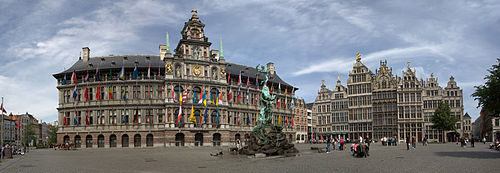
The Grote Markt is the central square of Antwerp, Belgium, situated in the heart of the old city quarter. It is surrounded by the city's Renaissance Town Hall, as well as numerous guildhalls with elaborate façades, the majority of which are reconstructions from the 19th and early 20th century, approximating paintings of the square by Flemish artists.
Wikipedia · CC BY-SA 4.0 · 30 Jul 2026
Maros M r a z (Maros) · CC BY-SA 3.0

Het Steen is a medieval fortress in the old city centre of Antwerp, Belgium, one of Europe's biggest ports. The surviving structure was built between 1200 and 1225 as a gateway to a larger castle of the Dukes of Brabant which was demolished in the 19th century. As the first stone fortification of Antwerp, Het Steen is Antwerp's oldest building and used to be part of its oldest urban centre.
Wikipedia · CC BY-SA 4.0 · 18 Sep 2024
Jean-Pol GRANDMONT · CC BY-SA 3.0


The Plantin–Moretus Museum is a museum in Antwerp, Belgium which showcases the history of printing in Antwerp and the prominent role played in that history by the family of printers founded by Christophe Plantin and Jan Moretus in Antwerp in the second half of the 16th century.
Wikipedia · CC BY-SA 4.0 · 13 Aug 2026
Klaus Graf · CC BY 2.5

The Rubenshuis is the former home and workshop of Peter Paul Rubens (1577–1640) in Antwerp. Purchased in 1610, Rubens had the Flemish townhouse renovated and extended on the basis of designs by Rubens himself. After the renovations, the house and its courtyard garden had the outlook of an Italian palazzo, which reflected the artistic ideals of Rubens.
Wikipedia · CC BY-SA 4.0 · 11 Nov 2025
Unknown · CC BY-SA 3.0

The Atomium is a landmark modernist building in Brussels, Belgium, originally constructed as the centrepiece of the 1958 Brussels World's Fair. Designed by the engineer André Waterkeyn and the architects André and Jean Polak as a tribute to scientific progress, as well as to symbolise Belgian engineering skills at the time, it is located on the Heysel/Heizel Plateau in Laeken, where the exhibition took place.
Wikipedia · CC BY-SA 4.0 · 16 Aug 2026
Trougnouf (Benoit Brummer) · CC BY 4.0

The Cinquantenaire Arcade is a memorial arcade in the centre of the Parc du Cinquantenaire/Jubelpark in Brussels, Belgium. The centrepiece is a monumental triple arch known as the Cinquantenaire Arch. It is topped by a bronze quadriga sculptural group with a female charioteer, representing the Province of Brabant personified raising the national flag.
Wikipedia · CC BY-SA 4.0 · 16 Jul 2026
Diego Delso · CC BY-SA 4.0


The Grand-Place or Grote Markt is the central square of Brussels, Belgium. It is surrounded by opulent Baroque guildhalls of the former Guilds of Brussels and two larger edifices: the city's Flamboyant Town Hall, and the neo-Gothic King's House or Bread House building, housing the Brussels City Museum. The square measures 68 by 110 metres and is entirely paved.
Wikipedia · CC BY-SA 4.0 · 1 Sep 2026
Celuici · CC BY-SA 4.0

Manneken Pis is a landmark 55.5 cm (21.9 in) bronze fountain sculpture in central Brussels, Belgium, depicting a puer mingens: a nude boy urinating into the fountain's basin. Though its existence is attested as early as the mid-15th century, Manneken Pis was redesigned by the Brabantine sculptor Jérôme Duquesnoy the Elder and put in place in 1619. Its blue stone niche in rocaille style dates from 1770.
Wikipedia · CC BY-SA 4.0 · 31 Aug 2026
Bruxelles_Manneken_Pis.jpg: Myrabella derivative work: Myrabella (talk) · CC BY-SA 3.0

The Royal Museums of Fine Arts of Belgium are a group of art museums in Brussels, Belgium. They are part of the institutions of the Belgian Federal Science Policy Office (BELSPO) and consist of six museums: the Oldmasters Museum, the Magritte Museum, the Fin-de-Siècle Museum, the Modern Museum, the Wiertz Museum and the Meunier Museum.
Wikipedia · CC BY-SA 4.0 · 25 Jun 2026
Michel wal · CC BY-SA 3.0

The Royal Palace of Brussels is the official palace of the King and Queen of the Belgians in the centre of the nation's capital, Brussels. However, it is not used as a royal residence, as the king and his family live in the Royal Palace of Laeken in northern Brussels.
Wikipedia · CC BY-SA 4.0 · 2 Sep 2026
Sally V · CC BY-SA 4.0

The Belfry of Ghent is one of three medieval towers that overlook the old city centre of Ghent, Belgium; the other two belonging to Saint Bavo's Cathedral and Saint Nicholas' Church. Its height of 91 metres (299 ft) makes it the tallest belfry in Belgium. The belfry of Ghent, together with its attached buildings, belongs to the set of Belfries of Belgium and France, a UNESCO World Heritage Site.
Wikipedia · CC BY-SA 4.0 · 24 Jul 2026
Trougnouf (Benoit Brummer) · CC BY 4.0

Graslei is a quay in the historic city center of Ghent, Belgium, located on the right bank of the Leie river. The quay opposite of the Graslei is called Korenlei. Both quays were part of the medieval port and are now a cultural and touristic hotspot of the city, with a high concentration of café patios.
Wikipedia · CC BY-SA 4.0 · 11 Jul 2025
Michiel Hendryckx · CC BY-SA 4.0

The Gravensteen is a medieval castle in the city of Ghent, East Flanders in Belgium. The current castle dates from 1180 and was the residence of the Counts of Flanders until 1353. It was subsequently re-purposed as a court, prison, mint, and even as a cotton mill.
Wikipedia · CC BY-SA 4.0 · 19 Jul 2026
Marc Ryckaert (MJJR) · CC BY 3.0

The Museum of Fine Arts an art museum in Ghent, Belgium, is situated at the East side of the Citadelpark.
Wikipedia · CC BY-SA 4.0 · 10 Jul 2026
marie-julie · Public domain

Saint Bavo's Cathedral, also known as Sint-Baafs Cathedral, is a Roman Catholic cathedral in Ghent, Belgium. The 89-metre-tall (292 ft) Gothic building is the seat of the Diocese of Ghent and is named for Saint Bavo of Ghent. It contains the well-known Ghent Altarpiece, also called the Adoration of the Mystic Lamb.
Wikipedia · CC BY-SA 4.0 · 12 Jul 2026
Mylius · CC BY-SA 3.0

The Stedelijk Museum voor Actuele Kunst is a relatively new museum located in Ghent, Belgium, and is renowned both for its permanent collection and for its provocative exhibitions.
Wikipedia · CC BY-SA 4.0 · 12 Apr 2024
Cristina Pastor · Public domain

St. Nicholas Church is a Roman Catholic church, as well as one of the oldest and most prominent landmarks in Ghent, Belgium. Begun in the early 13th century as a replacement for an earlier Romanesque church, construction continued through the rest of the century in the local Scheldt Gothic style.
Wikipedia · CC BY-SA 4.0 · 12 Jul 2026
Trougnouf (Benoit Brummer) · CC BY 4.0

The Bois du Cazier was a coal mine in what was then the town of Marcinelle, near Charleroi, in Belgium which today is preserved as an industrial heritage site. It is best known as the location of a major mining disaster that took place on August 8, 1956 in which 262 men, including a large number of Italian labourers, were killed.
Wikipedia · CC BY-SA 4.0 · 11 Dec 2025
Bourgeois.A · CC BY-SA 3.0
Cartier Castle is a château in Marchienne-au-Pont, a district of Charleroi, in the province of Hainaut, Wallonia, Belgium.
Wikipedia · CC BY-SA 4.0 · 11 Aug 2026

The Church of Saint Sulpice is a Catholic church in Jumet, a neighborhood of the Belgian city of Charleroi in Hainaut Province, Wallonia. It is dedicated to Sulpitius the Pious. The oldest material traces of a religious building on the site date back to the 10th century.
Wikipedia · CC BY-SA 4.0 · 30 Jul 2026
Jmh2o · CC BY-SA 4.0


The Maison Mattot is a modernist-style residential building on Frans Dewandre Boulevard in Charleroi, Belgium. It was designed in 1937 by architect Marcel Leborgne for the Reine Astrid Maternity Hospital's director, Dr. Mattot. It is a terraced townhouse with a consultation room on the first floor and an apartment on the piano nobile, adapted to the needs of a single person.
Wikipedia · CC BY-SA 4.0 · 24 Jul 2026
Jmh2o · CC BY-SA 4.0
Sourced stays
Sourced experiences
Fly to Belgium
The facts you look up on the plane
Not going yet? Pin it.
One tap puts it on your map and in your pins, for when you are ready.